

Jordan Entry Requirements For Tourists In 2026
Jordan's entry rules can look straightforward at first glance, then quickly become confusing once you add visa on arrival, e visas, the Jordan Pass, and different procedures at each land border. This guide explains short stay entry requirements for the Hashemite Kingdom of Jordan for typical trips in late 2025 and 2026, with a focus on tourists and short business visitors arriving by air or major land crossings.
You will also see references to newer residency and police registration rules, which mostly affect people staying longer or living in Jordan. Because practices can differ by passport and crossing point, you should always confirm details with official Jordanian authorities or your own government's travel advice before you book or travel. This guide is general information, not legal advice, and final decisions always sit with Jordanian consular and border officers.
Entry Snapshot
For most visitors, Jordan is a relatively accessible destination with clear but passport dependent rules. In practical terms, most short stay visitors experience one of three paths.
- Many nationalities, including most of Europe, North America, and Asia Pacific, can obtain a paid visa on arrival for around 30 days at major entry points.
- Citizens of a smaller group of countries, such as Gulf Cooperation Council states, Lebanon, and Turkey, can usually visit visa free for up to three months within a six month period.
- Nationals of "restricted" countries must apply in advance through a Jordanian embassy or the Ministry of Interior e services system and cannot rely on a visa on arrival.
In all cases, you need a passport that is valid for at least six months beyond entry, with at least one blank page for stamps, and you should be ready to show proof of onward travel, accommodation, and sufficient funds.
Who Can Visit And For How Long
Jordan's short stay rules depend heavily on your citizenship, sometimes your residence, and your travel history. You should always start by checking your nationality against Jordan's official "restricted" and "non restricted" lists, since these determine whether you can get a visa on arrival or need prior approval.
For many travelers from Europe, North America, East Asia, and other major outbound markets, the typical pattern looks like this.
- You arrive with a passport valid at least six months.
- You buy a single entry visa on arrival at Amman's Queen Alia International Airport or certain land and sea borders for about 40 Jordanian dinars, and you receive permission to stay around 30 days.
- If you want to stay longer, you can usually extend your permission up to around 90 days total by registering and applying for an extension at a local police or residency office before your initial period expires.
A simple example helps. If you arrive on January 10 on a visa on arrival, you should expect an initial stay permission of about 30 days. If you plan to remain into February or March, you should contact the nearest security or residency center well before your first 30 days end to ask about an extension, and you should be prepared for extra paperwork under the latest residency rules. You cannot assume that a border officer will quietly extend your stay if you overrun the initial period.
Visa free visitors, such as citizens of GCC states, Lebanon, and Turkey, generally receive up to three months within a six month period without paying a visa fee, but they are still subject to Jordan's broader residency and security regulations if they stay longer than a short visit.
Recent rule changes have added another wrinkle. Jordan now expects foreigners who intend to stay more than about 14 days to report their address to a police station or residency extension office within a set time window, but official guidance from the United Kingdom notes that this registration rule does not apply to ordinary tourists, pilgrims, or transit passengers, and local legal explainers stress that it is aimed at people living in Jordan or undertaking longer stays. If you are planning an extended stay that goes beyond a conventional holiday, you should treat residency and registration as a separate requirement from your initial visa and obtain clear guidance from the Ministry of Interior or a qualified attorney before relying on this guide.
Finally, a small number of nationalities now benefit from new bilateral agreements, such as a 30 day visa free regime for Russian tourists and updated patterns for certain Central Asian citizens. Because these deals are evolving, you should always confirm that a visa free arrangement still applies to your passport just before travel.
Visa Options And Common Exemptions
For short stay visitors, Jordan offers several pathways into the country. Which one applies to you depends on your passport, your route, and occasionally your residence status.
Visa free entry
A limited group of nationalities may enter Jordan without a visa for tourism or short business, typically for up to three months in any six month period. This group includes citizens of Gulf Cooperation Council countries, Lebanon, and Turkey, as well as some newer visa free partners for shorter 30 day visits. If you hold one of these passports, you still need to meet general entry conditions, and you should not assume that visa free status covers work, study, or long stays.
Visa on arrival (VOA)
Most visitors who are not visa free but are also not "restricted" can obtain a paid visa on arrival at:
- Queen Alia International Airport in Amman.
- Aqaba's land and sea entry points, including the Wadi Araba crossing.
- The Sheikh Hussein Bridge in the north.
The King Hussein, or Allenby, Bridge near the West Bank is the major exception. At this crossing, Jordan does not usually issue visas on arrival, and your carrier or tour operator will often insist that you arrive with a visa already in your passport.
Visa on arrival fees and formats can change, but official tourism guidance still points to a baseline fee of 40 dinars for a one month single entry visa, with higher prices for multiple entry or longer validity visas obtained either on arrival or in advance. You should bring a payment method that works locally, and you should not rely on foreign currency cash at land borders.
E visa and advance visas
If your passport is on the "restricted" list, or you simply prefer to arrive with everything pre cleared, you can apply for a visa in advance. Jordan's Ministry of Interior runs an e services portal that handles visa and residence applications, and some airlines and tourism partners point travelers toward e visa channels that mirror the visa on arrival rules for eligible nationalities.
In practice, you might choose an e visa if:
- You are entering via a land border where visa on arrival is less predictable.
- You have previously overstayed in Jordan or another country.
- Your passport is from a country that sometimes faces additional questioning at the border.
If your nationality is fully restricted, you should treat the e visa or consular visa process as your main route and not travel without formal approval. Processing times vary, and you should never assume that a visa will be issued on a specific timeline.
Jordan Pass and visa fee waivers
The Jordan Pass is a popular product that bundles admission to major tourist sites with a waiver of the visa fee if you stay at least two consecutive nights in Jordan. It is not a visa by itself, but when conditions are met it can remove the separate visa fee for eligible nationalities. You should always read the latest conditions on the official Jordan Pass site and print or download your pass, since border officers and site staff may ask to scan it.
Documents You Should Prepare Before Travel
Jordanian border officers can and do ask to see supporting documents, especially if you are coming from a high risk region, visiting for an unusual purpose, or staying longer than a typical one or two week trip. Even if you expect a smooth visa on arrival, you should prepare a small document kit.
At a minimum, plan to carry:
- A passport valid at least six months beyond the date you enter Jordan, with at least one blank page.
- Proof of your right to enter, such as an e visa approval, a Jordan Pass that waives your visa fee, or confirmation that your passport is visa free.
- A printed or digital return or onward ticket, especially if you do not have a round trip booked on a single airline.
- Hotel reservations, a tour confirmation, or a clear invitation letter that shows where you will stay each night, especially outside Amman and Aqaba.
- Evidence of funds, for example recent bank statements or credit card limits, particularly if you plan to travel independently for several weeks.
- Travel insurance details, even though insurance is not a formal entry requirement for most visitors, since it is strongly recommended by many governments.
COVID 19 era testing and quarantine rules have been removed, and as of early 2026, travelers are no longer asked for pre departure or on arrival PCR tests solely because of COVID 19, although normal health checks remain possible. You should still watch for public health updates in case new diseases or outbreaks prompt additional screening.
If you expect to apply for an extension or residency permit after arrival, you should also bring extra passport photos, copies of your passport biodata page, and any supporting documents such as employment contracts or university admission letters, since local offices often require them.
What To Expect At The Border
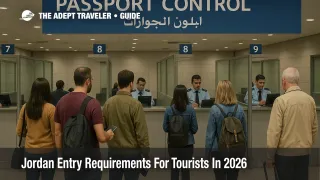
At Amman's Queen Alia International Airport, the process for a typical tourist from a visa on arrival eligible country usually follows a familiar pattern. After disembarking, you follow signs to the visa or "non Jordanians" area. If you need a visa on arrival, you first visit a bank or visa payment counter, pay the applicable fee, and receive a receipt or sticker. You then join the passport control line, where an officer will check your passport, visa status, entry purpose, and sometimes onward travel or accommodation details before stamping your passport and recording your entry in the system.
At Aqaba and the Wadi Araba crossing, procedures are similar but often tied into the Aqaba Special Economic Zone framework, which can affect visa fees and permitted stay lengths for some nationalities. If you are arriving as part of a package tour or cruise, your tour operator will often pre arrange these details, and you may see a different line or desk for group processing. You should still carry your own documents and not rely entirely on group lists.
At the Sheikh Hussein Bridge in the north, you can usually obtain a visa on arrival if your nationality is eligible, but you should expect slower processing, multiple queues, and bus transfers, since the crossing is designed for both tourists and residents moving between Jordan and Israel. Again, the King Hussein or Allenby Bridge is the main exception, where you should not assume visas are available on arrival and where travelers often face additional security screening and longer waits.
At all ports, border officers retain broad discretion. They may ask detailed questions about your itinerary, your employment, previous travel to the region, or your reasons for entering Jordan. You should answer truthfully and succinctly, keep your supporting documents handy, and understand that even with a valid visa, you can be refused entry if the officer is not satisfied with your answers or paperwork. If your situation is complex, you should seek advice from a qualified immigration attorney or your local Jordanian embassy well before travel.
On departure, land borders may charge exit fees in cash, and you should expect separate procedures for outbound immigration and customs. At airports, exit is usually handled by standard passport control and security screening, with occasional extra checks during periods of heightened security.
When Rules Are Different
Jordan's entry regime changes significantly once you move beyond a short, straightforward tourist or business visit. In these cases, you should treat this guide as a starting point only.
- Long stays, work, and study. If you plan to work, intern, volunteer, study, or reside with family for more than a simple holiday, you will generally need the correct category of visa and a residency permit issued or confirmed by the Ministry of Interior. The new residency and police registration rules make it especially important that you regularize your status early.
- Nationals of restricted countries. Citizens of countries on Jordan's restricted list must obtain prior approval and cannot rely on visa on arrival. Some may qualify only if they hold valid residence in the EU, GCC, or other specified regions.
- Dual nationals and refugees. Travelers who hold Jordanian documents, Palestinian refugee papers, or multiple nationalities may face different procedures, especially at land borders. These cases are sensitive and should be discussed directly with Jordanian authorities or a specialist lawyer.
- Minors traveling alone or with one parent. As in many countries, Jordan can apply stricter checks to children traveling without both parents or legal guardians, particularly where custody issues may exist. You should carry consent letters and supporting documents and review your own government's guidance.
- Travelers with past overstays or criminal records. If you have previously overstayed in Jordan, been removed from another country, or carry a serious criminal record, you should assume additional scrutiny. You may need to apply well in advance and should not rely on past successful entries as a guarantee of future admission.
For any of these higher risk categories, travelers should consult a qualified attorney or appropriate authority before they rely on this guide, and they should allow extra time for applications and potential interviews.
Where To Confirm The Latest Rules
Because Jordan's visa categories, residency obligations, and entry processes can change with little formal notice, you should always confirm the latest rules directly with official sources before you finalize flights or non refundable bookings.
Start with Jordanian authorities.
- The Ministry of Tourism and Antiquities publishes current visa fee information and basic guidance on visa on arrival and tourist entry.
- The Ministry of Interior e services portal lists visa, residence, and restricted country information, which is crucial if your passport is not from a major visa on arrival country.
- Visit Jordan, the official tourism site, provides practical points of entry, border crossing details, and links to official partners such as the Jordan Pass.
Then cross check with your own government's travel advice.
- The United States, United Kingdom, and Canada all maintain detailed travel advisories that summarize current entry requirements, note changes like police registration rules, and flag security issues that may affect specific regions or borders.
You should repeat these checks shortly before departure, since new regulations, health measures, or bilateral agreements can alter visa free or visa on arrival eligibility at short notice.
Before You Book
For a typical tourist trip to Jordan, your preparation should follow a clear sequence. First, confirm how your passport is classified, visa free, visa on arrival, e visa, or restricted, and decide whether you will apply in advance or rely on a visa on arrival at a suitable entry point. Second, make sure your passport has at least six months of validity and enough blank space, and gather proof of onward travel, accommodation, and funds in a simple folder or digital wallet. Third, if your stay approaches or exceeds thirty days, or if you plan to work, study, or live in Jordan, seek explicit guidance on residency permits and police registration before you commit to long term housing or employment.
Throughout, remember that this guide is general information, not legal advice, that practices can vary between officers and border posts, and that Jordanian authorities always have the final say on your entry and length of stay. If your situation is unusual or complex, or if you have any doubt about your status under the new residency framework, you should speak directly with a Jordanian embassy or a qualified immigration attorney before you travel. When in doubt, carry more documentation rather than less, arrive early for border crossings, and keep printed copies of key approvals and confirmations so you can present them quickly if asked.
Sources
- Jordan Ministry of Tourism and Antiquities, Visa Information
- Jordan Ministry of Interior, E Applications for Visa and Residence Permits
- Visit Jordan, Official Tourism Site, Entry and Visa Information
- Jordan Pass, Official FAQ
- U.S. Department of State, Jordan International Travel Information
- UK Foreign, Commonwealth & Development Office, Jordan Travel Advice, Entry Requirements
- Government of Canada, Travel Advice and Advisories, Jordan
- Jordan Ministry of Interior, Restricted and Non Restricted Countries