

Maldives Entry Requirements For Tourists 2026
For most tourists, entry to the Maldives works as a short stay visit with a visa granted on arrival, provided you hold the right documents, meet basic financial and accommodation tests, and submit the required Traveller Declaration via the IMUGA portal within 96 hours before travel.
In practical terms, this means you usually arrive at Velana International Airport near Malé, clear passport control as a tourist, and receive a visitor endorsement for up to 30 days, with the possibility of extension to a maximum of 90 days in total if Maldives Immigration approves your application.
The main exception is that, as of April 2025, travelers using Israeli passports are banned from entering or transiting the Maldives under a formal immigration law amendment, although Israeli citizens who hold and use a different country passport may still be admitted under that other nationality.
Who Can Visit And For How Long
Short stay tourist entry to the Maldives is structured around your citizenship and your purpose of travel. The default rule for most visitors is a free 30 day tourist visa on arrival, available for almost all nationalities that meet normal entry conditions such as passport validity, accommodation, funds, and onward travel.
Some nationalities benefit from bilateral agreements that allow a 90 day stay without a separate visa, although the practical experience at the border still involves a similar arrival process and the same document checks. Because these arrangements evolve and differ by country pair, you should confirm your exact allowance with Maldives Immigration and, where relevant, your own foreign ministry or embassy before travel.
For most tourists, especially if you hold passports from common outbound markets such as the United States, Canada, the United Kingdom, or the European Union, you can plan around 30 days initially, with the option to apply in country for an extension of up to 60 additional days, for a maximum of 90 days total in a given visit. Extensions are not guaranteed and remain at the discretion of Maldives Immigration, which may ask for updated proof of accommodation, funds, and an onward ticket.
Your stay is counted from the date of arrival as stamped in your passport. If you arrive on 1 March and receive a 30 day permission, your last regular day would typically be 30 March, and you must either depart on or before that date or complete the extension process and receive confirmation before your original permission expires. Overstays, even by a day or two, can lead to fines, removal, and future entry difficulty.
Citizenship also matters in a negative sense. If you are traveling on an Israeli passport, current Maldivian law bars you from entry and even transit, regardless of your purpose of travel. Dual nationals who also hold another passport should understand that Maldivian authorities will treat you according to the passport you use to enter.
Visa Options And Common Exemptions
For typical tourists, the main pathway to enter the Maldives is the tourist visa on arrival. No pre travel visa application is required if you are visiting for leisure, do not plan to work, and can show that you satisfy the standard entry criteria. At the airport, border officers review your documents and, if satisfied, issue a visitor endorsement in your passport for up to 30 days.
Key points for the visa on arrival in practice
- It is free of charge for tourists.
- It is normally valid up to 30 days from arrival.
- It can be extended in country, on application, up to a maximum of 90 days total, subject to approval.
There are other visa categories, including business visas, which can be granted for 30 to 90 days at a time, not exceeding 180 days in a calendar year, and various work and resident permits. These have different eligibility and application processes, often requiring sponsorship by a Maldivian entity or employer, and fall outside the core tourist focus of this guide. If you plan to work, volunteer, study, or stay long term, you should investigate the correct visa type with Maldives Immigration and consider professional immigration advice.
A small number of travelers may be exempt from the standard tourist visa structure under bilateral agreements, especially for diplomatic or official passport holders. These arrangements are technical, subject to change, and often do not affect ordinary leisure visitors, so you should always check the exact conditions for your passport type with official sources rather than assuming you qualify automatically.
Regardless of category, you should never plan to work in the Maldives on a tourist visa, even informally or as a volunteer. Maldivian authorities treat this as a violation of visa conditions, which can result in removal and future bans.
Documents You Should Prepare Before Travel
The Maldives is strict about documentation at the border, and airline staff will also screen you before boarding, because they can be liable for fines and removal costs if you are refused entry. In practice, travelers who arrive with a complete, well organized set of documents tend to move through passport control more smoothly.
You should prepare at least the following.
- Passport with sufficient validity. Maldivian regulations state that your passport must have at least one month of validity beyond arrival and include a machine readable zone, and they do not accept passports whose validity has been manually extended. In reality, many airlines and foreign ministries strongly recommend or require at least six months validity from your arrival date. To avoid last minute boarding problems, you should treat six months as your practical minimum and renew early if needed.
- Onward or return travel. You should carry a confirmed return ticket or onward ticket that leaves the Maldives within your permitted stay. Border officers may also check that you meet entry requirements for your next destination, for example, visa and passport validity for a transit through a hub such as Doha or Singapore.
- Proof of accommodation. For most visitors, this will be a prepaid resort or hotel booking at a registered facility. Independent travelers staying in guesthouses should carry printed confirmations that match the address and dates entered in your IMUGA Traveller Declaration.
- Proof of funds. Maldivian rules reference sufficient funds to support your stay, but do not publish a single fixed daily amount. Officers may look for credit cards, recent bank statements, or evidence that your accommodation is fully prepaid. Because resort stays can be expensive, you should be prepared to show that you can cover extra meals, transport, and incidental costs.
- Traveller Declaration via IMUGA. All travelers to and from the Maldives must complete the Traveller Declaration electronically via the IMUGA portal within 96 hours of flight time for both arrival and departure. The form asks for personal details, flight information, and accommodation, and submission is free. Keep a screenshot or PDF of the confirmation QR code on your phone.
- Health documentation where applicable. If you are arriving from a country with risk of yellow fever transmission, you must carry a valid yellow fever vaccination certificate for entry to the Maldives, although children under one year are exempt. Other routine vaccines are a separate health topic and should be discussed with your healthcare provider before travel, not at the border.
Carry paper copies where possible, even if your resort or agent has already filed details. Officers and airline staff sometimes find printed confirmations faster to review than screenshots deep within email threads.
What To Expect At The Border
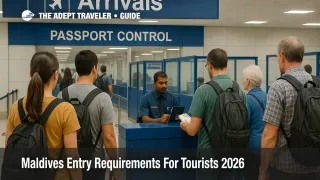
Most tourists arrive at Velana International Airport near Malé, where passport control is laid out in standard queues for foreign visitors and separate lanes for Maldivian citizens and residents. Signage is clear, but the hall can feel busy when several widebody flights arrive close together.
After disembarking, you will follow signs to immigration. There are currently no fully automated e gates for most foreign tourists, so you should expect to see a human officer at a passport control booth. In the queue, staff may check that you have completed your IMUGA Traveller Declaration and may ask to see the QR code or confirmation screen.
At the booth, the officer will typically
- Scan your passport and verify its validity and machine readable zone.
- Confirm your intended length of stay and resort or guesthouse.
- Ask to see your return or onward ticket.
- Ask additional questions if they are unsure about your plans or funding.
If everything is in order, the officer stamps your passport with a tourist endorsement and writes the number of days granted. You then proceed to baggage claim and customs, where screening is usually straightforward for ordinary tourists with personal luggage only.
If there is a concern about your documents or intent, you may be directed to a secondary inspection area for more detailed questioning. This can happen if, for example, your passport is close to expiry, your travel plans look open ended, or your answers conflict with your IMUGA declaration. Border officers have wide discretion to shorten the length of stay they grant, or to refuse entry altogether, even when your documents are technically valid on paper. You should answer questions truthfully and calmly and never attempt to hide work plans or misrepresent your itinerary.
For cruise arrivals or yacht visitors, document checks typically happen at designated seaports in coordination with local agents. Processes are similar, but you may experience more variability depending on the port and the scale of your vessel. Independent sailors and yacht crews should seek detailed clearance instructions from Maldives Immigration and port authorities before departure.
When Rules Are Different
There are several situations where entry rules or risks diverge significantly from the standard tourist experience, and you should approach these conservatively.
- Israeli passports. As described earlier, holders of Israeli passports are currently banned from entering or transiting the Maldives, under an amendment to immigration law passed in April 2025 in response to the Gaza conflict. This policy may evolve, but you should treat it as firmly in force until official sources state otherwise.
- Long stay, work, or study. If you intend to work, volunteer, study, or remain in the Maldives for extended periods, you will need the appropriate long stay or work visa rather than relying on repeated tourist entries. Processes and employer obligations can be complex, and you should consult Maldives Immigration directly or a qualified immigration attorney before committing to such plans.
- Business travel. Short business visits may fall under specific business visa categories, with different duration limits and conditions compared with pure tourism. If you are attending conferences, exploring investments, or conducting commercial negotiations, you should verify whether a business visa is required ahead of travel.
- Minors and families. Children traveling with one parent, legal guardians, or non relatives may face additional questioning to confirm consent and guardianship. While Maldives Immigration does not publish detailed public rules for every family scenario, many airlines and foreign ministries recommend carrying notarized consent letters and birth certificates when a minor travels without both parents.
- Travelers with complex histories. If you have a record of immigration overstays elsewhere, significant criminal history, or previous issues with Maldivian authorities, your risk of refusal rises. In these cases, you should not rely on general guides and instead seek advice directly from a Maldivian embassy, your own foreign ministry, or a qualified attorney before booking.
Separate from immigration formalities, you should also note that travel advisories for the Maldives can change, including current warnings about increased terrorism risk in areas frequented by tourists. Always check your home government's latest advisory, understand local security guidance, and make sure travel insurance suits the risk level you are comfortable with.
Where To Confirm The Latest Rules
Because entry rules can change with little notice and may be applied differently at specific airports or over time, you should always verify details directly with official sources shortly before you travel.
Your first reference point should be the Maldives Immigration website, which publishes the core tourist visa rules, entry requirements, and links to the IMUGA Traveller Declaration platform. This is where you will see the most authoritative version of passport validity requirements, documentation standards, and extension procedures.
You should also review
- The foreign ministry or consular services of the Maldives, which provide visa information and practical notes for visitors, sometimes with more detail about how to extend stays or resolve issues.
- The official travel advice or foreign travel pages of your own government, which interpret Maldivian rules in the context of your citizenship, including safety advisories, health considerations, and any bilateral arrangements.
- Your airline's conditions of carriage and travel document checks, which may add stricter passport validity rules than the Maldivian minimum, especially around the common six month standard.
If you plan to work, study, stay long term, or if you have any unusual circumstances, you should contact a Maldivian embassy or consulate and consider professional immigration advice. Do not rely on informal social media posts or anonymous forums for these decisions. When sources conflict, defer to the most conservative interpretation that still allows your trip to proceed, or adjust your plans.
Final Thoughts
The Maldives remains relatively straightforward for ordinary short stay tourists, thanks to its long standing policy of visa on arrival for most nationalities, but that simplicity can be misleading. Behind the marketing line, Maldivian authorities apply specific conditions around passport validity, onward travel, accommodation, funds, and health documentation, and recent political decisions mean that some passports are now outright barred.
To give yourself the best chance of a smooth arrival, you should travel with a passport that has at least six months validity, complete your IMUGA Traveller Declaration within the 96 hour window, carry printed proof of accommodation and return tickets, and be prepared to show that you can fund your stay without working. If you expect to stay beyond 30 days, you should plan early for a possible extension, understand that approval is discretionary, and avoid letting your original permission expire while you wait.
Above all, treat this guide as structured background rather than a final authority. Before you book, and again shortly before you travel, confirm the latest Maldivian entry requirements and any safety advisories with official sources, your airline, and your own government. If your situation is complex, especially around work, long stays, or dual nationality, consult a qualified attorney or appropriate authority rather than relying on general information. Arriving well prepared, with more documentation rather than less, remains the most reliable way to keep your Maldives trip focused on islands, not immigration desks.
Sources
- Maldives Immigration, Tourist Visa and Entry Requirements
- Republic of Maldives Ministry of Foreign Affairs, Maldives Visa
- United States Department of State, Maldives International Travel Information
- Ireland Department of Foreign Affairs, Travel Advice for Maldives
- Visa Policy of the Maldives, overview of tourist visa and entry conditions
- Reuters, Maldives bans Israeli passport holders
- Associated Press, Maldives bars travelers with Israeli passports