

Cosmic Rays, Bit Flips, and the Airbus A320 "Icarus" Recall
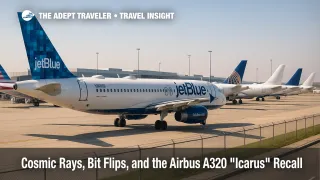
Modern aviation faces an invisible cosmic hazard. In late 2025, a rare software vulnerability in Airbus A320-family jets was thrust into the spotlight after a JetBlue Airbus A320 en route from Cancun to Newark suddenly pitched down mid-flight, injuring passengers and forcing an emergency landing1, 2. This incident, initially attributed to turbulence, was ultimately linked to radiation-induced data corruption in the jet's flight control computer. The discovery prompted an unprecedented global software recall of ~6,000 Airbus A320-family aircraft in November 20253, 4. The event has highlighted real-world risks of cosmic rays flipping bits in safety-critical travel systems, and spurred industry-wide action to bolster digital resilience.
Key Metrics Snapshot
- Incident Flight & Date: Oct 30, 2025 - JetBlue Flight 1230 (Airbus A320) from Cancun to Newark1.
- Event: Sudden uncommanded pitch-down at cruise altitude; ~190 ft altitude loss in ~4 seconds5. Crew recovered control and diverted to Tampa.
- Injuries: ~15 passengers injured (non-life-threatening) due to the abrupt descent2, 6.
- Cause: Suspected bit flip (single-event upset) in the Elevator Aileron Computer (ELAC) - cosmic radiation likely corrupted critical flight-control data7, 8.
- Recall Scope: ~6,000 Airbus A318/A319/A320/A321 aircraft (about half of all in service A320-family jets) required immediate software fixes3.
- Fix Implementation: ~5,100 aircraft could be patched via software update (~3 hours each)9; ~900 older jets required hardware replacement of flight computers (not allowed to carry passengers until replaced)10.
- Fleet Disruption: Mandatory grounding of affected jets until fixed (emergency airworthiness directive)11. Many airlines updated software overnight, minimizing disruptions, but some cancellations occurred - e.g. Air France canceled 35 flights12, ANA 65 flights13, while Wizz Air and easyJet completed all updates with no cancellations14, 15.
- Comparative Scale: Largest Airbus recall in history, ~6,000 jets far exceeding the 387 jets grounded in the Boeing 737 MAX crisis (2019)16, though with no fatalities in this case.
The JetBlue A320 Incident: A Mid-Air Plunge with Mystifying Cause
On October 30, 2025, JetBlue Flight 1230 was cruising at 35,000 feet under clear skies when, without warning, the aircraft pitched nose-down sharply. According to investigative reports, both of the A320's elevator-aileron computers (ELACs) simultaneously registered corrupted sensor data - specifically a false indication of an imminent aerodynamic stall5, 19. The flight-control system responded as if the plane were stalling: it pushed the nose downward about 2°, causing the jet to drop roughly 190 feet in under 4 seconds5. Passengers experienced a jarring negative-G lurch; unbuckled travelers were lifted from seats, and objects flew about the cabin. The pilots instantly disconnected the autopilot, manually stabilizing the aircraft after the brief free-fall. They declared an emergency and diverted to Tampa, Florida, landing safely at 2:19 PM local time1.
Injuries and immediate aftermath: Approximately 15 people suffered injuries (cuts, bruises, and suspected concussions), though thankfully no one was critically hurt2. Emergency crews met the aircraft in Tampa and transported the injured to hospitals. The incident occurred during a period of otherwise routine cruise flight, absent any severe weather. This led investigators and the FAA to initially suspect a flight control malfunction rather than turbulence20. The aircraft was taken out of service for inspection, and JetBlue and federal authorities launched a full investigation into the cause21.
Turbulence or something else? Early speculation in the media lumped the JetBlue event with a string of turbulence-related injuries in 202522. Indeed, 2025 had seen multiple flights encounter severe turbulence resulting in passenger injuries. However, data from Flight 1230's route showed no significant weather or clear-air turbulence at the time. The abrupt single downward jolt - with no prior warnings or continued instability - was uncharacteristic of turbulence, which usually causes a series of erratic bumps or a longer upset. This discrepancy prompted a closer look at the flight data recorder (FDR) and the aircraft's computers.
Flight data clues: The FDR revealed an anomalous sequence in the seconds before the dive. Both independent ELAC units (which control the A320's elevators and ailerons) received erroneous angle-of-attack readings simultaneously5. In essence, the computers "believed" the aircraft was pitching up into a stall when it was not. In an Airbus, even manual stick inputs are mediated by computers (a fly-by-wire architecture), so a spurious sensor input can directly lead to incorrect control commands. Investigators found no evidence of sensor damage or common-mode hardware failure. What they did find were telltale signs of data corruption in the digital messages passed between sensors and the ELAC computers8. This pointed to neither pilot error nor external weather, but an internal bit-level error - essentially, a single flipped binary digit in the system's memory or logic.
Cosmic radiation as the culprit: On November 28, Airbus stunned the industry by announcing that the likely cause of the JetBlue incident was radiation from space flipping a bit in the flight computer's software, not a traditional mechanical fault8. In a statement to airlines and regulators, Airbus explained that "intense solar radiation" had possibly corrupted data critical to the functioning of flight controls on the JetBlue A3208. In plainer terms, a burst of high-energy particles - either from a solar storm or cosmic rays - induced a fault in the ELAC's calculations, triggering the false stall and automatic nose-down response. This marked the first time regulators explicitly tied a specific aircraft system failure to space radiation and mandated fleet-wide action23, 24. While cosmic-ray effects on electronics had long been theorized, they were considered exceedingly rare and mostly benign25. The JetBlue scare turned that theoretical risk into a tangible safety issue that could not be ignored.
Airbus A320 Software Recall: A Global Fleet Grounded
Once the link was made between the JetBlue incident and a software vulnerability, Airbus moved with unprecedented urgency. In late November 2025, just ahead of the busy holiday travel season, Airbus issued a global All Operators Telex and worked with regulators to enact emergency Airworthiness Directives (ADs) grounding every A320-family jet that had the suspect software installed11. This "recall" encompassed approximately 6,000 aircraft worldwide - over half of all A320-family jets in service3. Authorities in Europe (EASA), the U.S. (FAA), and around the globe coordinated on the directive, an extraordinary measure recalling only comparisons to the Boeing 737 MAX grounding in 2019 in terms of scale16.
Scope of the fix: Investigators honed in on the A320's ELAC software version L104 (sometimes nicknamed the "Icarus" update in media26). This was a recent software standard introduced in 2019 under Airbus's "Safety Beyond Standard" initiative, intended to enhance flight-envelope protections on the A32027, 28. Ironically, L104 introduced new logic to prevent stalls - but lacked certain data-integrity filters present in later versions29, 30. Airbus discovered that ELAC L104 was vulnerable to single-event upsets (bit flips from radiation) in a way that could induce uncommanded control movements31, 29. The JetBlue aircraft had been running L104, and it turned out that two earlier unexplained incidents on Asian carriers (in 2021 and 2023) might have been minor precursors that went unpublicized29, 32. Armed with this knowledge, Airbus's fix was essentially to remove or patch the problematic software.
Software rollback: Regulators ordered airlines to uninstall ELAC L104 and revert to the previous safe version (L103 or L103+) on all affected jets33. In practice, this meant re-loading the flight control computer software that had been in place prior to 2019. The process was technically straightforward - an engineer connects a data loader device in the cockpit and uploads the older firmware34, 35. The challenge was doing this for thousands of airplanes immediately. The ADs effectively grounded each aircraft until the software reversion was complete11. (Regulators did permit one-off "ferry flights" - moving empty planes to maintenance hubs - but no passenger service until fixed36.)
Operational scramble: Airlines worldwide sprang into action as the recall hit just after U.S. Thanksgiving 2025. At the moment Airbus's bulletin went out (Nov 28), an estimated 3,000 A320-family jets were actually in the air carrying passengers4. Those flights were allowed to finish, but upon landing the aircraft had to be kept on the ground until updated. Airlines had to rapidly reschedule flights, mobilize maintenance teams, and in some cases, hunt for the correct software loaders and files. Initially, there was confusion - Airbus's blanket alert didn't list specific tail numbers or serials, leaving airlines to identify which of their A320s had L104 installed37. Within 24 hours, however, most carriers isolated the affected jets and began applying the fix38.
- Swift progress: Thanks to round-the-clock maintenance shifts, many airlines updated a large portion of their A320 fleets within a day or two. Airbus had estimated ~3 hours per software upload9, so airlines with dozens of jets had to perform multiple updates in parallel. For example, Europe's Wizz Air announced it completed the software reversion on all its A320-family planes overnight, allowing normal operations by the next day14. UK carrier easyJet likewise finished over a weekend without cancellations15. These successes were aided by the fact that the fix was a rollback to proven code - less risky than introducing a brand new patch.
- Cancellations and delays: Some disruption was unavoidable, especially for carriers with large A320 fleets or limited maintenance capacity. Air France canceled 35 flights during the software retrofit12. All Nippon Airways (ANA) canceled 65 domestic and regional flights on the first Saturday of the recall13. Avianca, which relies heavily on A320s, reported over 70% of its fleet was affected and instituted "significant" schedule cuts for about 10 days, even temporarily halting new ticket sales until December 839. In the U.S., American Airlines initially warned of hundreds of potential disruptions, but later revised the number of affected jets down to 209 and managed only minimal delays40. JetBlue (the incident airline) had ~150 Airbus jets to fix; it completed work on 137 by the Sunday after Thanksgiving, cancelling about 20 flights on the Monday to accommodate the remainder41. Meanwhile, several airlines faced logistical hiccups, such as a shortage of data loader devices to simultaneously update many planes42. In one example, an airline had to borrow extra loading units to speed up the uploads.
- Older hardware replacements: Complicating matters, Airbus identified about 900 older A320-family aircraft (generally early A320ceo models) that could not simply revert software. These jets used an older ELAC hardware or processor that would still be susceptible to the radiation issue even with L103, or lacked the capacity to run the patched software. For these, Airbus mandated a physical replacement of the ELAC B computer unit with a newer, shielded unit10, 43. Obviously, swapping out avionics hardware is more time-consuming than a software flash. Airlines had to source replacement units (Airbus and suppliers ramped up production of the kits), install them, and test the systems. Regulators ordered that until the new computer was installed, those ~900 jets must remain out of passenger service10. By early December, industry sources said the number of such aircraft was actually a bit less than initially thought (~1,000), and it was shrinking as some were retrofitted or exempted44. Still, airlines like Avianca kept a chunk of their older A320s parked awaiting new hardware, causing ongoing schedule adjustments into mid-December.
Regulatory coordination: The recall was a coordinated global effort. EASA issued Emergency AD 2025-0268-E on November 28, 2025, and the FAA followed with a parallel directive within hours33. Other aviation authorities (Canada, Asia, etc.) mirrored these orders so that by November 29, virtually every affected A320-family plane worldwide was grounded until fixed. Such unity recalled the global grounding of the 737 MAX in March 2019. Notably, Airbus's recall alert was proactive: only one serious incident (JetBlue) had occurred with no fatalities, yet the fleet action was taken to prevent any chance of a worse outcome. As the CEO of Flyadeal (a Saudi low-cost carrier) remarked, "the thing hit us at 9pm...and I was surprised how quickly we got through it" - highlighting how airlines and regulators, cognizant of past lessons, moved faster than in prior crises45, 46.
Disruption impacts: Fears of massive flight chaos over the Thanksgiving weekend subsided quickly as fixes progressed. The UK Civil Aviation Authority noted the situation was "very much out of the ordinary" but praised the swift response and observed that the actual airport impact was limited given the scale47, 3. By Dec 1, Airbus reported that the "vast majority" of the ~6,000 jets were already modified and back in service, with fewer than 100 still awaiting work (mostly the ones needing new computers)48. In a public statement, Airbus CEO Guillaume Faury apologized for the disruption and emphasized that safety was the priority49. Industry analysts noted a stark contrast to Boeing's initial handling of the MAX issues - Airbus was transparent and decisive, likely mindful of avoiding any hint of hesitation50, 51. This stance was well-received by regulators and helped reassure the public that this was a precautionary grounding for a software fix, not a sign that the A320 was fundamentally unsafe to fly52, 53.
Comparing past aviation groundings: The A320 "Icarus bug" recall joins a short list of instances where large fleets were grounded for software or avionics safety issues. Below is a comparison of major events:
| Event (Year) | Aircraft & Cause | Trigger Incident(s) | Fleet Affected | Grounding Duration | Resolution |
|---|---|---|---|---|---|
| A320 "Icarus" Recall (2025) | Airbus A318/A319/A320/A321 - Flight control software vulnerability (ELAC L104) causing potential bit flips7, 8 | JetBlue Flight 1230 (Oct 30, 2025): uncommanded pitch-down, 15 injured2, 17 | ~6,000 aircraft globally (50% of A320 fleet)3 | ~1-3 days for most jets (urgent AD; fix before next flight)11 | Rolled back software to previous version (L103)54; ~900 older units required new hardware10. No fatalities; fleet returned to service within a week. |
| Boeing 737 MAX Grounding (2019) | Boeing 737 MAX 8/9 - MCAS flight-control software flaw leading to repeated nose-down commands55 | Lion Air 610 crash (Oct 2018) and Ethiopian 302 crash (Mar 2019); 346 total fatalities55 | 387 aircraft worldwide (all MAX in service)16 | 20 months (Mar 2019 - Nov 2020)16 | Redesigned software (MCAS logic overhauled), new pilot training and sensor redundancy. Gradual return to flight in late 2020-2021. |
| Boeing 787 Battery Grounding (2013) | Boeing 787-8 - Lithium-ion battery thermal runaway fires in electrical bay | JAL 787 fire at Boston (Jan 7, 2013); ANA 787 smoke event (Jan 16, 2013)56, 57 | 50 aircraft (entire 787 fleet at the time)58 | ~3 months (Jan-Apr 2013)59, 58 | Modified hardware - new battery containment, ventilation and monitoring system. Fleet ungrounded after FAA approved fixes in April 2013. |
| Qantas A330 "SEU" Incident (2008) | Airbus A330-300 - Inertial reference unit fault, suspected single-event upset (cosmic ray) corrupted sensor data60, 61 | Qantas Flight 72 (Oct 2008): two sudden pitch-downs over WA, ~100 injured (no crash)61, 62 | Entire A330 fleet subject to AD (no blanket grounding) | N/A (planes not grounded; AD issued for software update) | Software updates to flight-control and ADR systems; revised procedures. Root cause never conclusively proven, but cosmic particle strike considered likely62. |
Table: Recent Fleet-Wide Groundings/Recalls for Software-Related Safety Issues. The 2025 A320 recall stands out in scale and proactivity, with swift software reversion averting any fatal accident52, 50.
Radiation-Induced Bit Flips: Physics and Engineering 101
The JetBlue incident might sound like sci-fi - "cosmic ray knocks plane out of the sky" - but it is rooted in very real physics. High-energy radiation from space can alter the behavior of microelectronics in a phenomenon known as a single-event upset (SEU). In simple terms, a stray particle (from the Sun or from deep space) can flip a bit in a computer's memory or logic, changing a 0 to 1 or vice versa63, 64. If that bit happens to be part of a critical calculation (say, an angle-of-attack sensor reading), the computer's output can become dangerously wrong in an instant.
Sources of radiation aloft: Airliners at cruise altitude are exposed to a constant drizzle of radiation from two main sources:
- Cosmic rays from deep space: Extremely energetic particles (primarily protons) are ejected by distant cosmic events like supernovae. These galactic cosmic rays bombard Earth's upper atmosphere relentlessly. When a cosmic ray strikes air molecules, it creates a shower of secondary particles - including neutrons, muons, and other subatomic debris - that cascade downwards65. At ground level, we're largely shielded (the atmosphere absorbs most of it). But at 35,000 feet, the atmosphere is much thinner66. An aircraft at cruise can experience a particle flux hundreds of times higher than at sea level19. Notably, neutrons generated by these cosmic interactions are a prime culprit for bit flips in silicon chips67 - they have no charge but can collide with nuclei in microelectronics, inducing electrical changes.
- Solar storms: The Sun sporadically emits intense bursts of charged particles during solar flares and coronal mass ejections. These solar energetic particles (mostly protons) can be even more energetic than galactic cosmic rays68. During a strong solar storm, radiation levels at flight altitudes can spike dramatically - dozens or even thousands of times above normal in extreme cases68, 69. Fortunately, major solar particle events are infrequent and usually shorter-lived (hours to days). However, when they occur, they primarily threaten high-latitude flights (near the poles) because Earth's magnetic field funnels charged particles toward the polar regions70. In fact, airlines sometimes reroute or altitudinally restrict polar flights during severe solar storms to limit radiation exposure to crews and electronics.
How a bit flip happens: Whether from a cosmic ray or solar proton, the mechanism is similar. A particle zipping through the aircraft can strike a semiconductor device - for instance, a memory chip or processor transistor in the flight computer. This impact can deposit a burst of charge in the circuit. In a digital system, bits are stored as tiny electric charges; disrupt that charge enough and a 0 becomes a 1. This is the SEU. It's "single-event" because it's triggered by one particle and "upset" because it upsets the normal binary state. Importantly, the hardware isn't permanently damaged - it's a transient error (one memory cell was wrong until corrected or reset)71. The system might continue running obliviously, now with a wrong value in one register.
If the flipped bit is inconsequential (say in an unused portion of memory), nothing happens. But if it lands in an "important" place - for example, the value of the aircraft's pitch angle being calculated - the computer might make a bad decision. In the JetBlue A320's case, investigators believe exactly this occurred: a flipped bit in the ELAC's angle-of-attack data made the software falsely detect an extreme AOA, triggering stall protection when it wasn't needed5, 72.
Altitude and latitude factors: The probability of an SEU rises with altitude and nearer the poles. At 35,000-40,000 feet, the radiation intensity can be dozens to hundreds of times greater than at ground level70, 19. EASA has noted that aircraft at high altitudes, especially on polar routes, face the highest particle flux70. That's one reason regulators require airlines to monitor crew radiation doses on long polar flights73. During the JetBlue flight (flying over Florida at FL350), latitude wasn't extreme, but a hypothesized solar event increased flux globally. Interestingly, some experts pointed out that solar activity on Oct 30, 2025 was actually moderate - suggesting the bit flip may have just been a random cosmic ray hit, not a solar flare direct effect74. Either way, it illustrates that even on a "normal" day, cosmic particles are zinging through airplanes routinely.
Why now? One might ask: if cosmic rays have always been there, why haven't we seen incidents like this more often? The answer lies in both technology and solar cycles. Modern avionics use highly integrated semiconductor chips with ever-smaller transistors - this makes them faster and more power-efficient, but also more sensitive to radiation75. A smaller transistor needs less charge to flip state, so a particle that might not have affected an older, larger transistor can upset a modern one. Over the decades, there have been minor unexplained glitches attributed to SEUs (researchers in the 1980s and 90s documented rare inflight upsets)76, 77. But until recently, they were theoretical footnotes, as Sandy Murdock (former FAA) quipped: seen as "rare, one-in-a-billion events" that hadn't caused a known crash25. Additionally, we're currently in an active solar period - Solar Cycle 25 peaked around 2024-2025 - which means more solar flares and particle storms than, say, five years ago78. Veteran space-weather scientist Clive Dyer notes that manufacturers may have grown complacent over ~20 quiet years, as no major solar-driven upsets occurred79. The JetBlue incident was a wake-up call that even our best-engineered systems are still subject to the laws of physics.
Beyond "bit flips" - other radiation effects: While SEUs (soft errors that corrupt data but don't damage hardware) are the main concern in avionics, radiation can cause other issues too80. A high-energy hit can induce a single-event latch-up (SEL), where a surge of current can temporarily seize a circuit (potentially requiring a reboot). In severe cases, it can cause physical damage - a phenomenon called single-event burnout - frying a transistor or integrated circuit permanently80. These are less common, especially in civil aviation electronics, but they are well-known in satellites and spacecraft that operate in harsher radiation environments. Designers categorize these outcomes as: (1) transient upsets (recoverable errors), (2) minor damage (device degradation that might cause future faults), and (3) permanent damage (device fails and needs replacement)80. The A320's issue thankfully appears to be in category (1) - a transient bit flip that the system didn't catch.
Safeguards in Avionics: How Systems Mitigate Radiation Risks
Aviation engineers are not blind to the risks of radiation - in fact, certification standards since the mid-2000s explicitly require considering single-event effects in critical systems81. The A320 incident, however, shows that gaps can still exist when specific combinations of hardware, software, and cosmic conditions align81. Let's explore how aircraft electronics are normally hardened against such "soft errors":
- Redundancy and Voting: The cornerstone of aviation safety is redundancy. Critical flight systems are built with multiple independent channels - often triply redundant computers that "vote" on any control output. The logic is that the odds of one computer glitching spontaneously are low, and the odds of two or three glitching in the exact same way at the same time are astronomically low82. For example, an Airbus A320 has two ELAC units and additional spoiler elevator computers; if one ELAC produced implausible commands, the other should override it. In the JetBlue case, this redundancy didn't prevent the event because both ELACs received the same faulty sensor data simultaneously5. Essentially, the bit flip occurred upstream in data shared by both channels. This was an unusual failure propagation, and it exposed a hole: the system lacked a cross-check to detect "both computers wrong in the same way." After this recall, one can expect Airbus to add logic to compare inputs and ignore sudden extreme readings unless confirmed by multiple sources.
- Error-Detecting and Correcting Memory: Avionics computers typically use ECC (Error-Correcting Code) memory, which can automatically detect and correct single-bit errors in storage. ECC RAM adds parity/check bits so that if a cosmic ray flips one bit in memory, the hardware notices and fixes it on the fly. This is a common safeguard in mission-critical computing (servers, spacecraft, etc.). It's possible that in the A320's case, the bit flip may have occurred in a part of the system not protected by ECC - perhaps within a processor register or an analog-digital sensor circuit where ECC isn't applicable. Future designs might expand the use of error-detecting codes on internal data pathways.
- Watchdog Timers and Resets: Many flight systems include watchdog timers that reset a computer if it becomes unresponsive or behaves erratically (which could be due to a bit flip causing a software hang). In this incident, though, the system did exactly what it was told, just based on bad data - so a watchdog wouldn't trigger. However, if a radiation strike had frozen the ELAC's processor, the watchdog would have rebooted it. A reboot in flight sounds scary, but systems are designed to failover seamlessly. (Airbus flight controls have multiple lanes - if one reboots, another carries the load in the interim.)
- Diverse Hardware/Software Channels: Another mitigation is to have dissimilar redundancy - for instance, two computers running different code or even using different CPU types to minimize the chance the same bug or hardware fault affects both. Some modern avionics employ lockstep processing, where two microprocessors run the same instructions in tandem and constantly compare results; if they diverge, an error is flagged immediately. Lockstep essentially catches bit flips in real time, at the cost of requiring duplicate hardware. It's commonly used in automotive safety microcontrollers and some fly-by-wire systems.
- Physical Shielding: High-energy particles are hard to stop, but strategic use of shielding can attenuate the radiation. Critical avionics boxes might be placed in lower sections of the fuselage (where there's a bit more atmospheric mass above) or enclosed in materials that slow down particles. However, as one aviation engineer noted, "shielding really well... would add weight; it's more practical to use redundancy than to encase computers in heavy armor"83. Black boxes (flight recorders) are heavily shielded - but they only need to survive crashes, not be weight-efficient. For onboard electronics, a balance is struck between reasonable shielding and reliance on other mitigation techniques.
- Radiation-Hardened Components: In extreme cases (mostly spacecraft, military, or high-altitude reconnaissance aircraft), rad-hard chips are used. These are semiconductors designed and manufactured to withstand radiation (using insulating substrates, larger transistors, etc.). They tend to be much more expensive and sometimes less performant. In airliners, generally COTS (commercial off-the-shelf) electronics are used with other mitigations, because the environment, while harsher than ground level, isn't as bad as space. That said, after this event, Airbus did mention adding extra shielding or revised components for older A320s44 - a nod that some hardware hardening was needed for those units.
Taken together, these strategies mean that commercial aircraft are already very safe from random cosmic glitches. Indeed, the odds of a single flight experiencing a serious SEU-induced failure have been estimated to be extremely low - one industry figure cited it as "very, very low for one computer, and really, really, really low for multiple computers on the same flight"82. That's why it took until 2025 for a notable incident to manifest. However, as this recall shows, low probability is not zero, and with thousands of flights every day, even rare events can eventually happen.
In the JetBlue scenario, the safeguards present mitigated the outcome: the crew received an immediate "stall" warning (false, but as designed for what the computer thought was happening) and they reacted swiftly to override. The plane's structure easily tolerated a 2° sudden pitch (though passengers were shaken up). It was a safety net doing something erratic because one layer of protection (data validation) failed. The software fix essentially adds another layer to prevent a single-bit error from cascading to a control surface command so directly.
Broader Travel Ecosystem Exposure to "Bit Flips"
Aviation is just one part of a digitized travel infrastructure increasingly vulnerable to soft errors (transient, radiation-induced glitches) as well as other digital faults. The A320 incident shines a light on where else such single-event upsets could have meaningful effects in travel:
- Other Aircraft Systems: Besides flight controls, aircraft have many critical computers - e.g. Flight Management Systems (FMS) that manage navigation and performance, autopilot and navigation sensors, communications radios, and engine FADEC (Full Authority Digital Engine Control) units. An SEU in any of these could cause malfunctions: for instance, a flipped bit in a navigation system might throw off GPS position or trigger a fail-safe reversion. Modern jets are designed to detect most such anomalies (e.g. triple redundant inertial sensors cross-compare), but incidents have occurred. In 2014, a business jet's autopilot abruptly disconnected due to a processor upset (suspected cosmic ray), and the pilots had to manually recover - a non-event, but noted in maintenance logs. Satellites in aircraft systems - like those used for broadband internet or GPS - are themselves subject to space radiation. If a GPS satellite or receiver has a bit flip, it could briefly give erroneous location data. Fortunately, avionics cross-check multiple satellites and inertials, so one wrong datum won't confuse the system for long.
- Air Traffic Management: On the ground, air traffic control (ATC) centers and communication networks rely on large computer systems that are generally well-protected with power backups and error-correcting servers. But they are not explicitly hardened like avionics are. A cosmic-ray bit flip in an ATC computer could, for example, cause a software crash or an incorrect radar tracking for one aircraft target. There have been mysterious outages in ATC systems historically that engineers suspected might be due to SEUs (though more often it's software bugs). The stakes are high: an outage in a central ATC system can delay thousands of flights. The good news is these systems usually have redundancy and failover - if one radar feed goes haywire, controllers have secondary systems. Nonetheless, the indirect effects of a glitch (like loss of a tracking system leading to reduced capacity) are a concern. A notable example: in January 2023, a U.S. NOTAM system outage (while not attributed to a cosmic ray but a contractor error) grounded flights nationwide for hours - showing how a single corrupted database file in a critical ground system can have massive operational impact. A bit flip could in theory corrupt a key database or file if not caught by backups or ECC, leading to similar chaos.
- Airport infrastructure: Today's airports are mini cities with extensive digital control - everything from runway lighting systems, automated weather sensors, baggage handling conveyors, to security screening machines are run by computers or PLCs. Most of these are not specifically radiation-hardened, but since they're at ground level, the natural radiation rate is low. Still, a freak SEU could knock out, say, an automated baggage sorting system's PLC, causing it to reboot and delaying luggage. Or consider digital runway systems: if an instrument landing system or its monitoring computer had a transient error (unlikely due to multiple safeguards and self-tests), it could suspend precision landings until reset. Airport power grids and fuel farms also depend on control electronics - a cosmic bit flip in a sensor might trigger a false alarm that shuts something down until human override. These would generally be minor nuisances or safety delays rather than immediate danger.
- Border control & identity systems: As travelers, we increasingly encounter automation at borders - ePassport gates use biometric scanners and databases to verify identities. Immigration databases are robust IT systems (usually with ECC and transaction checksums), but a stray bit flip in memory could, in theory, result in a corruption - perhaps an officer suddenly seeing garbled text or an incorrect flag on a traveler. Normally, such errors would be caught by internal validation or simply cause the application to crash (prompting a restart). The impact might be a brief outage of e-gates or need to fall back to manual processing. Given security implications, these systems often have thorough logging - a weird blip might prompt an investigation, but unless it's repeatable, it could be chalked up to a transient IT glitch.
- Airline operations and reservation systems: The business side of aviation - crew scheduling systems, flight planning software, reservation and ticketing databases - all run on big servers or cloud platforms. Those environments typically use enterprise-grade hardware with ECC memory and backups. Thus, single-bit errors are usually corrected on the fly and remain invisible. However, on very rare occasions, cosmic rays have been known to impact terrestrial computing: there are documented instances of unexplained flips causing everything from bank ATM failures to election vote count errors. In airline ops, one could imagine a bit flip in a scheduling server's memory might cause it to mis-assign a crew or lose track of an aircraft position, potentially causing delays until the error is caught. More dramatically, if a flip occurred in code that isn't protected and triggers a software crash, a major airline's ops control center could go down. Airlines have disaster recovery plans for IT outages (we've seen cases of database failures grounding airlines for hours), so the concern is less about the cosmic ray per se and more about ensuring critical software is resilient to any random fault.
- Payment and financial systems in travel: The vast networks that process credit card payments for tickets, manage loyalty miles, or settle accounts between travel agencies and airlines run on general-purpose data centers. These rely on the same mitigation as any financial IT (redundant servers, ECC, transactional integrity). The travel industry doesn't have unique exposure here, but an interesting related domain is space-based financial data - for instance, some cryptocurrency operations have put nodes in orbit, and cosmic radiation is a consideration for their reliability. In a travel context, if one day space tourism companies are processing payments via satellite systems, they'd need to factor this in.
One key insight: legacy systems and third-party tech might be more vulnerable. Much of the travel infrastructure still runs on decades-old technology - some airport control systems or airline mainframes date back to the 1980s-90s. In those days, cosmic ray upsets were less understood; plus those systems' hardware might have larger transistor geometries (which is actually more robust to radiation) but no ECC memory, etc. Also, third-party vendors providing software/hardware (like a company that installs automated passport control kiosks) might not be held to the same rigorous safety standards as aircraft manufacturers. This creates potential weak links where a radiation-induced error could cause an outage without the robust mitigation that aviation-grade systems use. A concrete gap is that regulatory oversight is strongest for aircraft and ATC systems, but more diffuse for things like airport IT networks or airline scheduling platforms, which might not undergo strict fault tolerance certification.
Post-Recall: Industry and Regulator Response
The A320 cosmic-ray recall was a novel scenario for civil aviation regulators. In its wake, safety authorities and industry groups have been assessing how to prevent a repeat and strengthen resilience:
- Regulatory scrutiny of software: EASA and FAA have signaled a closer look at software assurance processes. Even though Airbus followed existing standards (the ELAC L104 software was certified to DAL-A, the highest level of DO-178C standard), regulators are considering whether additional requirements are needed for radiation robustness. For instance, EASA had already published guidance in April 2021 about addressing single-event effects in avionics design84, 70. Post-recall, we may see those guidelines hardened into more formal certification criteria. This could mean requiring evidence that a single-bit upset cannot lead to a catastrophic hazard (perhaps by design analysis or fault injection testing). The standards committees (RTCA/EUROCAE) might develop new advisory circulars or update DO-254 (hardware design assurance) to emphasize mitigations for decreasing component sizes.
- Airworthiness Directives & reporting: The recall itself was executed via emergency ADs. Moving forward, authorities may institute mandatory incident reporting for any unexplained inflight upsets or computer anomalies. The goal would be to capture data on potential SEUs that were previously dismissed as "random glitches." A more systematic reporting could reveal patterns (e.g., multiple minor events during a solar storm week) that would otherwise go unnoticed. Airlines might be required to log occurrences of flight control computer reboots, sudden autopilot disconnects, or inexplicable instrument shifts, and report them in a centralized database. ICAO could facilitate this globally, updating the safety management systems (SMS) framework to include space weather-induced incidents as a reportable category.
- Space Weather Monitoring integration: There is growing recognition that space weather should be treated similarly to other environmental hazards like thunderstorms or volcanic ash. In 2019, ICAO actually started providing Space Weather advisories to aviation (primarily aimed at alerting to solar radiation storm levels and communication/navigation impacts). After this event, airlines and ATC providers are likely to pay closer attention to those advisories beyond just crew health. For example, if a major solar flare/particle event is forecast, airlines might choose to temporarily lower cruise altitudes (trading fuel efficiency for a bit more atmospheric shielding) or avoid high-latitude routes where radiation is concentrated85. Some regulators might push for real-time radiation monitors aboard aircraft - a concept studied in the past - so that if radiation spikes, the crew and systems get an alert. While we don't want pilots suddenly panicking about cosmic rays, such data could feed into automated safety responses or at least guide maintenance (e.g., if a plane flew through a strong solar storm, maybe do a thorough check of systems afterwards).
- Design redundancies and upgrades: Airbus's immediate fix was software, but the company is also likely re-examining its hardware. The need to replace ~900 older ELAC units suggests they are introducing either better shielding or updated processors with more tolerance10. Future aircraft designs (A321XLR, A350, Boeing's next gen) will certainly incorporate this event's lessons: expect more fault-tolerant architectures that can handle an SEU gracefully. This could include self-checking pairs of processors, more robust sensor fusion algorithms that default to safe mode if data goes wild, and perhaps even incorporating multiple diverse sensor types for critical parameters (so that a bizarre value can be recognized as out-of-family). Regulators could require manufacturers to demonstrate via testing that a single-event upset anywhere in a critical system either has no effect, is immediately corrected, or at worst leads to a controlled loss of function (e.g., autopilot disconnect) rather than an uncontrolled command.
- Standards bodies involvement: Organizations like RTCA, EUROCAE, and IEEE are likely to convene study groups. EUROCONTROL (overseeing European ATM) may look at how ground ATC systems can be made more resilient - maybe by incorporating redundant computing on different power supplies or cloud-based failovers to handle unforeseen faults. IATA (airline association) might develop best practices for airlines, such as radiation risk management plans (similar to how they have turbulence management programs). There may even be cross-industry workshops between the aviation sector and other fields (like nuclear power or medical device makers) which also contend with soft errors, to share mitigation strategies.
- Addressing gaps: A clear gap identified is outside the aircraft. One safety expert noted that "the sun's capacity to affect software might damage more than onboard systems" and called for a broad task force to evaluate non-traditional vulnerabilities86. Legacy ground systems (like old radar processing units, or airport power control systems running on PLCs) might not be under any mandated SEU protection program. Regulators could extend audit requirements to major infrastructure providers - for example, requiring that critical airport systems have some form of redundancy or backup in case a control computer glitches. This is tricky, because it borders on areas not historically certified by aviation authorities (you don't "certify" an airport's baggage system in the way you certify an aircraft). It may fall to airport authorities and companies themselves to implement more robust designs voluntarily. One approach is fail-safe design: ensuring that if a system does have an upset, it fails in a safe state. The A320 did nose-down (arguably a fail-unsafe outcome), which is why it was serious. But consider a runway lighting system - if its controller had an SEU, ideally the lights would just default to "on" or some safe state, not go out at a critical moment.
- Training and procedures: There's also a human factors element. Pilots are trained for all sorts of failures, but "uncommanded flight movement due to computer bit flip" wasn't exactly in the manual (it fell under generic computer failure scenarios). After JetBlue 1230, Airbus and airlines updated simulator training scenarios to include sudden anomalies that recover when a system is turned off and on (essentially instructing: if something weird and unrecoverable happens, assume any system could be at fault and try alternate control laws or backups). Cabin crew procedures for dealing with injurious turbulence can also apply to these events - e.g., ensuring passengers keep seatbelts fastened when seated at all times, which in this case mitigated injuries (those injured were largely not belted, according to reports). From the regulator side, the emphasis is on reinforcing that space weather is now part of the aviation safety matrix - not just for long-term crew health or radio interference, but for system reliability.
In sum, the post-mortem on this recall is prompting a mindset shift: treating cosmic radiation almost like a form of "random turbulence" for electronics - something to anticipate and design around, even if individual events are extremely rare.
Future Outlook: Rising Challenges in the Digital Sky
As we look ahead, several trends could elevate the importance of guarding against radiation-induced soft errors in travel systems:
- Solar Cycle Peaks and "Space Climate Change": We are currently around the peak of Solar Cycle 25 (the Sun's 11-year activity cycle). Solar scientists project this cycle and the next could be comparably intense to the late 1990s/early 2000s. That means a higher likelihood of strong solar flares and proton storms in the next few years. Indeed, in November 2025 (just two weeks after the JetBlue event), an X-class solar flare erupted, flooding the atmosphere with elevated radiation for days87, 69. While no aviation incidents were reported from that, it underlines the potential for multiple aircraft to be affected simultaneously in a worst-case solar event. Clive Dyer cautioned that a truly massive solar storm could raise radiation levels "a thousand times higher" than normal and "many aircraft could be bothered by it" all at once78, 69. This scenario - equivalent to a geomagnetic storm of Carrington Event magnitude - is low probability, but not impossible. It could result in widespread upsets: numerous planes getting false warnings or rebooting systems, plus communication/navigation outages. The industry may need to treat such extreme space weather the way it treats a blizzard or hurricane: by delaying or rerouting flights preemptively. On the flip side, during solar minimum years, background cosmic rays (galactic) actually increase (since the Sun's magnetic field is weaker, more deep-space rays get in). So there's really no time of zero risk, it's a trade-off between cosmic background and solar events. Monitoring and forecasting improvements will be key - better predictive models might give airlines hours of warning of incoming particle bursts, much like storm forecasts.
- More Automation, Less Human Buffer: The trajectory of aviation (and travel in general) is toward greater automation and autonomy. Future aircraft designs (think single-pilot airliners or even pilotless freighters) will rely even more on computers to make decisions. If a human isn't in the loop or is monitoring many systems at once, the tolerance for an unmitigated bit flip is even lower. In a highly automated flight, a momentary anomaly that a human pilot could override (as in JetBlue 1230) might instead cause an autonomous system to hiccup or make a bad choice. This implies that next-gen automation will need multiple layers of fail-operational design - not just fail-safe that hands off to a human. Similarly, air traffic control is incorporating AI tools for sequencing and separation; airports are using automated vehicles for baggage and refueling. The more we entrust to software, the more we must ensure that software can handle or at least safely fail in the face of unexpected faults like SEUs. This could slow the deployment of automation until these reliability questions are satisfactorily answered. On the flip side, automation can also help mitigate radiation risk by reacting faster than humans to certain failures (for example, a future autopilot might recognize its own sensor fault and reconfigure instantly, whereas a human might take seconds).
- Explosion of Satellite Constellations: The travel ecosystem is becoming ever more entwined with space systems - from GPS and Galileo for navigation, to Starlink and OneWeb satellite internet on planes, to satellite-based ADS-B tracking of flights. With thousands of satellites now in low Earth orbit, we have to consider the vulnerability of these constellations to space weather. A solar storm that can upset an aircraft computer will certainly be hitting satellites in orbit even harder. In February 2022, a moderate solar geomagnetic event actually caused 40 new Starlink satellites to decay and burn up because they lost attitude control in a geomagnetic storm. In the context of travel, if a strong solar event or cosmic burst knocked out or disrupted a large number of communication satellites, it could temporarily degrade in-flight connectivity, or even impact ATC datalinks and navigation if GPS accuracy drops. Dense constellations also raise the question of collision avoidance: satellites use automation to dodge each other, and if an SEU caused a satellite to misfire its thrusters or report wrong position, we could see an orbital near-miss or worse. While that might not immediately affect a plane in the sky, it could damage the space infrastructure that aviation and travel rely on.
- Emergence of Advanced Air Mobility: Looking beyond commercial airliners, the coming years will see more electric air taxis, drones, and high-altitude pseudo-satellites (like solar-powered UAVs) in the skies. These vehicles are often lighter, with electronics potentially closer to consumer-grade in some cases due to cost. A drone or air taxi's flight controller could be less shielded. If they fly at lower altitudes the cosmic ray flux is smaller, but they still face some risk. With potentially thousands of autonomous drones in urban airspace, even a one-in-a-million chance per flight might manifest occasionally. Regulators will need to ensure even these smaller craft have thought through SEU resilience, especially if they fly over populated areas.
- Treating Bit Flips as an "Environmental Hazard": In aviation, hazards like windshear, icing, volcanic ash, bird strikes, etc., are well-catalogued and have specific countermeasures and operational protocols. We may see radiation-induced upsets join this list formally. This would mean: (a) environmental monitoring (space weather alerts) becomes routine in flight operations centers; (b) design standards treat the radiation environment as part of the certification envelope - for example, requiring that an aircraft tolerate the radiation equivalent of, say, the 95th percentile worst-case flight (similar to how wings must handle worst-case turbulence loads, or engines must handle ingesting a certain amount of ice or birds); and (c) pilot training and simulator scenarios include "your instruments are lying due to radiation" cases, to drill the appropriate response (which is usually: maintain control, cross-check with backups, and revert to basic flying if needed).
- Cross-industry learning: Other sectors can offer guidance. The computer server industry has long dealt with cosmic ray flips - major data centers see many ECC memory corrections daily. They've developed techniques like memory scrubbing (periodically checking memory integrity) and resilient architectures. The aerospace industry (satellites, deep space probes) use redundancy and fault-tolerant voting extensively - for instance, the Mars rovers have rad-hard chips and still suffer occasional bit flips that trigger safe mode, which they recover from autonomously. The medical device field also worries about SEUs: there have been instances of implanted pacemakers resetting due to cosmic rays (extremely rare, but documented), and thus those devices use error detection and have backups. Aviation can draw on these experiences to improve. Conversely, the high reliability culture of aviation can help inform emerging tech sectors like driverless cars - which, as they become more prevalent, might encounter soft errors at ground level (less likely, but possible if a car's computer runs without ECC memory, for example). A system resilience approach treats these as systemic issues: we accept that we can't stop cosmic rays, but we can design systems to withstand and recover from these random faults.
A Systems Resilience Challenge, Not a Cause for Alarm
The tale of the JetBlue A320 and the cosmic ray is dramatic - it revealed a hidden vulnerability in a workhorse aircraft and grounded a global fleet. But it's important to emphasize that air travel remained extraordinarily safe throughout. The event resulted in injuries but no loss of life, and the swift recall demonstrated the aviation system's ability to respond proactively to a new risk. From an air traveler's perspective, safeguards are strong: aircraft have multiple backups, pilots are skilled at handling the unexpected, and regulators enforced a fix before a more serious accident could occur52, 50.
For airlines and manufacturers, the incident is a reminder that safety engineering is an evolving journey. As Airbus's initiative name "Safety Beyond Standard" suggests, meeting the bare standards isn't the end - one must anticipate the outliers. The sun and cosmos will continue to throw challenges at our increasingly digital travel networks. With upcoming solar cycles and expanding use of electronics, the industry will treat radiation-induced bit flips not as science fiction, but as a design case to guard against - much like windshear or icing conditions. Investment in resilience - whether through better hardware, clever software, or operational strategies - will pay off across many domains, not just aviation.
In the end, the 2025 A320 recall can be seen in a positive light: it exposed a blind spot and allowed the aviation community to address it before disaster. It underscores a broader lesson for all critical infrastructure in the travel ecosystem: robustness in the face of the unpredictable is the key to keeping our complex, interlinked systems safe and reliable. The sky may occasionally throw curveballs (or cosmic rays), but with vigilance and ingenuity, we can continue to fly confidently above the clouds.
Sources
- Planes grounded after Airbus discovers solar radiation could impact systems - BBC News
- Struck by a cosmic ray: Galactic particles may have forced a passenger jet to make an emergency landing - Space.com
- JetBlue flight diverts to Tampa after flight control issue, injuries reported - Reuters
- Safe Fly Aviation Report: Airbus A320 Solar Flare Crisis Forces Grounding - Safe Fly
- FlightGlobal: A320 grounding linked to software update designed to protect against in-flight loss of control - FlightGlobal
- FlightRadar24: 3,000 A320s In the Air When the Recall Hit - FlightRadar24 Blog
- Channel NewsAsia/Reuters: Airbus says most of its recalled 6,000 A320 jets now modified - CNA
- Business Standard: What is the Airbus 'Icarus Bug' and how are airlines fixing it? - TBS
- Wikipedia: List of Boeing 737 MAX groundings
- Wikipedia: 2013 Boeing 787 Dreamliner grounding
- StackExchange: Aviation Engineering Forum Discussion on SEUs
- JDA Journal: Emergency Airworthiness Directive 2025-0268-E Full Text - JDA Journal
- NASA Space Weather Prediction Center: Solar Cycle 25 Forecast Summary
- Nature: Cosmic ray-induced soft errors in modern computer systems
- EASA Guidance Material: Addressing Single-Event Effects in Avionics (2021)
- The Verge: Inside the Airbus A320 Recall and the Push for Resilient Avionics
- Airbus Technical Communication: ELAC Software Rollback Instructions (A320/A321)
- IEEE Spectrum: The Physics of Cosmic Rays and How They Affect Avionics
- ICAO: Manual on Space Weather Information in Support of International Air Navigation
- Reuters: Airbus Says Most of Its A320 Jets Now Fixed After Recall - Reuters
- Bloomberg: How Airlines Handled the Sudden A320 Recall
- SpaceWeather.com: Solar Particle Event Timeline - October-November 2025
- Aviation Safety Network: Incident Report - JetBlue 1230, Oct 30, 2025
- BBC: What Is a Bit Flip and Why It's So Hard to Engineer Against - BBC Future
- Getty Images Editorial Use Airbus A320 Fleet Archive
- NTSB: 787 Dreamliner Battery Final Report (2014)
- Avionics Today: Designing for Cosmic Ray Resilience