

Greenland Invasion Hype: Rare Earths Behind the Rhetoric
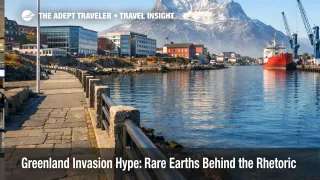
The idea that the United States is gearing up to invade Greenland has made the rounds in sensational headlines and social media feeds. But a closer look reveals a different story: far from plotting a military takeover of this Arctic island, Washington's real focus is on critical minerals and strategic partnerships, not conquest. Recent fiery rhetoric, fueled largely by Trump-era provocations, is better understood as hardball diplomacy aimed at Denmark (which controls Greenland's foreign and defense policy) to secure access to Greenland's rare earth elements. In this Travel Insight, we take a policy-driven look at why an invasion narrative doesn't hold water and what the United States' true strategic goals are in Greenland.
Greenland's unique geopolitical status and resource wealth have put it in the spotlight of great-power competition. Yet despite talk of annexation or military intervention, Greenland remains a peaceful, self-governing territory of Denmark, host to longstanding U.S. military facilities and open to travelers as ever. Below, we break down the facts: the mineral riches exposed by melting ice, Denmark's cautious stance on mining, America's critical minerals strategy vis-à-vis China, the precedent of a hard-nosed Ukraine minerals deal, and why neither the U.S. nor any rival is about to "take" Greenland by force. For globetrotters and Greenland's visitors, the bottom line is reassurance, this remote Arctic destination isn't about to become a war zone, and the latest saber-rattling has little real impact on travel or daily life on the island.
Melting Ice Uncovers Greenland's Rare Earth Riches
Greenland's vast icy landscape is fast becoming an economic frontier as climate change alters the terrain. The island's ice cap, second only to Antarctica, has been steadily retreating, exposing new land and mineral deposits that were long locked away under glaciers1. Among the most prized of these emerging resources are rare earth elements (REEs), the suite of 17 minerals essential for high-tech electronics, green energy, and advanced weapons systems. Geological surveys indicate that Greenland holds significant concentrations of rare earths, along with other critical minerals like uranium, copper, cobalt, and nickel, in its rocks and coastal plains2. As ice melts and previously inaccessible areas open up, prospectors and mining companies have taken keen interest. In fact, between the mid-2010s and 2020, there was an explosion of exploration licenses in southern and coastal Greenland, targeting newly revealed mineral zones2.
By the numbers, Greenland's rare earth endowment is globally significant. Estimates suggest the island could hold around 36 million tonnes of rare earth oxides in total, placing it on par with some of the largest reserves on Earth2. Of those, roughly 1.5 million tons are proven, economically viable reserves, which currently ranks Greenland eighth in the world for rare earth element reserves2. With further exploration, analysts believe Greenland might even prove to have the second-largest rare earth trove after China2. These minerals, found in deposits like the southern Kvanefjeld and Tanbreez sites, could be a game-changer for supply chains of everything from electric vehicle motors to missile guidance systems.
Crucially, Greenland's riches are near the surface thanks to geological history and the ice retreat. Unlike some deposits buried deep underground elsewhere, many of Greenland's minerals are in relatively shallow ore bodies, or on newly uncovered land, making them attractive (in theory) for open-pit mining1. One oft-cited example is the Kvanefjeld (Kuannersuit) deposit, which is rich in rare earths and uranium and sits on Greenland's ice-free southern tip. Similarly, the Tanbreez site holds an abundance of eudialyte ore containing rare earths and other metals, just waiting for exploitation once permits and infrastructure are in place2.
However, turning these buried riches into actual mines is easier said than done. Greenland's environment is extreme and infrastructure is sparse. There are literally few roads (under 100 miles of paved road in the entire country2) and no railways to speak of. Everything, equipment, workers, ore, would have to move by sea or air. The climate, while warming, remains harsh with long dark winters and rugged terrain. Moreover, local communities and Inuit residents have a strong voice in what development is allowed on their land. All these factors mean that even though the ice is yielding new opportunities, Greenland is not poised for an immediate mining boom. As the Atlantic Council notes, the island's mineral wealth is "largely theoretical" at this stage; to date, only two mines (for gold and anorthosite) are operating, and no rare earth mine has reached production yet2. Greenland's rare earths are a tantalizing prize gradually unveiled by nature, but unlocking them will take time, technology, and above all community consent.
Denmark and Greenland: Caution Over Mining and Sovereignty
If Greenland is the stage for this resource drama, Denmark and Greenland's own governments set the script. Greenland is an autonomous territory within the Kingdom of Denmark, self-governing in most areas since the late 1970s but with Copenhagen retaining control of defense, foreign affairs, and monetary policy. When it comes to mining and land use, Greenland's home-rule authorities (the Naalakkersuisut and Parliament in Nuuk) call many of the shots, though Denmark keeps an eye on things, especially if strategic materials like uranium are involved.
In recent years, Greenland's elected leaders have adopted a cautious, even resistant, stance on certain mining projects, reflecting environmental concerns and indigenous community opposition. A pivotal moment came in 2021, when Greenland's parliament (Inatsisartut) passed a law banning uranium mining and blocking mining at sites with high uranium content2. This decision wasn't only about radioactive material; it had direct implications for rare earth mining too. The Kvanefjeld rare earth project, for example, contains substantial uranium alongside its rare earth elements. Once the uranium ban was enacted, it "effectively halted rare earths development at the Kvanefjeld project" because any rare earth extraction there would bring up uranium as a byproduct2. Greenland's lawmakers chose to forego, at least for now, a major rare earth venture rather than risk the environmental and political fallout of uranium contamination.
This uranium ban reflected sustained local opposition to that project and others seen as threats to Greenland's pristine environment and traditional livelihoods2. It underscores a key point: Denmark and Greenland are not blindly rushing to dig up minerals at any cost. On the contrary, there is a strong vein of public sentiment in Greenland in favor of protecting the land and exercising sovereignty prudently. In 2013, Greenland had lifted an earlier ban on uranium mining under a previous, pro-development government, raising hopes of a mining boom. But after public protests and an election, the political winds shifted. By 2021 the ban was back, aligned with the platform of a new Inuit Ataqatigiit-led government that prioritized the environment. Denmark, for its part, supported Greenland's right to decide and has generally heeded local wishes on such matters (after all, heavy-handedly overruling Greenland could fuel the island's independence movement, which Denmark wants to avoid).
Beyond uranium, Denmark has signaled wariness of large-scale Chinese involvement in Greenland's mining sector, a factor we'll explore later. Notably, Danish authorities quietly worked behind the scenes to block or reroute Chinese investment in Greenlandic airports and minerals in the late 2010s. For example, when Chinese companies showed interest in financing new airports in Greenland, Denmark stepped in with its own funding to keep them out3. And in 2019, Greenland pointedly decided not to use Chinese telecom giant Huawei for its 5G network build-out, a move praised in Copenhagen and Washington3. All of this highlights that Denmark's policy is to safeguard Greenland's strategic assets, whether that means limiting uranium mining or keeping critical infrastructure in Western hands.
The takeaway is that Greenland is not a resource free-for-all. Its leaders are balancing economic hopes with environmental protection and political self-determination. Denmark, holding ultimate sovereignty, has thus far respected Greenland's democratic choices, even when that means major rare earth deposits stay untapped due to local opposition. This reality undercuts any simplistic notion that the U.S. could simply force its way to Greenland's minerals; any access will have to be negotiated with buy-in from Copenhagen and Nuuk. And indeed, U.S. strategy seems to recognize this, focusing on diplomatic agreements rather than any plan to violate Denmark's authority over its territory.
U.S. Rare Earth Needs and the China Factor
Why is the United States so eager for Greenland's rare earth elements in the first place? In a word: China. Over the past two decades, China has become the dominant global supplier of rare earth minerals and the processed materials derived from them. By some estimates, China controls about 70% of global rare earth mining, 90% of the refining and processing capacity, and over 90% of manufacturing for things like high-strength rare earth magnets4. This near-monopoly means that the rest of the world, including the U.S., is highly dependent on China for critical ingredients in high-tech and defense products. From the smartphones in our pockets to the jets and missiles in America's arsenal, Chinese-sourced rare earths are ubiquitous.
Such dependency is a strategic vulnerability that U.S. policymakers have fretted over for years. Beijing has not been shy about using its rare earth leverage as a geopolitical bargaining chip. Famously, in 2010 China halted rare earth exports to Japan for two months amid a territorial spat, sending shockwaves through global markets5. Prices for some rare earth oxides spiked several-fold and consumers scrambled for alternatives, vividly illustrating how China could "weaponize" supply chains for political ends6. More recently, as U.S.-China strategic rivalry intensified, China has imposed export controls on certain rare earth-related technologies and hinted at curbing exports of key minerals needed by U.S. industries4. Each signal from Beijing reminds Washington that China holds the cards on these resources, a fact not lost on American defense planners who note that thousands of U.S. weapons systems components rely on Chinese rare earths4.
For the United States, securing non-Chinese sources of rare earths and associated processing capability has become a national priority. This was outlined in strategy documents and echoed by military leaders who warn that reliance on an adversarial power for critical materials is untenable for long-term security. The U.S. has been investing in rare earth projects domestically and in allied countries, funding research into substitutes and recycling, and scouring the globe for friendly suppliers. It's in this context that Greenland emerges as a very attractive potential partner. As noted, Greenland's rare earth reserve base is significant, potentially one of the largest outside China2. Moreover, Greenland is politically aligned with the West (through Denmark) and is a democracy governed by rule of law. In an ideal scenario from Washington's perspective, Greenland's rare earths could be developed by Western companies, processed in Western facilities, and help break China's chokehold on the supply chain.
China is well aware of this dynamic and has itself tried to get a foothold in Greenland's mineral sector. A Chinese state-linked firm, Shenghe Resources, took a major stake in the company behind the Kvanefjeld project years ago2. Chinese mining companies have also shown interest in other Greenlandic deposits and infrastructure. These moves caused heartburn in Washington and Copenhagen, raising fears that Beijing could extend its strategic reach into the Arctic via "investment diplomacy." In one telling episode, U.S. officials reportedly leaned on the owner of the Tanbreez rare earth project (which was being courted by Chinese buyers) to instead sell to an American-led consortium; which they did, albeit at a discounted price, to keep the project in friendly hands2. And when a Chinese construction firm earlier bid to build airports in Greenland, Denmark (with quiet U.S. support) intervened to nix that plan, injecting Danish funds to ensure Chinese companies didn't gain a footprint on the island3.
Greenland sits at the intersection of U.S.-China strategic competition. The U.S. goal is to reduce dependence on China for critical minerals by developing alternative sources like Greenland4. China's goal, conversely, is to maintain its dominance and, if possible, prevent rivals from breaking free of it. Both see Greenland's rare earths as valuable, but the U.S., by virtue of its alliance with Denmark, has the inside track diplomatically.
This context helps explain the hardline tone recently emanating from Washington. When President Donald Trump and his administration talk about Greenland in almost alarmist terms (claiming the U.S. must "secure" the island or even purchase it outright), it is largely a reflection of U.S. anxiety over China's control of rare earths and the desire to lock down a friendly source. As Rebecca Pincus, an Arctic security expert, observed, the two main U.S. interests in Greenland today are "the radar base at Pituffik [Thule] and the island's strategic mineral deposits."7 The Pentagon cares about Greenland because of its location for missile defense (more on that later), and because "preventing China from gaining control over Greenland's mineral resources is a key concern" for the U.S. and Europe alike7. In essence, China's rare earth leverage has driven the U.S. to play hardball to ensure it has a stake in Greenland's future mining, even if that hardball comes in the form of provocative statements that spook the uninitiated.
Aggressive Diplomacy: The Ukraine Minerals Deal Precedent
Some of the recent Greenland rhetoric sounds almost unhinged, Trump at one point musing that the U.S. will take Greenland "whether they like it or not", leading many to wonder if it's pure bluster or part of some negotiation strategy8. To understand the method in the madness, it's instructive to look at a parallel episode: the U.S.-Ukraine "minerals-for-aid" controversy. While Greenland and Ukraine are very different situations, they both involve the Trump team using shockingly blunt demands over minerals as a bargaining tactic.
In early 2025, reports emerged that President Trump's White House had pressed Ukraine to hand over a huge share of its critical mineral wealth as a form of "repayment" for U.S. military aid during the war with Russia9. In a proposal that astonished many, Washington allegedly asked for $500 billion worth of Ukrainian minerals, effectively 50% of Ukraine's known rare earth and critical mineral reserves, in exchange for continued support9. Ukrainian President Volodymyr Zelenskiy balked at this, responding indignantly that he "can't sell our country" and noting that the U.S. aid given thus far was nowhere near $500 billion9. Zelenskiy revealed that the draft deal would have given the U.S. 50% ownership of Ukraine's critical minerals, but provided Ukraine with no firm security guarantees in return9. He rejected the demand outright, calling it "not a serious conversation"9.
Why would the U.S. even float such an audacious idea? The logic, from the perspective of Trump's negotiators, was likely that Ukraine sits on valuable resources (such as lithium, manganese, rare earths) needed for clean energy and defense industries. If the U.S. could lock in a large share of those by leveraging Ukraine's dire need for aid, it would secure a non-Chinese supply while being "paid back" for assistance. It was an extreme opening bid, one that angered the Ukrainians and was ultimately not accepted, but it set the stage for tough bargaining. Trump himself bluntly said he wanted "$500 billion in rare earth minerals from Kyiv to secure Washington's assistance"9. This episode, which came to light via Reuters and other outlets, was a stark example of transactional diplomacy: trying to translate military aid into mineral rights.
The relevance to Greenland is this: the Trump administration's bold, pressure-heavy approach to negotiations, staking out maximalist positions (like demanding half of Ukraine's minerals, or telling Denmark to hand over Greenland), is seen as a tactic to force the other side into a deal on favorable terms. In Ukraine's case, the gambit failed, as Zelenskiy made clear that sovereignty wasn't for sale in that manner9. In Greenland's case, Trump's bluster about "buying" the island or using force has likewise been flatly rejected by Danish and Greenlandic leaders, but it has gotten their attention2, 10. The strategy, one might cynically call it the "Art of the Deal" approach, is to apply extreme rhetorical pressure, back it with some punitive threats (tariffs on Denmark and NATO allies, in Trump's Greenland scenario10), and then compel the other party to come to the table to negotiate an agreement that addresses your core interests (which, in reality, might be more limited than the initial bombast suggests).
In other words, the U.S. doesn't actually need to own Greenland or govern its 56,000 inhabitants to get what it wants. What it wants is access to Greenland's rare earth minerals and a commitment that China won't be allowed to snatch them up. By brandishing the specter of an American takeover, Trump could be aiming to unnerve Denmark just enough that they concede a long-term mineral access deal to the U.S. (for example, exclusive rights for American firms to develop certain mines, or a U.S.-Denmark strategic minerals pact). It's coercive diplomacy, not pretty, certainly not in the traditional ally-to-ally playbook, but it is a playbook this team has used before. A senior European analyst, Fabian Zuleeg, noted that U.S. security concerns in Greenland are being "exaggerated to justify a more unilateral and coercive approach"7. The Ukraine minerals episode shows what that coercive approach can look like in practice.
None of this is to say Denmark will simply capitulate. In fact, the Danish and Greenlandic response so far has been defiant. Greenland's Prime Minister and Denmark's officials have repeatedly said Greenland is not for sale and any agreement must respect Greenland's autonomy and international law10. But the pressure from Washington has had one clear effect: it has pushed Denmark and other NATO allies to increase their own engagement in Greenland (sending small troop deployments, investing in Arctic capability) to show they are taking security seriously11. In essence, Trump's shock tactics have jolted Denmark into action, potentially opening the door for a negotiated mineral partnership down the line, as an alternative to endless tensions. The Ukraine scenario serves as both a warning and a template: aggressive asks can backfire, but they can also move the dial. For now, the U.S.-Denmark dialogue on Greenland's resources continues, under heavy atmospherics.
Why a U.S. Military Takeover Won't Happen
Amid all the tough talk, it bears emphasizing a fundamental point: the United States is not going to invade or forcibly seize Greenland, and the alarmist "invasion" narrative is unfounded. There are multiple reasons, legal, strategic, and practical, that make a U.S. military takeover of Greenland extraordinarily implausible. Understanding these reasons helps separate the bluster from reality.
First, Greenland is a part of the Kingdom of Denmark, a NATO ally. An attack on Greenland would be an attack on Denmark, triggering NATO's Article 5 mutual defense clause (Greenland is explicitly covered by Article 5 as it is North Atlantic territory under a member state's sovereignty)7. It is almost unthinkable that the U.S. would initiate a war with one of its closest treaty allies; it would be a literal betrayal of NATO. Such an action could indeed "spell the end of the alliance" as some European officials have warned11. The U.S. gains nothing by wrecking NATO unity and turning Europe against it. Even British Prime Minister Keir Starmer publicly stated he did not believe Trump was actually considering military action to seize Greenland, trying to calm fears and noting it would be wildly out of line10. The U.S. military, for its part, has deep ties with Danish defense; they train and operate together. The Pentagon has no appetite to fight Danish forces or cause chaos in the Arctic, a point underscored by Denmark's own Arctic commander, Major General Soren Andersen, who dismissed the idea of conflict between NATO allies as a purely "hypothetical" scenario not on his radar12.
Second, the U.S. already enjoys a robust military presence in Greenland, with Denmark's full consent. The centerpiece is the Thule Air Base (Pituffik Space Base) in northwest Greenland, a American installation dating back to the Cold War. Thule hosts vital space surveillance and missile early-warning systems (part of NORAD), satellite tracking, and airfield facilities. At the height of the Cold War, Thule Air Base had some 10,000 U.S. personnel stationed there13. Today the numbers are smaller (hundreds of U.S. Air Force and contractor personnel), but the base remains strategically important. Beyond Thule, during the Cold War the U.S. operated over 50 smaller installations across Greenland, including radar stations and research camps14. Virtually all of those were scaled down or closed after the Cold War ended. In fact, the U.S. drastically reduced its military footprint in Greenland in the 1990s, reflecting reduced threat levels13. This historical trend, the U.S. withdrawing forces when not needed, flies in the face of the notion that America now suddenly needs to conquer the island. The 1951 U.S.-Denmark Defense Agreement that allows American bases in Greenland is still in effect and was even amended in 2004 to accommodate Greenland's home-rule government13. Under that agreement, the U.S. can operate military assets in designated areas of Greenland essentially indefinitely, with Denmark's blessing. If Washington wants more military presence for some reason (say, new radar sites or periodic troop rotations), it can achieve that by negotiating within the NATO framework, as indeed is happening now with Denmark inviting more NATO exercises in Greenland11, 12rather than by force. As one expert observed, "Washington already holds extensive basing and surveillance rights on the island and could expand its presence through cooperation... without resorting to threats."7
Third, invading and occupying Greenland would be a logistical nightmare and strategically pointless. Greenland is huge (2.2 million square kilometers, about the size of Western Europe) but sparsely populated and mostly covered by ice. There are no invasion beaches with opposing armies to defeat; the "battle" would consist of possibly confronting Danish/Greenlandic coast guard units or a token force of Danish troops (Denmark currently has about 150 personnel in Greenland under its Joint Arctic Command)11. While that might sound easy to steamroll, the real challenge would come the day after: administering and supplying a gargantuan Arctic territory against the will of its inhabitants and the international community. Any forcible takeover would spark global condemnation - the United Nations, U.S. allies, and likely Americans themselves would see it as blatant imperialism. It would also set a disastrous precedent (how could the U.S. credibly oppose, say, Russia taking territory by force if it did the same to an ally?). In practical terms, keeping an occupation force in Greenland fed, fueled, and functioning through polar winter would strain U.S. logistics for minimal gain. The U.S. military would far prefer to use Greenland's bases with Danish cooperation than to own an enormous, cold land outright.
Finally, the supposed threats that might justify a U.S. "pre-emptive" invasion, namely Russian or Chinese designs on Greenland, are not credible (I address this more in the next section). If Denmark were truly about to hand Greenland to Moscow or Beijing, one could imagine U.S. panic. But Denmark has done nothing of the sort; on the contrary, it's strengthening defenses. In essence, there is no emergency that would require America to "rescue" Greenland by occupying it. This is why top Danish officials, while alarmed by Trump's rhetoric, stress that they "don't see a NATO ally attacking another NATO ally"12. The entire Pentagon planning apparatus, which constantly runs scenarios for global conflicts, simply isn't gearing up for a war against Denmark. The "invasion" chatter is a political gambit, not a military plan.
Concerns of a U.S. military takeover are vastly overblown. Greenland is already a de facto strategic partner to the U.S. (hosting its base), and any issues can be resolved through alliance channels. Even in the depths of the Trumpian pressure campaign, NATO partners like the UK have called for "calm discussion" and made clear their belief that war is not on the table10. U.S. aims can be met without violating Greenland's autonomy or Danish sovereignty. The noise about invasion should be seen for what it is: noise. Or as one seasoned Arctic commander, Maj. Gen. Andersen, put it when asked about U.S. threats: "I don't see a NATO ally attacking another NATO ally."12
Russia and China: No, They're Not Poised to "Take" Greenland
Part of the invasion narrative has been fueled by warnings (chiefly from President Trump) that if the U.S. doesn't assert control over Greenland, then Russia or China will swoop in and take it. This claim doesn't withstand scrutiny. Neither Moscow nor Beijing has the intent or capability to seize Greenland, and suggesting otherwise is a strategic red herring. Let's break down each case:
Russia is mired in other problems, most obviously the ongoing war in Ukraine, and has limited ability to project military power beyond its own Arctic shores. While Russia certainly has interests in the Arctic (it has the world's largest Arctic coastline and a fleet of icebreakers), Greenland is on the opposite side of the Arctic, adjacent to North America. Any Russian move on Greenland would require bypassing or confronting NATO forces in the North Atlantic, essentially a declaration of war on NATO. It's a suicide mission scenario that even the most hawkish Russian generals aren't contemplating. The Danish Defense Intelligence Service has assessed that Russia poses a very limited direct threat to Greenland; Denmark's Arctic commander emphasized his focus is on monitoring Russia's activities (like submarine routes under the Arctic Ocean), not any hypothetical invasion of Greenland12. Indeed, when Trump claimed Denmark can't protect Greenland from Russia, Danish officials responded by pointing to ongoing NATO efforts deterring Russia, and reaffirmed that an attack on Greenland would trigger NATO's full collective defense7. Russia is in no position to fight NATO over a frozen island. Its military is bogged down, and its Arctic assets, though significant in its own region (like bases on Franz Josef Land or the Kola Peninsula), do not translate into an expeditionary force that could capture and hold distant Greenland.
China has even less military reach in the Arctic. Despite China's growing global navy, it still lacks a true blue-water fleet capable of sustained operations in the North Atlantic, especially in the face of U.S./NATO opposition. China has no military bases anywhere near Greenland, nor any mutual defense treaties that would give it legal pretext. What China does have is a keen economic interest in the Arctic - scientific stations, icebreakers for research, and investments in mining and energy projects (mainly in Russia's Arctic and elsewhere). Beijing has declared itself a "Near-Arctic State" and formulated a Polar Silk Road vision, but to date its presence in Greenland is minimal and non-military3. Chinese navy ships occasionally venture into the North Atlantic on goodwill visits or exercises, but there are no Chinese destroyers lurking off Nuuk despite Trump's vivid claims3. As one Norwegian Arctic security expert noted bluntly, "Greenland is not swarming with Chinese and Russian vessels. This is nonsense."3 Beijing's only conceivable avenue to influence Greenland militarily would be in tandem with Russia, but even that alliance has limits, and Russia itself isn't eyeing Greenland militarily. Chinese strategists know that trying to grab territory from a NATO member would be extraordinarily foolish. Instead, China's interest in Greenland is economic and diplomatic: access to rare earth minerals (through investment or partnerships) and perhaps use of new Arctic shipping routes in the future. On those fronts, China has indeed tried to insert itself, for example, a Chinese company's attempted purchase of an old naval base in Greenland some years back was stymied, and its ambitions in Greenland's mining sector have largely been frustrated by local and Danish pushback3. Far from plotting an invasion, China has in recent times dialed down its Greenland ventures because the "diplomatic costs" were too high when met with Western resistance3.
To underscore expert views: Fabian Zuleeg, chief of a European policy think tank, stated "There is no serious or immediate security threat to Greenland from Russia or China that would justify U.S. talk of using force."7 Similarly, other analysts note that while both Russia and China have strategic interests in the Arctic, these are being managed via diplomacy and economic means, not military adventures7. The notion that either would invade Greenland is considered "misleading" and alarmist7. European and Danish officials have consistently rejected Trump's framing of the issue, stressing that Greenland's security environment is stable and that existing alliances are sufficient to deter any aggression7. In fact, Denmark's current course of action, boosting its own military presence and inviting NATO allies for exercises in and around Greenland, is aimed at precluding any vacuum that rivals could exploit11. By showing that "the Arctic is not only for the Kingdom of Denmark, it is for all of NATO" (as Denmark's defense minister said)11, the alliance is signaling to Russia and China: don't even think about it. This unified stance makes a covert or forceful takeover virtually impossible without triggering a world war, which neither Moscow nor Beijing desires.
One real strategic concern, as Western analysts point out, is not a foreign invasion but rather a foreign-influence scenario short of war, for example, if China were to strike a lucrative minerals deal or infrastructure agreement that gave it de facto control over some of Greenland's resources or ports. This would be a kind of "soft power takeover," locking up access to rare earths in a way that sidelines the U.S. That, arguably, is the true long-term risk that hawks in Washington worry about2. It's precisely why the U.S. has been actively countering Chinese investments and wooing Greenland with economic aid of its own (the U.S. reopened a consulate in Nuuk in 2020 and has offered development funds). But again, this is a competition played out via deals and development, not invasions. As one Atlantic Council expert noted, the key is to ensure Greenland's mineral development happens with "trusted partners" and doesn't allow "strategic capture" by adversaries2.
The specter of Russia or China physically taking Greenland is not grounded in reality. Russia is checked by NATO and its own limitations; China is playing a long economic game but lacks military avenues. The unified Western response, even amid internal rifts, has been to close ranks in defense of Greenland's status. NATO's article 5 protection looms large: any aggression would "trigger a full alliance response" and thus is not a rational course for Russia or China7. Knowing this, Trump's references to Russian and Chinese designs on Greenland should be seen less as genuine warnings and more as rhetorical devices to justify U.S. assertiveness ("we must act, or else they will"). It's a classic use of a threat narrative to prod allies into action. But even those allies, while acknowledging competitive pressures in the Arctic, maintain that diplomacy and presence, not panic, are the answer7. In the end, Greenland is not the next Crimea or South China Sea island; it's firmly within NATO's envelope, and everyone involved knows it.
The Real Strategic Play: Minerals and Influence, Not War
If we cut through the hyperbole, it becomes clear that the U.S. interest in Greenland, and that of other major powers, is fundamentally about securing strategic advantages without crossing lines into open conflict. The real "game" around Greenland is a competition for influence and resources: who gets to develop the rare earth mines? Who maintains alliances and presence in the Arctic? And how to do all this while keeping the region stable? In this light, the invasion talk is a distraction. The U.S. doesn't need to conquer Greenland to achieve its goals; it needs to ensure that when Greenland's minerals are developed, they flow through Western pipelines and not exclusively to China. It needs to ensure that Greenland's strategic location (between North America and Europe in the Arctic circle) continues to serve Western defense interests (like hosting radar and satellite stations) and not anyone else's. These objectives can be, and are being, pursued via intensive diplomacy, economic investment, and security cooperation.
Indeed, recent developments bear this out. Under intense U.S. prodding, Denmark and other NATO partners have moved to increase their visibility in Greenland, effectively sharing the security burden. European small deployments and planning for Arctic exercises signal to Washington that "we are taking this seriously", hopefully reducing the perceived need for unilateral U.S. action11. Simultaneously, Greenland's government has been courted with economic aid packages (the U.S., EU, and others have offered development funds for sustainable mining, education, and infrastructure in Greenland to win goodwill). Rather than send in the Marines, the U.S. is more likely to send trade delegations and geological survey teams. This is the carrot to go with Trump's stick: if Greenland cooperates on minerals, investment will follow and everyone benefits. If not, the (implied) stick is that the U.S. will raise a fuss and make life diplomatically uncomfortable. It's a hard-nosed negotiating posture, but ultimately a negotiated outcome is the only plausible result. As observers note, "patient statecraft" and partnership can yield more durable results in Greenland than coercion2. Even the saber-rattling administration likely recognizes that an actual invasion would destroy the very alliances the U.S. is trying to strengthen.
Greenland's leaders, for their part, have made their red lines clear: sovereignty is not up for sale or coercion, but they are open to equitable partnerships. Greenland's Prime Minister Múte Egede and Denmark's Prime Minister have both stated that they welcome investment and even a greater U.S. commercial presence, just not a transfer of sovereignty or any abridgment of Greenlandic rights10. This suggests that the most likely endgame is some kind of U.S.-Greenland-Denmark agreement on mineral access. It could take the form of preferred access for American companies to certain mining projects, joint ventures between American and Greenlandic firms, or perhaps a strategic materials treaty where Greenland commits a portion of production to allied countries. Such arrangements would fulfill the U.S. desire to secure rare earth supplies while allowing Greenland to retain control and reap economic benefits. Greenland could become a key link in Western critical mineral supply chains in the coming decades, an outcome that negates the need for any country to fight over it.
One model often cited is Australia or Canada, allies rich in minerals who work closely with the U.S. on critical mineral strategy. Greenland could join that club. In fact, just as this Travel Insight is being published, U.S. Secretary of State Marco Rubio was preparing to meet Danish officials to discuss Greenland cooperation, signaling high-level talks underway2. The rhetoric may have been fiery, but it has sparked the dialogue needed.
The only real "threat" regarding Greenland is that it could align its resource deals in a way unfavorable to the U.S. (for instance, selling mining rights to a Chinese company with off-take agreements funneling rare earths to China). The U.S. is acting to prevent that. through pressure and incentives. Meanwhile, neither the U.S. nor anyone else actually wants to disrupt the peace in the Arctic with military action, which would be wildly counterproductive. NATO remains committed to keeping the Arctic a low-tension region (recent strains notwithstanding), and even Russia and China, despite some saber-rattling of their own, have not taken steps to militarize the Greenland area3. So, we find ourselves in a scenario where the loudest noises are political theater masking a behind-the-scenes negotiation. As one European diplomat quipped, this is about "concessions, not conquest." Denmark may eventually grant the U.S. more say in Greenland's mineral development (perhaps quietly agreeing to bar Chinese bidders, as it already essentially does), and the U.S. in turn will tone down the tariff threats and security ultimatums.
For policy analysts and travelers alike, recognizing this underlying reality is important. It means the current tensions are likely a passing storm, not a permanent new conflict zone. Greenland will continue to be what it has been: a unique Arctic land governed peacefully by Danes and Greenlanders, increasingly important on the world stage but not about to be invaded by anyone.
Stable Greenland: Minimal Impact on Travelers and Tourism
In the midst of these geopolitical chess moves, one group might be nervously watching the headlines: travelers with Greenland on their bucket list, or those in the travel industry who facilitate Arctic tourism and travel. The good news is that for travelers and tourism, the impact of this diplomatic drama has been negligible. There are no travel warnings, no restrictions, and no instability on the ground in Greenland stemming from the war of words.
Greenland's capital, Nuuk, and other towns remain as tranquil (and remote) as ever. The sight of protesters in Nuuk carrying signs against annexation, as was briefly seen in response to Trump's statements,10 has been rare and peaceful. These were political expressions, not civil unrest. There is no deployment of U.S. troops in the streets or any such scenario that would affect everyday life. In fact, local Greenlandic businesses and residents have carried on, somewhat bemused by the outside world's sudden fascination with their homeland's status. As Greenland's Premier quipped, "We choose the Greenland we know today," emphasizing continuity and calm despite outside pressures11.
For tourists, all flights, cruises, and tour operations in Greenland have continued normally. Arctic expedition cruises still visit the fjords, hikers still trek the tundra, and the newly expanded Nuuk Airport is still receiving connections (with an eye on more international flights in coming years, which was Greenland's big preoccupation before the political tempest). The U.S. base at Thule is in a far northern part of Greenland where no tourists go (except maybe the odd adventurer on a scientific charter). Its operations have not changed in any way visible to the public; if anything, the U.S. military presence is slightly more engaged in joint exercises with Europeans, but all on existing installations11. There is no militarization creeping into tourist areas or nature reserves.
Denmark's move to bring a few dozen NATO military personnel to Greenland for training exercises might actually mean that if you're flying through Kangerlussuaq or Nuuk, you could coincidentally see a Danish or German Air Force plane on the tarmac or uniformed personnel transiting, a novel sight, but hardly a disruption11. These are small contingents (a dozen here, 15 there) and their presence has been low-key. They are there as a political signal, not an occupying force. To the average Greenlander, and certainly to a visitor, they are largely invisible.
It's also worth noting that Greenland's internal governance and civil stability remain unchanged. The local police, government services, and community life continue under the Home Rule authority. No new restrictions or laws have been imposed due to the international dispute. The rule of law and normalcy prevail. If you're a traveler planning an expedition to see Greenland's icebergs or experience Inuit culture, you won't need to worry about geopolitical tensions impacting your trip. There are no curfews, no military checkpoints, nothing of the sort. Tour operators have not reported any decline in interest; in fact, the surge in media attention has arguably made more people curious about Greenland as a destination (albeit one hopes they come for the ice fjords and Northern Lights, not because they think they'll witness some great power standoff, which they won't).
The U.S. State Department travel advisory for Denmark (which covers Greenland) remains at a normal level, indicating no special threats. Likewise, other countries have not issued any advisories suggesting travelers avoid Greenland. because there is no reason to. In a figurative sense, the "hottest" thing in Greenland is still the midnight sun in summer, not conflict.
Greenland's tourism officials have even tried to capitalize subtly on the moment, reassuring visitors that "Greenland remains open, safe and welcoming, whatever you heard on the news!" The narrative in travel circles is that if you come to Greenland, the only invasions you might experience are an "invasion" of awe at the natural beauty, or perhaps a friendly "occupation" of a cozy seat at a local café chatting with Greenlanders about all the international fuss. The people of Greenland are known for their hospitality and resilience; they've taken the geopolitical noise in stride and would gladly share their perspective with curious visitors (many Greenlanders find the idea of a U.S. invasion frankly absurd and even darkly humorous).
For the travel industry, it's important to emphasize that stability in Greenland is rock-solid. All stakeholders, Denmark, the U.S., NATO, etc., have a vested interest in keeping it that way. No matter the posturing, none of the parties want to actually disrupt Greenland's society or scare away investors and tourists. In fact, Greenland's economic development (including tourism) is something everyone encourages as it lessens reliance on Danish subsidies and empowers the local population. So flights from Iceland or Copenhagen will keep ferrying adventurers, cruise ships will keep calling in the summer, and the only "might" you'll need to contend with is the might of Greenland's glaciers and nature.
Conclusion: Rhetoric vs. Reality in Greenland
The clamor about a looming U.S. invasion of Greenland turns out to be much ado about nothing. What we have here is a classic case of rhetoric overshadowing reality. The noise, "America to take Greenland!", has been loud, but the facts on the ground remain unchanged: Greenland is at peace, under Home Rule within the Kingdom of Denmark, and highly unlikely to witness any military conflict. The U.S. is not secretly landing Marines on Greenlandic shores; it's negotiating behind closed doors for mineral agreements. Denmark is not mobilizing to fight America; it's juggling the diplomatic task of addressing U.S. concerns without sacrificing sovereignty or Arctic stability. And China and Russia, despite being invoked as bogeymen, are not about to plant their flags in Nuuk; their influence is being kept in check through international cooperation and Greenland's own agency.
In policy terms, Greenland's future will be shaped by tables, not trenches. Expect boardroom meetings and high-level summits, not battlefields. The likely outcomes in the next couple of years might include new U.S.-Denmark memorandums on critical minerals, more scientific collaboration in mapping Greenland's resources, perhaps increased Western investment in Greenland's infrastructure (airports, ports, fiber optic cables - areas where China previously sought contracts). These are the fruits of diplomacy and yes, tough bargaining. But they are far from the dramatic scenarios of forceful annexation that some commentators feared. In many ways, the Greenland episode, once the dust settles, could reinforce the value of alliances: it has reminded NATO why trust and dialogue among allies are paramount, and it has shown Greenlanders that the international community ultimately supports their right to choose their own path.
For travelers and those of us in the travel insight community, the takeaway is reassuring. Greenland remains the enchanting Arctic destination it has always been, with its towering icebergs, colorful villages, and rich Inuit heritage unmarred by this geopolitical tempest. If anything, the saga adds a layer of modern intrigue to Greenland's story, a reminder that even a distant ice-clad land can be central to global conversations. Visiting Greenland, you might stand at the edge of the ice cap or watch whales off the coast and reflect on how this tranquil place became the focus of superpower attentions. It's a fascinating juxtaposition, but one that underscores an old truth: not every loud claim translates into action. In Greenland's case, the loud claims of invasion are melting away just like its ice, revealing the solid ground of strategic partnerships beneath.
The narrative of a U.S. invasion of Greenland is unfounded and can be confidently debunked. The United States real aims in Greenland are securing rare earth minerals and maintaining strategic foothold, which it seeks to achieve through diplomatic pressure and agreements, not through military force. Denmark's and Greenland's own policies play a crucial role in this dance, as they carefully manage resource development and foreign involvement. Meanwhile, Russian and Chinese threats to Greenland exist more in rhetoric than reality, given NATO's shield and those nations' limited capacity or intent to intervene. As travelers or observers, we can cut through the noise: Greenland is not on the brink of conflict. It remains a stable, welcoming Arctic frontier, one whose minerals and location give it outsized importance, yes, but which will continue to be governed by law and cooperation. The only invasion likely to occur is one of engineers and investors (perhaps American, European, and Greenlandic) when the time comes to break ground on new mines. That, in the grand scheme, is a development to watch with interest, but not alarm. Safe travels, or as they say in Greenlandic, Angalajjutigivit! (Bon voyage!)
Sources
- What Lies Beneath Melting Glaciers and Thawing Permafrost? | Lamont-Doherty Earth Observatory
- Greenland's critical minerals require patient statecraft - Atlantic Council
- What we know: Is China a threat to Greenland as Trump argues? - RTL Today
- China's Rare Earth Leverage Is the Frontline of 21st Century Geopolitics - The Diplomat
- Revisiting the China-Japan Rare Earths dispute of 2010 | CEPR
- Japan's Responses to China's Supply Chain Dominance - RUSI
- Does Russia or China actually threaten Greenland? Experts say Trump's warnings don't match reality
- US military has a long history in Greenland, from WWII to Cold War
- Zelenskiy, on US minerals deal, says: I can't sell Ukraine | Reuters
- Trump links Greenland threat to Nobel Peace Prize snub, EU eyes trade retaliation | Reuters
- Europeans send troops to Greenland as Trump presses claim | Reuters
- Denmark's Arctic commander says focus is on Russia, not U.S., amid security concerns | Reuters
- The 1951 Agreement Allowing US Military in Greenland
- The US Military Once Had a Much Bigger Presence in Greenland