

U.S. Backs Off Airline Delay Compensation
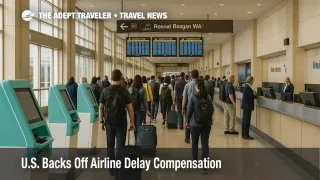
U.S. air travelers will not be getting automatic cash payments for long airline caused delays after all. On November 14, 2025, the Department of Transportation, DOT, formally withdrew a Biden era proposal that would have required airlines to pay between about $ 200.00 (USD) and $ 775.00 (USD) when flights ran late for reasons within the carrier's control. The Trump administration argued that the rule would impose "unnecessary regulatory burdens" and raise costs, a stance airlines welcomed and consumer advocates called a step backward after years of shutdown related cuts and mass disruptions.
The practical result is simple, but important. You still have strong refund rights in some situations, especially for cancellations and major schedule changes, but you will not see an EU style cash compensation system for delays in the near term. That gap makes it more important to understand what U.S. law does cover today, how it differs from Europe, and how to use airline policies, credit card benefits, and travel insurance to protect yourself.
What The Canceled Rule Would Have Done
The Biden administration's DOT opened a formal rulemaking in December 2024 to explore mandatory compensation when flights to, from, or within the United States were significantly delayed or canceled for airline controlled reasons, such as crew or maintenance problems. The draft framework asked whether carriers should pay at least $ 200.00 (USD) for domestic delays of three hours or more, scaling up to $ 775.00 (USD) for the longest disruptions, with parallel amounts on international routes. It also floated mandatory free rebooking, meal vouchers, and hotel coverage, even on competing airlines, when the carrier was at fault.
U.S. airlines and their trade group, Airlines for America, fought the idea from the start, arguing that they already offer refunds and that mandatory cash payouts would push up fares and distort operations. By September 2025, DOT had signaled that it planned to withdraw the proposal, and the Federal Register notice posted on November 14 confirmed that decision, citing high compliance costs and the risk that extra obligations could weaken airlines rather than discipline them.
Consumer advocates and some lawmakers counter that this was a rare chance to force airlines to internalize the cost of controllable disruption. A group of Democratic senators and representatives had urged the Trump administration to keep the rule on track, framing it as a common sense protection for families stuck with unplanned hotel bills and missed events when flights broke down.
Latest Developments
The withdrawal comes as DOT is still implementing a separate 2024 rule that requires airlines to provide automatic cash refunds when they cancel or significantly change flights and passengers decide not to travel. That rule defines "significant" in concrete terms, such as long departure time shifts or added connections, and aims to end the old practice where each airline quietly set its own refund trigger.
At the same time, the department is reviewing whether to roll back a Biden era requirement that airlines disclose baggage and change fees up front, and it has leaned more heavily on public shaming via its Airline Cancellation and Delay Dashboard, which tracks which carriers offer meals, hotels, and rebooking when delays or cancellations are within their control.
In other words, regulators are keeping some consumer tools, like refunds and transparency, while stepping away from direct cash compensation for delays. That is a conscious policy choice, and it leaves most of the burden of disruption on travelers and their own planning.
Analysis
Today, U.S. law draws a hard line between refunds and compensation. Airlines must refund your fare when they cancel or significantly change a flight and you decline rebooking, and a 2024 rule is turning that right into an automatic process that does not require you to fight customer service. But there is still no federal obligation to pay you extra cash when a flight runs late, even if the airline clearly caused the problem.
Instead, delay benefits sit in three buckets. First, major U.S. airlines have voluntarily promised meals, hotel rooms, and rebooking for "controllable" delays and cancellations, a shift DOT pushed in 2022 and now tracks on its public dashboard. Those commitments vary by carrier, and they are policy, not law, which means they can be changed. Second, many premium travel credit cards include trip delay coverage that can reimburse hotels, meals, and incidentals after a defined number of hours. Third, standalone travel insurance can plug remaining gaps, but only if you buy it in advance and understand its triggers and exclusions.
By contrast, passengers in Europe, Canada, and the United Kingdom are operating in a different universe. The European Union's Regulation EC 261, often called EU261, entitles travelers to fixed cash compensation, historically between € 250 and € 600, when flights are heavily delayed, canceled, or oversold and the airline is responsible, although member states have recently moved to raise delay thresholds and adjust payout levels. Canada's Air Passenger Protection Regulations require large carriers to pay between $ 400.00 (CAD) and $ 1,000.00 (CAD) when passengers arrive several hours late because of airline controlled issues, and the United Kingdom has kept an EU style framework with its own compensation bands.
Background
In these other jurisdictions, the law itself creates a financial penalty when airlines cause long delays, which is meant to deter lax operations and give travelers automatic leverage. Airlines still do not pay when the disruption stems from extraordinary events, such as severe weather or air traffic control strikes, but when they are at fault, cash is on the table. The now abandoned U.S. proposal would have nudged the system in that direction, although with different thresholds and dollar amounts.
By walking away from that framework, Washington is effectively locking in a model where refunds are guaranteed in a narrow set of cases, but compensation is outsourced to airline goodwill and financial products. That is good news for carriers, which avoid a new line item of mandatory payouts, and for travelers who care more about rock bottom fares than predictable compensation. It is bad news for those who end up burned by controllable delays that wreck a vacation or a cruise connection yet do not cross the threshold for a cancellation refund.
In the near term, the most realistic levers for stronger passenger rights are legislative, not regulatory. Several members of Congress have already pushed the Trump administration to reverse course on delay compensation and fee transparency, but federal preemption makes it hard for states to create their own parallel regimes, so any big change will probably need to run through an FAA reauthorization or a dedicated consumer bill. Given the current political climate and airline lobbying strength, travelers should not count on that happening quickly.
For now, the rational strategy is defensive. Build longer buffers into tight itineraries, especially when connecting to cruises or long haul flights. Favor airlines that, on the DOT dashboard, commit to hotel rooms and meal vouchers for controllable delays, and avoid those that offer the bare minimum. Make sure at least one card in your wallet has robust trip delay coverage, and consider a modest travel insurance policy for high stakes trips where missing the first night would be costly.
Final thoughts
The decision to scrap federal airline delay compensation keeps the United States out of alignment with Europe and other markets where airline delay compensation is a legal right, not a negotiation. It preserves airline flexibility and, arguably, some pricing headroom, but it also cements a system where you shoulder most of the risk when flights slip for reasons the carrier could have prevented.
Until Congress rewrites the rules, your best tools are information and preparation. Know the difference between your refund rights and any voluntary delay perks, compare airline policies before you book, and treat trip delay coverage as a core part of your travel kit. Airline delay compensation may not be coming from Washington, but you can still shift some of the risk back off your own balance sheet.
Sources
- US drops Biden plan to require passenger compensation for delayed flights
- US drops Biden plan to require airlines to pay compensation for disrupted flights
- USDOT withdraws Biden administration's proposed rule for airline passenger compensation
- Feds scrap proposal to offer cash to airline passengers for flight disruptions
- Biden-Harris Administration Announces Final Rule Requiring Automatic Refunds of Airline Tickets and Ancillary Service Fees
- Airline Cancellation and Delay Dashboard
- Air passenger rights in the European Union
- Compensation for flight delays and cancellations in Canada
- Delays, UK Civil Aviation Authority
- US Drops Plan That Would Have Paid Travelers for Flight Delays