

Global A320 Safety Recall To Delay Flights Worldwide
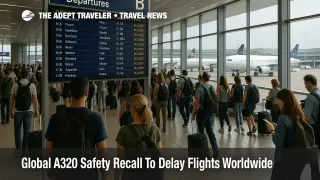
Air travelers around the world now need to budget extra time and expect rolling schedule changes, because Airbus has called for immediate safety measures on a large part of the A320 family fleet and airlines are warning of delays and cancellations as they pull aircraft out of service for fixes. The impact will be most visible at big A320 hubs in Europe, the United States, India, and Latin America from November 28, 2025 onward, where single aisle Airbus jets carry a huge share of passengers. Travelers should tighten their contingency plans, allow longer connections, and be prepared for last minute rebookings, aircraft swaps, or even overnight stops when an affected aircraft is held for work instead of flying its scheduled route.
The A320 safety recall flight delays stem from a newly identified risk that intense solar radiation can corrupt data critical to the functioning of flight controls on some A320 family aircraft, which Airbus and regulators say must be addressed before those jets keep flying normal schedules.
What Airbus And Regulators Changed
In a November 28, 2025 press release, Airbus said analysis of a recent in service event revealed that intense solar radiation may corrupt flight control data on A320 family aircraft and that a significant number of jets in service could be affected. In response, the manufacturer issued an Alert Operators Transmission, or AOT, directing airlines to install available software and hardware protections, and noted that the instructions would be mirrored in an Emergency Airworthiness Directive from the European Union Aviation Safety Agency, EASA.
Aviation trade reporting on the Airbus bulletin says a follow up notice tightens the requirements even further, stating that affected A320 family aircraft must receive the fix before their next scheduled passenger flight, with only narrow exceptions for repositioning flights to a repair base. That bulletin puts the number of aircraft involved at roughly 6,000 jets worldwide, more than half of the global A320 family fleet, which makes this a structural capacity problem rather than a local issue that one or two carriers can absorb quietly.
Regulators have moved in parallel. EASA has been preparing emergency and standard Airworthiness Directives that reference both the Airbus AOT and related flight control and software issues on the A320 family, which obliges European and many non European operators to comply on an accelerated timetable. Other authorities, including the Federal Aviation Administration, FAA, are reviewing or adopting equivalent directives that bring the same requirements into U.S. based operations.
How Many Flights Could Be Affected
The scale of the recall becomes clear when you look at airline fleets. A320 family aircraft are the workhorses of many networks in Europe, North America, Asia, and Latin America, carrying short and medium haul traffic on everything from domestic shuttles to five hour holiday routes. Airbus and trade outlets put the number of aircraft requiring near term software or hardware protection at about 6,000 worldwide, a majority of the single aisle fleet.
Carriers are already feeling the impact. Reporting from TRT World and other outlets describes widespread disruption as airlines in Europe, Asia, and the Americas slow or cancel departures to make room for repairs, with some operators temporarily suspending ticket sales or flattening schedules while work proceeds. In Australia, Jetstar has cancelled dozens of domestic and regional flights while it takes more than a third of its Airbus narrow body fleet out of rotation for the required updates, even as other local carriers report lighter effects because fewer of their aircraft fall under the bulletin.
Major U.S. airlines also expect friction. American Airlines, one of the largest A320 operators, has said that roughly half of its A320 family aircraft need the software fix, and while each update typically takes about two hours, staggered work still means some aircraft will miss rotations or enter service late, adding minor but noticeable delays on busy days. European groups including Air France KLM, and carriers in India and Latin America, have warned of delays and scattered cancellations as they line up maintenance slots and adjust crew pairings around aircraft that suddenly become unavailable.
The timing is particularly sensitive for the United States, where the A320 fleet supports dense holiday traffic layered on top of weather driven disruptions already covered in recent U.S. flight delay outlooks, and for Europe, where winter schedules run leaner, with less spare capacity to soak up a wave of grounded jets.
Background: Why Solar Radiation And Software Matter
Modern A320 family aircraft rely on several layers of flight control computers, including Elevator and Aileron Computer units that interpret pilot inputs and sensor data, then move control surfaces accordingly. In normal operations, redundancy and fault tolerance mean no single computer problem should endanger the aircraft. The new concern is that intense solar radiation, especially during strong solar activity, can corrupt critical data feeding into those systems in a way that defeats existing safeguards.
Airbus and EASA are therefore treating the software vulnerability as a safety of flight issue. By reverting to earlier software builds, adding new protection logic, or in some cases replacing affected hardware modules, operators can restore the intended level of resilience, but those changes must be tested and signed off before the aircraft returns to normal service. From a traveler perspective, that means your flight is more likely to be delayed or rebooked than to operate with an unresolved safety concern, because the directives require airlines to fix the problem before they carry passengers again.
What This Means For Upcoming Trips
In the short term, travelers should expect a pattern of rolling disruption rather than a single global shutdown. Many airlines are sequencing updates overnight or between peaks, prioritizing aircraft that serve the densest routes, and trying to rotate spare aircraft into key banks so that hubs keep moving. Even with that strategy, there will be days when a missing A320 means a last minute aircraft swap to a smaller jet, a downgauged schedule, or a flight cancellation that cascades into missed connections.
If you are booked on an A320 family flight over the next week, the first step is to check your reservation details and your airline s fleet guide to confirm the aircraft type, then monitor the carrier s app or website closely in the 24 to 48 hours before departure. Many operators will push updates about aircraft changes, departure time shifts, or proactive rebooking offers as they take individual jets offline for upgrades.
For travelers with tight connections, the safest move is to build in extra buffer. For domestic or regional trips that connect to long haul flights, consider at least three hours at major hubs, especially in Europe and the United States where A320 fleets are concentrated. Separate tickets, for example a self booked low cost A320 hop connecting to a different carrier s long haul, are particularly vulnerable, because a grounded narrow body may not trigger through protection or hotel support from the onward airline.
On short haul routes with frequent service, it may be worth moving to earlier departures on the same day or to alternative airports served by different aircraft types, such as Boeing 737 or regional jet operations that are not affected by this specific bulletin. In some regions, particularly Europe, rail can substitute for certain city pairs if air disruption becomes severe.
How Airlines Are Likely To Manage The Fix
From an operational standpoint, airlines are incentivized to compress the repair window. The typical software update, validation, and paperwork cycle takes roughly two to three hours per aircraft, which allows some carriers to work through a substantial portion of their fleets over a long weekend if maintenance slots and technicians are available. Hardware replacements, where required, will take longer and may push some jets into short term storage until parts arrive.
You can expect airlines to prioritize aircraft that support their most profitable routes and their largest connecting banks. That means that while some off peak or secondary routes may see heavier cancellations, core trunk routes are more likely to operate with a mix of updated A320 family aircraft and unaffected types. Loyalty members and high yield passengers may see more proactive rebooking help, but the basic pattern will still be longer lines at customer service counters when multiple A320 flights are pulled out of the schedule at once.
Airlines will also try to keep crews and aircraft aligned to avoid secondary disruption. When an A320 comes out of service, it is not just the passengers who need rerouting but also pilots and cabin crew who were scheduled to operate a string of legs. Those changes can ripple into later days, so even after an airline completes most of its updates, timetables may stay fragile until rotations settle back into a steady pattern.
What Travelers Should Watch In The Coming Days
Over the next few days, the key indicators for travelers will be how quickly individual airlines report completion of the majority of their A320 upgrades, how many flights they cancel outright versus delay, and whether they start to relax change fee waivers that might be introduced to encourage voluntary rebooking. In markets where carriers rely heavily on A320 family aircraft, such as parts of Europe and India, disruption may last longer simply because fewer spare aircraft exist to cover gaps.
For now, travelers should assume that safety driven grounding and repair is the right outcome, even when it causes inconvenience. The practical steps are straightforward, although they require attention. Keep your airline contact details current, opt in to push notifications, install the airline app for real time flight status, and check your booking at least daily in the run up to departure. If your itinerary involves a tight self made connection, look for ways to add margin or consolidate on a single carrier. Finally, build some flexibility into hotel bookings and ground transport at hub airports, in case an overnight stop becomes necessary.
Sources
- Airbus update on A320 Family precautionary fleet action
- Airbus A320 repairs must be before next flight
- Flight chaos erupts around the world as Airbus orders urgent repairs on thousands of jets
- Airbus issues major A320 recall after flight control incident
- American Airlines cuts number of jets needing Airbus software fix to 209
- Jetstar cancels 90 domestic flights across Australia after global Airbus A320 recall