

Southern Thailand Floods Disrupt Trains And Border Travel
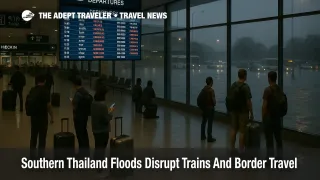
Southern Thailand floods travel disruptions are now the main risk for winter itineraries that combine Bangkok with the deep south, because weeks of severe rain have killed at least 162 people and left parts of the rail, road, and border network only partly restored. Travelers whose plans depend on long distance trains, interprovincial buses, or overland border hops between Thailand and Malaysia are seeing patchy service in several southern provinces even as waters recede. Foreign visitors who were stuck in the worst affected areas now have a temporary visa overstay exemption to fall back on, but they also need to plan routes and buffers carefully if they want to avoid last minute scrambles and arguments at immigration.
In practical terms, this means Southern Thailand floods travel disruptions are shifting the risk from airports and island hubs to the deep south transport spine, where trains, buses, and some land borders remain constrained even while Phuket, Krabi, Surat Thani, and the Gulf islands work close to normal.
Where Flooding Still Affects Travel
Government and media updates put the death toll from the southern floods at more than 160 people, with more than a million households affected across multiple provinces. The worst damage clusters in the deep south, including Songkhla, Narathiwat, Pattani, Yala, Satun, and neighboring provinces where rivers overflowed, roads washed out, and power and telecoms went down. Hat Yai, the main transport and commercial hub in Songkhla, has seen floodwaters pull back in many districts, but some roads and neighborhoods remain under strain and recovery work continues.
The Tourism Authority of Thailand reports that many main roads in Songkhla and Nakhon Si Thammarat are passable again, with key arteries into Hat Yai back in use, but several secondary routes and stretches of Highway 43 still face closures or high water. Satun, Narathiwat, Pattani, and parts of Phatthalung continue to report suspended local public transport, closed national parks, and temporary shutdowns of rural attractions. That mix of improvement and lingering disruption is the core challenge for travelers, who may find that a flight into a regional airport is operating on time while the last fifty kilometers by bus or van are impossible or very slow.
At the same time, the authorities stress that many of Southern Thailand's biggest tourism draws remain open. Phuket, Phang Nga, Krabi, Ranong, Surat Thani, and Chumphon are all described as operating normally, with airports functioning and most tourist activities available, although some marine services on routes such as Chumphon to Ko Tao continue to run with weather related adjustments. That is the split travelers need to understand, the coastal resort belt is mostly fine, but the deep south inland and border districts still have meaningful constraints.
Rail Services On The Southern Line
For many visitors, the State Railway of Thailand is the backbone for reaching the south, especially classic overnight trips from Bangkok to Trang, Kantang, Hat Yai Junction, and beyond. Flooding along the southern line forced weeks of rolling suspensions and reroutes, but SRT now reports that water levels around key sections are dropping and that engineers are shoring up embankments, replacing washed out ballast, and repairing damaged fasteners between Ban Ton Don Station and Hat Yai Junction.
As of November 29, SRT has restored normal service on Express 83 and 84 between Bangkok's Krung Thep Aphiwat station and Trang, and on Rapid 167 and 168 between Bangkok and Kantang, with departures from Bangkok resuming on November 28 and returns from the south on November 29. That is a significant win for travelers aiming at Trang, the Andaman coast, or connecting bus and boat links onward to islands such as Ko Muk and Ko Kradan.
Other trains remain constrained. Rapid 169 and 170, which usually run between Bangkok and Yala, are temporarily truncated to terminate at Phatthalung from the start of December, turning what would normally be a through train into a service that stops short of the worst hit deep south districts. Several services toward Hat Yai Junction and Su ngai Kolok remain suspended outright, including Special Express 31 and 32 between Bangkok and Hat Yai Junction, Special Express 37 and 38 and Rapid 171 and 172 to Su ngai Kolok, and multiple local services that connect Nakhon Si Thammarat, Yala, Phatthalung, and Narathiwat to the border.
In practice, this means rail is again a workable option for Bangkok to Trang or Kantang, but not a reliable through route into the three southernmost provinces. Travelers who already hold tickets on suspended services can claim full refunds at stations nationwide, and SRT is directing passengers to its hotline and real time train status map for day by day updates on which segments are open and which routes still rely on bus bridges via Thung Song or other intermediate hubs.
Buses, Ferries, And Border Checkpoints
Interprovincial buses have followed a similar pattern, partial restoration in some corridors and ongoing suspensions in others. The state owned Transport Company has resumed its long haul routes from Bangkok to Hat Yai and Bangkok to Songkhla, which restores a standard overland link for many backpacker and budget itineraries into the deep south. However, routes from Bangkok to Trang and Satun, Bangkok to Yala, Bangkok to Pattani, and Bangkok to Su ngai Kolok are still suspended, with operators waiting for road conditions to improve before restarting.
Within provinces, conditions vary even more. In Songkhla, interprovincial buses are running again on the Bangkok to Songkhla and Bangkok to Hat Yai legs, but city taxis and minibuses in Hat Yai remain largely suspended, which can turn the last few kilometers from the bus station or airport into a problem for travelers with heavy luggage. In Satun, all public bus services remain suspended and some roads connecting Satun to Songkhla and Trang are still cut, although Pak Bara Pier is operating limited services on the Pak Bara to Ko Lipe route as conditions allow.
Narathiwat, Pattani, and Yala are the hardest hit from a public transport perspective. Narathiwat Airport is open, but provincial railway operations, public buses, ferries, and river crossings are largely suspended, with only a single Narathiwat to Su ngai Kolok bus line still running. Yala has Betong Airport and the Betong border checkpoint open, yet flights on the Hat Yai to Betong route are suspended and public vans, buses, and trains across the province are halted for now. Pattani also reports that bus and rail services remain off line and that tourism activity is on pause while access roads and safety conditions are reviewed.
Border crossings are a mixed picture. The main overland gateways at Sadao, Padang Besar, and Ban Prakob on the Malaysian frontier are open again, which is crucial for travelers using buses, trains, or private transfers between Hat Yai and Malaysia. In contrast, the Tak Bai border checkpoint in Narathiwat is closed until further notice, and the Wang Prachan crossing in Satun is open for people but not for vehicles because the connecting road network remains damaged. Anyone who had planned a loop that used smaller land borders to stitch together Thailand, Malaysia, and the Gulf islands will need to reroute through the main crossings or shift to flights.
On the marine side, ferry operations into Ko Samui, Ko Pha ngan, Ko Tao, and the Andaman islands are mostly functioning, but some high speed lines such as Songserm and selected Lomprayah departures are suspended, and Boonsiri Ferry has paused Chumphon to Ko Tao services until early December. Schedules may change day by day based on wind and wave forecasts, so travelers should not assume that a ticket booked weeks ago still matches the real timetable.
How The Temporary Overstay Exemption Works
Recognizing that many foreign tourists simply could not leave because trains, buses, and roads were cut, the Thai Immigration Bureau has introduced a temporary exemption from overstay fines for travelers stranded by the floods in eight southern provinces, Songkhla, Nakhon Si Thammarat, Phatthalung, Trang, Satun, Pattani, Yala, and Narathiwat. The exemption covers visitors whose permitted stay expires between November 20 and December 31, 2025, and who are genuinely unable to depart on time because transport links were disrupted or routes were impassable.
Officials emphasize that this is not a general amnesty for people who were already overstaying or for travelers trying to stretch a normal holiday into a quasi long stay. Immigration officers at airports, land borders, and local offices have been told to apply the exemption for those directly affected by the floods while keeping normal security screening in place.
For travelers caught up in the disruption, the practical steps look like this. Keep every piece of evidence that shows you could not leave when planned, train and bus cancellation messages, airline schedule changes, photos of closed roads or flooded stations, and screenshots from official channels confirming suspensions. If you are in one of the eight provinces and realize your permitted stay will expire before you can exit, contact the nearest immigration office as early as possible and explain that you intend to depart as soon as a route opens. When you finally exit through an airport or land border, be ready to show that your overstay fell inside the November 20 to December 31 window and that you were physically blocked from leaving.
This exemption waives the normal daily overstay fine for eligible travelers in the affected provinces. It does not change underlying visa categories, permit work on a tourist status, or guarantee that immigration officers will ignore unrelated past violations. Travelers who push the boundaries, for example by leaving the affected region for a beach break elsewhere while still claiming they were stuck, risk losing the benefit and facing fines or future entry problems. The safest approach is to exit the country promptly once a feasible transport option exists.
For deeper context on how Thailand normally treats overstays, and how this exemption fits into tightening enforcement around back to back visa exempt entries and long stays, it is worth pairing this update with a broader guide to Thai visa rules and overstay penalties, such as Adept Traveler's evergreen explainer on Thailand visa rules and overstay fines.
Planning Trips Over The Next Few Weeks
If you are planning a December or early January trip that includes Southern Thailand, the main strategic move is to separate the relatively normal tourist belt from the still stressed deep south corridors. Flying into Phuket International Airport (HKT), Krabi International Airport (KBV), Surat Thani Airport (URT), or Chumphon Airport (CJM) remains straightforward, with normal operations reported and only routine weather related adjustments. Island chains such as Ko Samui, Ko Pha ngan, and Ko Tao continue to receive ferries and night boats, although some high speed lines run reduced timetables.
The most fragile links are still the ones that depend on Hat Yai International Airport (HDY), overland border crossings, and the southernmost rail and bus corridors. Hat Yai Airport is open with some cancellations, and interprovincial buses to Hat Yai and Songkhla are running again, but city transport and some feeder roads remain disrupted, which means travelers should allow extra time to move between the airport, rail station, and hotels. Narathiwat Airport (NAW), Nakhon Si Thammarat Airport (NNT), and Trang Airport (TST) report normal operations, yet their hinterlands still have patchy public transport and some closed attractions.
For multi leg itineraries that combine Bangkok, the Gulf islands, and Andaman destinations with side trips into the deep south or land crossings into Malaysia, a few planning rules help.
First, avoid tight same day chains that rely on multiple vulnerable modes. For example, do not plan to arrive on an overnight train into Thung Song or Phatthalung, change straight to a bus to Hat Yai, then cross the border to Malaysia the same afternoon. Build at least one buffer night near major hubs such as Surat Thani, Trang, or Hat Yai to absorb cancellations or reroutes.
Second, keep your routes flexible. If trains beyond Phatthalung remain suspended and bus routes into Yala or Narathiwat are still offline, consider refocusing time on islands or more stable mainland provinces instead of forcing an overland route that local authorities themselves are discouraging. Travel insurance that covers delays, missed connections, and extra accommodation is especially valuable right now, and insurers will usually expect you to follow official advice from TAT, SRT, and local emergency offices.
Third, make smart use of official contacts. The TAT Contact Centre at 1672, the Tourist Police at 1155, and the SRT hotline at 1690 can all confirm what is actually running on a given day far more reliably than outdated third party booking engines. Travelers who find themselves stranded or facing imminent overstay should also use consular contacts, such as their embassy or the Ministry of Foreign Affairs coordination centre for foreigners affected by the floods, to document their situation.
Background And Structural Lessons
Southern Thailand is used to seasonal flooding, but the scale of this event and its impact on a wide swath of provinces highlight how exposed the transport network is to concentrated rain and runoff. Rail lines through low lying areas, long distance roads that hug rivers or coastlines, and smaller border crossings that depend on narrow local roads all become weak points when multiple days of heavy rain hit.
This episode also underlines a broader trend for travelers planning Southeast Asia itineraries. We have already seen sustained disruption from central Vietnam's recent floods and Storm Koto, where washed out tracks and blocked highways stranded a north south train with tourists on board. Cyclone impacts in the Bay of Bengal and South Pacific are reshaping risk maps for cruises and coastal routes. Southern Thailand's experience adds another data point, long distance overland links are often the first thing to fail and the last to return to normal, while airports and core tourism hubs can look fine on paper even as the countryside struggles.
For travelers and the industry, the forward looking takeaway is clear. Itineraries that lean heavily on a single southern rail or bus corridor, or that depend on a minor border crossing, need more redundancy and more buffer than they did a decade ago. Combined with sharper enforcement of immigration rules and tighter scrutiny of overstays, it is no longer safe to assume that a flexible attitude alone will smooth over structural vulnerabilities.
In regional context, Adept Traveler has already covered how central Vietnam's floods and Storm Koto have disrupted trains and coastal trips, and how cyclone season in the South Pacific has raised cruise risk around Vanuatu and New Caledonia. Readers weighing multi country trips may find it useful to read that Vietnam rail and coastal disruption piece alongside this southern Thailand update, to spot common patterns in where systems break and how official advisories translate into real world delays.
Sources
- Flooding situation in Southern Thailand, travel conditions update, TAT Newsroom
- Travel to Thailand, what you need to know about the floods, Toute la Thaïlande
- Thailand grants temporary overstay exemptions for flood affected visitors in southern provinces, Pattaya Mail
- SRT resumes normal train services as floodwaters recede in the South, Nation Thailand
- Southern railway flooding, SRT announces route changes and suspension of 6 train services, Nation Thailand
- Death toll in Thailand floods rises to 162, government says, Reuters