

Global A320 Software Recall Localizes Flight Delays
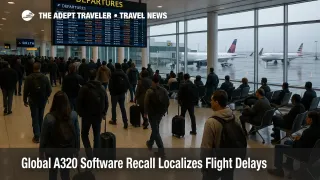
The A320 software recall delays now confronting airlines in India, the United States, and Europe are starting to look more localized than catastrophic, as carriers report that most affected jets have already received patches or temporary workarounds in the weeks since the October 30 incident. Passengers are still seeing short notice aircraft swaps, scattered cancellations, and some missed connections, but so far the worst case scenario of a sustained worldwide meltdown has not materialized. For most travelers, the practical task over the next few weeks is to identify A320 heavy itineraries, add buffer where needed, and use airline tools to stay ahead of the remaining retrofit work.
In plain terms, the A320 software recall delays story has evolved from global alarm to a patch race that is creating uneven, mostly localized disruptions rather than a blanket shutdown of Airbus single aisle flying.
Reports from airlines and regulators in North America, Europe, and Asia indicate that the majority of A320 family aircraft either already have the updated software or are operating under specific procedural mitigations while they await a slot in the maintenance queue. That is the key reason operations now look much more stable than they did when Airbus first warned operators, and when early official estimates suggested that roughly 6,000 A320 family aircraft worldwide might need attention before returning to normal patterns. The remaining risk comes from the portion of each fleet that still needs work, and from the way airlines shuffle aircraft around the network when one tail number suddenly cannot operate.
In earlier coverage, our initial safety notice piece, "Airlines Warn of Delays as Airbus Issues Urgent Safety Notice for A320 Jets," focused on the immediate grounding and software requirement after investigators tied a JetBlue A320 altitude loss to flight control computers exposed to intense solar radiation. A follow up, "A320 Software Recall Adds New Delay Risk For U.S. And Canadian Travelers," drilled into how that order translated into schedule changes for North American carriers, including American, Delta, and United. This article steps back to show how the recall is actually playing out across regions now that many airlines have cleared most of their backlog.
So far, one consistent pattern is that disruption is clustering by carrier and hub rather than hitting every A320 in the world at once. In India, local reporting describes pockets of delays where specific airlines have a high concentration of A320neos still waiting for software updates, which has led to bursts of cancellations and rolled departure times at key airports. In Japan, All Nippon Airways, better known as ANA, has had to cancel and consolidate some A321 services from its Tokyo Haneda Airport (HND) and Narita Airport (NRT) bases while updates are completed, although long haul operations with different aircraft types have generally continued as planned. In the United States, JetBlue, which uses Airbus narrowbodies extensively at John F. Kennedy International Airport (JFK) and Boston Logan International Airport (BOS), has reported clusters of cancellations and equipment swaps during intensive maintenance pushes.
By contrast, many large European and North American operators now say they have already patched most of their A320 fleets or are close to doing so. Low cost carriers such as easyJet and several full service airlines have indicated that only a minority of their aircraft remain in the queue, and that these are being rotated through overnight maintenance windows or off peak periods to minimize knock on effects. Regulators appear to have slightly eased their most pessimistic impact projections as this data has come in, emphasizing that the remaining work is important but manageable rather than an open ended capacity shock.
How It Works
A typical A320 family fleet is spread across dozens or hundreds of daily flights, so when a subset of aircraft require software updates, airlines juggle aircraft tails, maintenance windows, and crew pairings to keep the schedule flying. Instead of grounding every A320 at once, operators usually prioritize aircraft that can be updated overnight or during planned maintenance stops, then temporarily replace others with spare aircraft from related fleets, such as A321neos or older A319s. This is why many travelers are seeing aircraft swaps at check in or at the gate, and why a problem that started as one software vulnerability now shows up as a pattern of seemingly random cancellations and time changes at certain hubs
For travelers, the practical effect is that A320 software recall delays are more likely to appear as scattered trouble spots than as a global wave. One day, a morning departure from Delhi or Mumbai might be canceled at short notice while technicians work through a batch of Indian registered aircraft. Another day, a cluster of JetBlue flights from JFK or BOS could be swapped from A321neos to older A320s, or consolidated into fewer departures, as the airline tries to complete updates without knocking out entire banks of flights. On a different continent, a European carrier might quietly move one or two underperforming aircraft into hangars for longer checks, creating tight days on specific routes even if the overall schedule looks normal on paper.
Network planning teams are also using the recall as an opportunity to rationalize schedules in places where demand had already started to soften after the Thanksgiving and Diwali peaks. Instead of operating thinly loaded off peak flights while trying to fix aircraft, some airlines are folding those passengers into better filled departures and using freed up aircraft time to accelerate patching. This can actually improve reliability on remaining flights, but only if communication is clear and rebooking tools work smoothly for affected passengers.
From a safety perspective, regulators in major markets have been explicit that aircraft may only operate with updated software or with tightly controlled interim mitigations in place. That means the residual delays and cancellations are, in effect, the visible cost of maintaining the safety margin while software is brought up to standard across the fleet. There is no indication in current reporting that passengers on aircraft cleared to fly under the new rules face heightened risk compared with pre recall operations. The real concern for most travelers is logistical, not technical, as last minute changes ripple through already busy hubs.
Over the next several weeks, the main vulnerability will be tight connections built around multiple A320 family segments. Because airlines sometimes use generic "Airbus A320 family" labels in schedules and change equipment types late in the process, travelers with sub two hour domestic connections, and sub three hour international connections, should treat A320 heavy itineraries with caution. This is particularly true where two separate tickets or self connections are involved, since a short delay on one leg could strand passengers without protected rebooking options.
Travelers can reduce misconnect risk by using booking tools that display aircraft type and by favoring itineraries where at least one leg uses a different aircraft family, such as Boeing 737s or widebodies, which are not affected by this specific recall. On existing bookings, airline apps and websites are the fastest way to see if flights are operated by A319, A320, A321, or their "neo" variants, and whether any last minute swaps have appeared. If an itinerary relies on multiple A320 segments in a row, especially through concentrated hubs like JFK, BOS, or Delhi, it is worth calling the airline or using online chat to explore earlier departures or longer connections while the system is still stable.
This is also a useful moment to refresh general coping strategies for irregular operations. Our evergreen guide to handling flight delays and cancellations, which covers voucher rules, rebooking hierarchies, and how to approach agents constructively when lines are long, remains directly applicable to A320 software recall delays. Combining that playbook with a closer eye on aircraft types can help travelers get ahead of problems instead of reacting at the gate.
The A320 software recall is still working its way through global fleets, and some travelers will continue to encounter inconvenience, but the pattern now looks more like a series of localized stress points than a system wide crisis. With most major airlines reporting strong progress on software patches, and regulators maintaining firm safety rules, the recall's footprint on travel should gradually shrink through December, especially for those who build in sensible buffer time and monitor their flights closely in the hours before departure.
Sources
- AP News coverage of JetBlue A320 incident and recall response
- The Times of India reporting on A320 software updates and India delays
- Business Standard analysis of Indian carrier retrofit progress
- Airbus operator communications on A320 flight control software updates
- Statements and directives from aviation regulators on A320 software mitigations