

China Japan Flight Cuts Hit December Trips
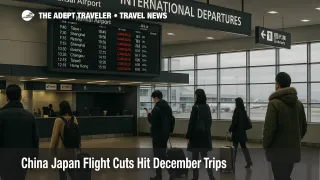
Travelers planning December trips between China and Japan now face a much thinner web of nonstop flights, especially into western Japan, because Beijing has quietly shifted from warnings to hard capacity cuts. After issuing a mid November advisory that urged citizens to avoid travel to Japan, Chinese authorities have asked airlines to slash services and December schedules now show 904 China Japan flights removed, around 16 percent of the 5,548 originally planned. Anyone whose itinerary relies on Mainland carriers into Osaka, Nagoya, Sapporo, or Fukuoka should be prepared for cancellations, reroutes through third country hubs, and tight competition for remaining seats. The safest play for most travelers is to lock in flexible tickets, avoid itineraries that connect in Mainland China, and leave extra buffer on both sides of long haul legs.
In practical terms, the new China Japan flight cuts for December mean a highly politicized travel spat has turned into a structural capacity squeeze on one of Asia's busiest leisure corridors, and travelers need to treat China Japan flight cuts December as a concrete planning constraint, not background noise.
Where December Flight Cuts Are Hitting Hardest
Data from Cirium, cited by Nikkei Asia and regional outlets, shows that Chinese airlines have cancelled 904 flights on 72 China Japan routes for December, roughly 16 percent of the 5,548 departures they originally scheduled between the two countries. That equates to around 156,000 lost seats in a single month, with more reductions possible if demand continues to evaporate.
Kansai International Airport (KIX), the main international gateway for Osaka and much of western Japan, has taken the sharpest hit, losing about 626 China operated flights in December alone. Narita International Airport (NRT) near Tokyo and Chubu Centrair International Airport (NGO) near Nagoya each see roughly 68 flights cut, while New Chitose Airport (CTS) serving Sapporo loses around 61. Fukuoka Airport (FUK) also sees significant cancellations on routes from coastal Chinese cities.
By contrast, Tokyo's Tokyo International Airport (HND), better known as Haneda, is relatively protected, with only a handful of December flights operated by Chinese carriers scrapped out of nearly one thousand initially planned. That split matters for travelers because it means some itineraries can still be salvaged by shifting from Kansai to Haneda or Narita, even as options into western and northern Japan shrink sharply.
How A Travel Warning Turned Into Seat Loss
The current crunch traces back to remarks by new Japanese prime minister Sanae Takaichi in early November, when she suggested that a Chinese attack on Taiwan threatening Japan's survival could trigger a military response. China condemned the comments, then on 14 November its foreign ministry and Ministry of Culture and Tourism advised citizens to avoid traveling to Japan, citing both security concerns and alleged assaults on Chinese nationals.
Within days, Chinese travelers had cancelled roughly half a million tickets for Japan flights, as major airlines offered free refunds and date changes through at least 31 December 2025. Our earlier coverage, including China Japan Travel Warning Triggers Airline Refunds and China Japan Travel Spat Cancels 491k Tickets, focused on that first wave of cancellations and refund policies.
The new development is that Beijing has reportedly instructed Mainland airlines to extend flight reductions to Japan through March 2026, which signals that officials see this as a long running pressure campaign rather than a short term protest. December's 904 cancelled flights are the first visible step in that extended timeline, and they hit exactly when many travelers expect to combine work trips, Christmas shopping, and winter vacations in Japan.
What This Means For Different Types Of Travelers
For Mainland Chinese travelers, the immediate effect is paradoxical. On paper, they enjoy generous flexibility, because at least eight major airlines including Air China, China Eastern Airlines, China Southern Airlines, Hainan Airlines, and Xiamen Airlines have published policies that allow free refunds or date changes on Japan routes for tickets issued before the advisory and scheduled through 31 December. In practice, however, shrinking capacity makes it harder to find new dates that line up with hotel bookings and vacation windows, especially around Christmas and New Year.
For travelers from the United States, Europe, or other parts of Asia, the picture is different. Most can still reach Japan on Japan based carriers like All Nippon Airways and Japan Airlines or via third country hubs on airlines based in South Korea, Taiwan, Hong Kong, the Gulf, or Southeast Asia. The main risk is not that Japan suddenly becomes hard to reach, but that any itinerary relying on a Mainland Chinese airline or hub becomes fragile. That includes tickets sold under foreign brand codeshares, where the marketing carrier is non Chinese but one leg is actually operated by a Mainland partner.
Business and conference travelers who used to favor Kansai International Airport because it sits closer to Osaka, Kyoto, and Kobe now face particularly tough choices. They can either accept the higher cancellation risk attached to China operated flights into Kansai, or shift to more reliable Haneda or Narita services and add rail time on the Shinkansen. Leisure travelers aiming for Hokkaido, Kyushu, or regional cities in Tohoku will see fewer direct options from Chinese coastal cities and may need to route via Tokyo instead of flying straight into New Chitose Airport, Fukuoka Airport, or other local gateways.
Rerouting Strategies Via Third Country Hubs
The most robust strategy for December is to treat China based flights as optional rather than essential. If you have not booked yet and you are not originating in Mainland China, look first at itineraries that fly nonstop to Tokyo or Osaka on Japan based carriers, or connect through hubs such as Seoul Incheon, Taipei Taoyuan, Hong Kong International, Singapore Changi, or Doha on non Chinese airlines.
If you already hold a ticket on a Mainland carrier, check immediately whether your itinerary is covered by that airline's Japan waiver, and decide whether you would rather cancel entirely or reroute. In many cases, it will be wiser to take the refund or an open ticket credit, then rebook on a more stable routing, than to cling to a direct flight that may be cancelled with little notice. That is especially true for multi stop trips that combine Japan with South Korea or Southeast Asia, where alternative routings via Seoul, Busan, Bangkok, or Kuala Lumpur can keep the wider itinerary intact even if the China leg disappears.
When rerouting, pay extra attention to minimum connection times. Some hubs that look interchangeable on a map handle winter congestion and irregular operations very differently. For example, Seoul Incheon and Singapore Changi typically maintain high on time performance even under pressure, while some busy Chinese hubs have thinner buffers and stricter overnight curfews. A conservative rule of thumb is to aim for at least two hours for international to international connections where your bags are checked through, and three hours if you need to change terminals or carriers.
Refunds, Rebookings, And Fine Print
The highly publicized free refund policies are mostly limited to tickets issued before the November advisory and scheduled through the end of December 2025. Travelers who bought later or who change destinations may find themselves outside those windows, especially if they try to pivot from Japan to South Korea, Southeast Asia, or domestic Mainland trips.
If your December China Japan flight is cancelled, you are generally entitled to a refund or rebooking on the same carrier, but not to cash compensation in the way European Union rules handle intra EU disruptions. For flights operated by Japanese or other non Chinese airlines, European and British passengers may still gain EU 261 or UK 261 style rights when departing from an EU or UK airport, but that depends on carrier and origin, not the political nature of the dispute. In all cases, it is safer to assume that hotels, rail passes, and attraction tickets will not be automatically refunded when an airline cancels, and build a trip with cancellable or changeable rates wherever possible.
Travelers who booked through Chinese online travel agencies or state linked tour operators should expect slower processing times and stricter documentation requirements for refunds, particularly on group tours. Many agencies are bundling air and land refunds together, which can delay payout even when the airline has already approved a ticket refund. That makes it important to keep screenshots of any waiver policies, save all confirmation emails, and be ready to escalate disputes through card issuers if necessary.
Economic Hit And How Long This Could Last
Early estimates pulled together by Japanese and international media suggest that nearly half a million China Japan trips were cancelled in the first days after the warning, and that Japan could lose more than 1 billion dollars in tourism revenue if the boycott and flight cuts persist into Lunar New Year. Nomura Research Institute has suggested that a prolonged collapse in Chinese arrivals could shave around a third of a percentage point off Japan's annual gross domestic product, and potentially more if it drags on for a full year.
Those numbers are not just abstract macroeconomics. They translate directly into quieter shopping streets in Tokyo and Osaka, lower occupancy in hotels that leaned heavily on Chinese tour groups, and thinner margins for regional airports and rail operators that banked on inbound demand. That in turn makes Japanese tourism boards and airlines more likely to chase visitors from South Korea, Southeast Asia, Europe, and North America with aggressive promotions, even as they brace for a lean winter from their largest pre pandemic market.
Given that Beijing has reportedly ordered airlines to maintain reduced Japan schedules into March 2026, travelers should not assume that capacity will snap back in January. A more realistic planning horizon is that through at least the first quarter of 2026, China Japan routes will remain volatile, with December's 904 cancellations acting as the first big test for how the system copes.
Planning December And Early 2026 Japan Trips
If you are already locked into December dates and you depend on a Mainland Chinese airline, the priority now is to secure a workable backup plan. That might mean shifting to a Japan based carrier into Haneda or Narita, then using the Shinkansen to reach Kansai or other regions, or rerouting through Seoul, Taipei, or Hong Kong on a non Chinese airline. It may be cheaper to accept an overnight layover than to insist on a same day tight connection that could evaporate if schedules tighten further.
If your trip is still flexible, consider delaying Mainland routed Japan travel until spring and booking December or Lunar New Year holidays via other corridors. South Korea, Thailand, Malaysia, and Vietnam are already poised to catch some of the diverted Chinese outbound demand, and non Chinese travelers can ride those capacity shifts as well. Our broader analysis in China Japan Tensions Hit Travel And Tourism also looks at how this fits into earlier episodes where China used travel as an economic lever.
For those who must keep Japan in their plans, the main levers are flexibility and redundancy. Choose fares and hotels that can be changed, pad itineraries with buffer time, double check who actually operates each flight segment, and avoid routing every critical leg through the same political choke point. You can also track ongoing developments on our Geopolitics topic page, which pulls together similar state driven travel disruptions worldwide.
Sources
- Japan protests China's travel advisory over Taiwan remarks
- 2025 China Japan diplomatic crisis
- Chinese airlines scrap over 900 Japan flights as Taiwan rift widens
- China orders airlines to cut Japan flights through March amid diplomatic tensions
- Japan counts cost of China's travel boycott as tensions flare
- Around 500000 China Japan trips thought cancelled after travel warning
- Chinese travellers cancel hundreds of thousands of trips to Japan amid rising tensions
- Chinese Airlines Axe Flights on 12 Japan Routes Amid Strained Relations
- Chinese Airlines Asked To Cut Japan Flights Through March 2026
- China Japan Tensions Hit Travel And Tourism