

Japan Domestic Flight Disruptions Hit Key Hubs November 30
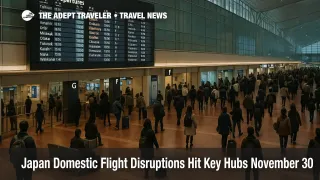
Japan domestic flight disruptions on November 30, 2025 showed how even Japan's usually clockwork short haul network can stumble, as four key airports, Tokyo International Airport (HND), New Chitose Airport (CTS) for Sapporo, Fukuoka Airport (FUK), and Kansai International Airport (KIX), logged a combined 57 cancellations and 262 delayed flights in a single day. The impact fell mainly on domestic flyers using All Nippon Airways, Air Do, Skymark, and several smaller carriers to hop between major cities and regional centers. Travelers booking tight same day connections around Tokyo, Hokkaido, Kyushu, or the Kansai region in the coming days should assume a more fragile baseline, build in extra buffer, or shift to less congested times and airports where they can.
The Japan domestic flight disruptions at these hubs underline how the Airbus A320 software recall and other operational strains are still rippling through the country's network, and why flyers should treat domestic Japan flights less like a guaranteed metro system and more like a system that occasionally needs deliberate margin.
Airport By Airport, How November 30 Broke The Pattern
FlightAware based data compiled by Travel And Tour World show that the heaviest disruption on November 30 was at Tokyo International Airport, better known as Haneda, which logged 35 cancellations and 106 delays, the single largest concentration of irregular operations in Japan that day. New Chitose, the main gateway for Sapporo and the wider Hokkaido region, recorded 13 cancellations and 27 delays, while Fukuoka saw 8 cancellations and 52 delays. Kansai International, serving Osaka and much of the Kyoto corridor, registered only 1 cancellation but a striking 77 delays, meaning many flights eventually operated but with long waits and missed connections for passengers.
For travelers on the ground, that pattern matters more than the headline totals. Haneda's mix of cancellations and delays increased the risk of outright missed trips, especially for passengers connecting to regional flights or the last Shinkansen departure of the day. At New Chitose, the relatively high number of cancellations for a regional hub meant that some travelers headed to Hokkaido's winter resorts likely lost their first night entirely and had to scramble for replacement flights or extra hotel nights in Tokyo. Fukuoka's comparatively low cancellation count but heavy delays translated into long days and late arrivals across Kyushu. Kansai's single cancellation but 77 delays meant a full day of rolling slippage, making same day rail transfers to Kyoto, Kobe, or further west much riskier than usual.
Which Airlines Were Hit Hardest
The same dataset shows All Nippon Airways, ANA, carrying the largest burden, with 27 cancellations and 62 delays across the four airports, including 22 cancellations and 55 delays at Haneda alone. That made ANA the central player in the disruption, and because ANA is one of the main domestic operators at Haneda, its problems quickly cascaded into missed regional connections and full standby lists. Air Do contributed 16 cancellations, split evenly between Haneda and New Chitose, which particularly affected Tokyo Sapporo flows. Skymark added 10 cancellations, spread across Haneda, New Chitose, and Fukuoka, while smaller players such as Oriental Air Bridge and Jetstar Japan also logged a handful of cancellations and delays centered on Fukuoka.
Although Japan Airlines, Peach Aviation, Hong Kong Airlines, and several other carriers appear in the disruption snapshot, the bulk of outright cancellations were on ANA, Air Do, Skymark, and a few niche operators. This mix matters for itinerary planning, because it hints at where fleet exposure and base assignments are concentrated. ANA and Air Do both operate significant Airbus A320 family fleets, and rely on Haneda and New Chitose for dense shuttle style routes, so any constraint on that aircraft type at those hubs is magnified.
How The A320 Recall Fed Japan's Domestic Crunch
The November 30 crunch did not appear out of nowhere. In the preceding days Airbus issued an Alert Operators Transmission and regulators including the European Union Aviation Safety Agency, EASA, ordered urgent software changes on about 6,000 A320 family aircraft worldwide after evidence that intense solar radiation could corrupt data used by elevator aileron computers, which control pitch and roll. Airbus warned that the required software rollback or hardware changes could force airlines to temporarily ground affected jets between flights while the work was completed.
Japan was one of the countries that saw immediate operational fallout. ANA, which operates more than 30 affected aircraft, canceled 65 domestic flights on Saturday, November 29, as it grounded 34 A320 family jets for software fixes, affecting roughly 9,400 passengers at Haneda and several regional airports, according to Japanese and regional news agencies quoting the airline. That wave of cancellations set up a difficult Sunday, as aircraft and crews were out of position and maintenance slots remained tight, which helps explain why the November 30 snapshot still showed 57 cancellations and 262 delays across the same key hubs.
At the same time, Airbus and industry sources now say that the majority of the global A320 fleet has already received the necessary software or hardware modifications, and that fewer than 100 aircraft remain grounded worldwide, which suggests that this particular technical issue is moving into its clean up phase rather than becoming an all winter constraint. However, as long as airlines in Japan and elsewhere are still flexing schedules to accommodate final fixes, travelers should expect occasional heavy disruption days like November 30 to persist.
A Pattern, Not A One Off
November 30 was not the first time this autumn that Japanese domestic hubs have seen metro breaking levels of disruption. Earlier in November, FlightAware based analyses published by Travel And Tour World highlighted days when Haneda and New Chitose alone recorded 30 cancellations with 337 delays, and separate days when Tokyo, Sapporo, and Fukuoka together saw more than 400 delays and 27 cancellations. In those earlier cases, airline mixes and exact causes varied, but the net experience for travelers was similar, with gateway airports behaving more like stressed hub systems than perfectly reliable shuttles.
For travelers, the point is not that Japan is suddenly an unreliable country to fly around. It is that in the current environment of safety driven technical fixes, tight aircraft utilization, and high travel demand, even Japan's best run airports will occasionally throw a day of cumulative delays that can overwhelm tight itineraries. Treating these disruptions as a pattern rather than freak events makes it easier to plan conservatively.
What This Means For Your Itinerary
If you have domestic sectors between Tokyo, Sapporo, Fukuoka, and Osaka in the next few weeks, assume that days following major operational events such as software recalls, strong weather systems, or national holidays carry a higher risk of rolling delays. On those days, opt for first wave departures wherever possible, because early flights are more likely to leave on time before delays accumulate, and even when they slip, you retain more daylight hours to recover later in the day.
For connections between flights, plan at least two hours between domestic sectors at Haneda, New Chitose, Fukuoka, or Kansai, and three hours or more when connecting from an international arrival to a separate domestic ticket. If your domestic leg is on an A320 family aircraft, which you can usually see in the booking engine or on your e ticket, consider treating that connection as slightly higher risk and adding another 30 minutes of margin, especially if you are connecting to the last feasible flight or a no refund tour or cruise departure.
If your onward leg is a Shinkansen or limited express train, avoid booking nonflexible seats on the last reasonable departure of the day after a flight. Instead, give yourself at least a full hour between scheduled flight arrival and train departure at stations such as Tokyo, Shin Osaka, or Hakata, and use passes or ticket types that permit easy changes if your inbound flight slips. A missed train can burn days on a rail pass or force expensive last minute tickets, which is often a bigger financial hit than an extra hour of waiting time.
Hotel planning should follow the same logic. On days with known fleet maintenance or weather stress, avoid stacking late arrival domestic flights with first thing in the morning excursions, tours, or tee times that cannot be shifted without penalty. In hubs like Tokyo and Osaka, consider booking the first night near the airport or main station rather than deep in a neighborhood, which gives you more options to salvage the night even if you arrive several hours late.
Background, How The System Is Supposed To Work
Under normal conditions, Japan's domestic flight system functions almost like an extension of the Shinkansen network. Frequent shuttle flights link Tokyo's Haneda, Osaka's Kansai and Itami airports, Sapporo's New Chitose, Fukuoka, and a web of regional fields, with high on time performance and quick turns. Travelers often book ambitious same day chains, for example an early morning arrival into Haneda, a mid day domestic hop, and an evening train or bus onward, with little thought to buffer, because historically the odds of everything running to time have been high.
The A320 software update episode has temporarily stressed that model by forcing airlines to pull aircraft from service for urgent safety work, then sprint to return them to the line just as peak holiday demand hits. Even as the technical fix nears completion, Japan's domestic disruptions on November 29 and 30 show how a few dozen grounded jets or out of position crews can ripple through a closely timed system. For travelers, building in slightly more conservative buffers will make the network feel reliable again, even while operators finish clearing the backlog of maintenance and schedule adjustments.
For a broader look at how the A320 software issue is affecting other regions, see our coverage of recall driven delays in Australia and New Zealand at the start of December, which maps how one global safety action can play out differently across hubs. And if you are constructing a multi city Japan itinerary that mixes flights and rail, our Japan domestic flights guide explains how to match airlines, rail passes, and regional airports so that a single delayed flight does not derail an entire trip.
Sources
- Japan in Major Travel Crisis as Airports of Tokyo, Sapporo, Fukuoka and Osaka Experiences 57 Flight Cancellations and 262 Delays by All Nippon, Air Do, Skymark and others, New Update
- Airbus update on A320 Family precautionary fleet action
- EASA Orders Immediate Airbus A320 Flight Control Software Changes
- Airbus Software Issue Forces ANA Domestic Flights Cancellations, Seoul Expects No Major Disruptions
- Airbus Confirms A320 Fleet Fix Near Completion After Global Safety Scare
- Hundreds of Travelers Abandoned in Japan as Passengers in Haneda and New Chitose Airport faces 30 Cancellations with 337 Delays
- Travel Disrupted in Japan as Airports of Tokyo, Sapporo and Fukuoka Experiences 27 Flight Cancellations and over 400 Delays by Air Do and other Airlines, New Update