

Global A320 Software Recall Nears Completion December 1 2025
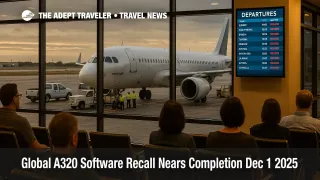
Global A320 software recall work is now close to finished, with Toulouse, France based Airbus saying on December 1 that fewer than 100 of about 6,000 affected jets still need the safety modification after regulators forced emergency software changes worldwide. The recall has touched fleets at American Airlines, Delta Air Lines, JetBlue Airways, United Airlines, Jetstar, Avianca, All Nippon Airways, and other carriers that rely heavily on the A320 family for short and medium haul routes. Travelers can start to expect more normal schedules again this week, but should still allow extra buffer where airlines are cycling remaining aircraft through checks.
In practical terms, the global A320 software recall is shifting from an emergency grounding risk to a cleanup phase, as airlines restore normal timetables while finishing software rollbacks and planning longer term hardware work on a subset of aircraft.
Background: What The A320 Recall Covers
Airbus launched the recall on November 28, 2025 after analysis of a recent A320 family incident showed that intense solar radiation could corrupt data inside the elevator and aileron computer, known as the ELAC, which feeds the jet's fly by wire flight controls. The company told operators that a specific software configuration increased the risk of a so called single event upset, where a cosmic ray or solar particle flips a bit in memory and creates spurious control inputs.
The core of the fix is not a new program, but a rollback to an earlier software version that has proven more resistant to radiation induced errors, combined with checks and in some cases replacement of affected ELAC hardware. Airbus describes the move as a precautionary fleet action intended to keep the aircraft safe to fly while regulators complete their own investigations.
European regulators moved first. The European Union Aviation Safety Agency, EASA, issued an emergency airworthiness directive effective November 29 that ordered operators of roughly 6,000 A319, A320, A321, A320neo, and A321neo aircraft to verify that their ELAC units were on the approved software and hardware list before further flight. The directive, numbered 2025 0268 E, explicitly cited the risk of uncommanded elevator movement and potential exceedance of structural limits if the problem was left uncorrected.
A similar emergency airworthiness directive followed from the Federal Aviation Administration in the United States, giving airlines a tight deadline, just after the Thanksgiving peak, to apply the fix before flying affected jets again. Local regulators in India and other markets layered on their own restrictions, in some cases prohibiting A320 family flights outright until airlines certified compliance.
The JetBlue Incident That Triggered The Recall
The recall traces back to an October 30, 2025 event involving JetBlue Flight 1230, an Airbus A320 operating from Cancun International Airport (CUN) to Newark Liberty International Airport (EWR). Midway through the flight, the aircraft experienced a sudden pitch down and loss of altitude that tossed unbelted passengers and crew, prompting the crew to divert to Tampa International Airport (TPA). About 15 people were reported injured and taken to hospitals after landing, and the aircraft was later tied to the software and radiation interaction now under scrutiny.
Investigators and Airbus engineers have pointed to intense solar radiation as the likely trigger that corrupted data inside the ELAC on that flight. Safety specialists note that radiation induced glitches have been a known concern for avionics for years, but this is one of the first times a specific interaction between cosmic rays, software timing, and a single flight control computer has led to a global grounding order for a particular fleet configuration.
The United States National Transportation Safety Board continues to investigate the JetBlue incident, which will eventually shed more light on how the aircraft's multiple redundant systems interacted and how crews responded in the cockpit. For travelers, the key point is that the recall is intended to prevent the same chain of events from recurring, not to address a chronic mechanical defect in the airframe.
How Airlines And Regulators Responded
Because the A320 family is the most widely used short haul aircraft in the world, with more than 11,000 delivered, even a short safety pause risked major disruption. Airbus and regulators tried to time the initial orders so that many carriers could do the work overnight or during off peak windows, but the scale still forced cancellations in some markets.
In the United States, American Airlines reported that 209 A320 family aircraft in its fleet needed the software fix, and it raced to complete those changes by midday on Sunday, its busiest travel day, in order to keep its schedule intact. Delta Air Lines had fewer than 50 aircraft affected, and United Airlines reported just six jets requiring the update. JetBlue, which relies heavily on A320 and A321 aircraft, saw scattered cancellations and aircraft swaps during the post Thanksgiving rush.
In Australia, Jetstar canceled nearly 100 flights on Saturday as engineers rolled back software on 34 of its 85 A320 family aircraft, a process that typically took 2 to 3 hours per jet, including post fix testing. Services resumed for most routes on Sunday once the updates were in place.
Elsewhere, carriers such as Avianca in Latin America and All Nippon Airways in Japan faced heavier hits because a large share of their narrow body fleets fell under the directive. Avianca even halted new ticket sales for a period, while ANA preemptively canceled dozens of flights. Regulators in India required airlines to keep affected aircraft on the ground until the modifications were complete, leading to further knock on delays and schedule shuffling.
Where The Recall Stands Now
By December 1, Airbus said that the vast majority of the approximately 6,000 potentially affected A320 family jets have been updated and cleared to fly, with fewer than 100 aircraft still waiting for work. Most of the remaining jets are believed to be older airframes or those scheduled into heavier maintenance checks, where operators prefer to stack disruptive work into a single visit.
The company and several news outlets also report that up to about 15 percent of aircraft may ultimately need more invasive hardware changes to their ELAC units, which is likely to be phased in over the coming months during planned maintenance. That work should be largely invisible to passengers, since it can be scheduled into existing heavy check slots, but it may constrain fleet flexibility at the margin if an airline has to rotate particular aircraft out of service for longer periods.
At the same time, Airbus has disclosed a separate quality issue affecting metal fuselage panels on a limited subset of A320 family jets, an item that has more to do with manufacturing and future deliveries than with the current in service fleet. The company says inspections are under way and that panels for aircraft already flying meet safety standards, although the discovery has added to investor pressure on the program.
What This Means For Upcoming Trips
For most travelers, the acute phase of disruption from the global A320 software recall has already passed. Airlines used the last weekend of November and the days immediately following to complete the bulk of software rollbacks, and on many carriers, the aircraft now operate as they did before the problematic update was installed. Schedules in North America, Europe, and Asia are already stabilizing as the final handful of aircraft move through the process.
The remaining impact will feel more like routine operational noise. An airline may occasionally swap an A320 family aircraft on short notice to free up a jet that needs a hardware change, triggering isolated seat map changes or slight timing shifts. On heavily utilized fleets where nearly every frame flies multiple segments per day, that can still cascade into full day disruptions on a few routes, especially at secondary bases with fewer spare aircraft.
Travelers on routes where the A320 family is the backbone of the schedule, for example dense domestic and regional runs within Europe, the United States, Australia, and parts of Latin America, should remain prepared for occasional rolling changes. However, those changes are now much more likely to be operational adjustments rather than emergency groundings tied directly to the safety directive.
Practical Advice For Travelers
From a safety standpoint, regulators consider compliant A320 family aircraft safe to fly, or they would not permit them to carry passengers. The emergency directives forced airlines to bring each affected jet into conformity before operating it again, and ongoing hardware upgrades will occur under the same oversight. Choosing to avoid the A320 family entirely would severely limit options without meaningfully reducing risk, given that the problematic configuration is being removed.
From a planning standpoint, the lesson is that software and space weather are now part of the travel risk mix, alongside storms, strikes, and air traffic control issues. When booking complex itineraries that string together multiple A320 family legs, especially on different tickets, travelers should continue to allow more generous layover times than the minimum connection standard, at least through early 2026 while hardware work is phased in.
It also remains wise to keep airline apps installed and notifications enabled, because the fastest rebooking options after an aircraft swap or last minute cancellation will usually appear there first. Where possible, choosing flights earlier in the day and avoiding tight connections through already congested hubs can further reduce the odds that a residual recall related adjustment will derail the entire trip.
For more detail on how the recall initially intersected with weather delays in one region, readers can review Adept Traveler's earlier piece on A320 recall work and storms affecting flights in Australia and New Zealand. Those wanting a deeper structural explanation can also consult our evergreen guide to how aircraft software updates and airworthiness directives work.
Sources
- Airbus update on A320 Family precautionary fleet action
- EASA Safety Directive 2025 0268 E, Flight Controls, Elevator Aileron Computer Replacement
- EASA Orders Immediate Airbus A320 Flight Control Software Changes
- Airlines Work To Fix Software Glitch On A320 Aircraft As Flights Are Disrupted
- Airbus Issues Major A320 Recall After Flight Control Incident
- Airbus Finds Another Issue Affecting Its Best Selling A320 Passenger Planes
- JetBlue Flight 1230 Makes Emergency Landing After Sudden Altitude Loss
- Travellers Face Disruption After Airbus Warns A320 Jets Need Software Fix