

Mexico Tourist Taxes Shift Between Coasts
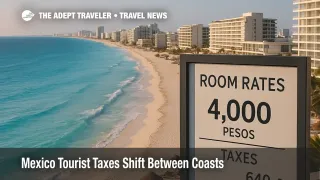
Beach travelers comparing Cancún on the Caribbean side with Puerto Vallarta on the Pacific now face a split screen on money, because Cancun Puerto Vallarta tourist taxes are moving in opposite directions for late 2025 and 2026. In Jalisco, Mexico's Supreme Court has scrapped Puerto Vallarta's new entry fee on foreign tourists as vague and unconstitutional, while the state prepares to lift its lodging tax again from 4 to 5 percent in January 2026. In Quintana Roo, officials are floating a 25 percent hike to the state's Visitax and a plan to force hotels and other providers to collect it directly, which would push a roughly 283 peso tax toward the mid 300 peso range.
In practice, this means Cancun Puerto Vallarta tourist taxes are drifting out of sync, with Puerto Vallarta losing a per visitor fee even as its lodging tax climbs, and Quintana Roo layering a potentially higher Visitax and existing environmental fees on top of already strong room demand.
What Changed In Puerto Vallarta
Early in 2025, Jalisco's congress approved a controversial 141 peso tourist fee aimed at foreign visitors to Puerto Vallarta, pitched as a way to fund street repairs, public space improvements, and sustainable tourism projects in the city. The fee, which was to apply to most foreign tourists over 14 years old, came on top of Mexico's federal Non Resident tax of 717 pesos per person for up to 180 days and existing state lodging taxes.
Mexico's National Human Rights Commission challenged the new Puerto Vallarta fee, arguing that it effectively taxed the transit of people, a power reserved for the federal government. In late 2025, the Supreme Court agreed and struck the fee down as vague and unconstitutional, leaving the state without the expected new revenue but removing a charge that would have hit foreign tourists on arrival by air or sea.
The ruling does not touch Puerto Vallarta's existing lodging tax, which is climbing on a separate track. Jalisco has already approved a gradual increase in its Impuesto sobre Hospedaje, allowing the rate to step up from 3 percent to 5 percent over two years, and local reports confirm that Puerto Vallarta's lodging tax will move from 4 percent to 5 percent in January 2026. That 5 percent will be added on top of the national 16 percent value added tax, known as IVA, which applies to most hotel stays.
For travelers, the net result in Puerto Vallarta is a cleaner, more predictable bill. A foreign couple booking a mid range hotel will still pay the 16 percent IVA and 5 percent lodging tax on their room total in 2026, but they will not see an extra 141 peso per person entry fee on arrival. Short stays that would have been hit relatively hard by a fixed entry fee benefit the most from that change.
How Visitax Works In Quintana Roo Today
On the Caribbean side, the story is different. Quintana Roo already layers several charges on foreign visitors to its resort zones, including Cancún, Playa del Carmen, Tulum, Cozumel, and the Riviera Maya.
The most visible is Visitax, a state level contribution that applies to foreign tourists aged four and older, whether they arrive by air or land. Under current law, Visitax is set at 2.5 units of UMA, a national unit of measure that is updated each year, which corresponds to roughly 283 pesos per person at current values, or about 15 to 18 US dollars depending on the exchange rate and payment provider.
Technically, Visitax is mandatory and payable by all foreign tourists who set foot in Quintana Roo, but until now the state has relied heavily on online portals and airport checks, where travelers show a QR code proving payment during departure formalities. In practice, enforcement has been uneven, with some visitors reporting perfunctory checks and others saying they were never asked to show proof at all.
On top of Visitax, most Quintana Roo hotel stays carry a lodging tax that third party platforms peg at around 6 percent, plus a municipal environmental sanitation fee for each room or guest per night, typically between about 30 and 80 pesos depending on the municipality and hotel category. These environmental charges, used for beach cleaning, water treatment, and sustainability projects, are almost always paid directly at the hotel front desk and are not always included in headline room rates.
Proposed Visitax Increase And Hotel Collection
Quintana Roo's government is now exploring changes that would make Visitax both larger and much harder to ignore. A draft plan reported by local media and highlighted by the Mexican Caribbean Hotel Council would raise Visitax by 25 percent and require hotels, restaurants, tour operators, car rental firms, and transfer companies to collect it directly from foreign visitors instead of leaving most payments to online portals and airport checks.
While details are still under debate, a 25 percent increase on a 2.5 UMA fee would push the tax into the mid 300 peso range per person once new UMA values and exchange rates are factored in. Requiring hotels and other providers to collect Visitax at check in or checkout would also move enforcement from a sometimes casual airport desk to the heart of the booking process, making it far more likely that visitors see and pay the charge every stay.
Local hoteliers have warned that such a move would be administratively complex and could dull the region's price competitiveness, especially for shorter trips and family groups that already face higher all in costs from lodging tax and environmental fees. However, state officials see Visitax as a key revenue stream for tourism infrastructure and promotion, mirroring the sustainability arguments used for Puerto Vallarta's now cancelled entry fee.
How Mexico's Layered Taxes Add Up
Across Mexico, hotel stays are subject to the 16 percent federal IVA, which functions as a national sales tax, plus state level lodging taxes that typically run between 2 and 7 percent, and in some cases additional municipal environmental or university levies. In coastal tourism states like Quintana Roo, Baja California Sur, and Jalisco, that stack can easily put 20 percent or more on top of the base room rate, even before special charges such as Visitax or local entry fees.
Foreign visitors also fund the federal Non Resident tax, currently 717 pesos for most short stay foreign tourists, which is usually embedded in airline tickets rather than charged at the hotel. For cruise passengers, a separate federal passenger fee of around 42 US dollars per person now applies at Mexican ports, effective July 1 2025. These national charges sit in the background while state and municipal taxes define how big the bill feels at checkout.
A Sample Week, Puerto Vallarta Versus Cancún
To make the coastal split more concrete, consider a simple example, a couple booking seven nights in a 4,000 peso per night mid range hotel. This is not a quote, just a rough illustration of how the current rules translate into pesos for a 28,000 peso base stay.
In Puerto Vallarta from January 2026, that couple would pay 16 percent IVA plus a 5 percent Jalisco lodging tax on the room total. That means about 5,880 pesos in combined tax, for a total around 33,880 pesos, with no separate municipal entry fee on top.
In Cancún under today's rules, the same 28,000 peso base would attract 16 percent IVA, a 6 percent Quintana Roo lodging tax, a municipal environmental fee that can easily run around 70 pesos per room per night, and Visitax at about 283 pesos per person for two people. Put together, that can push the total toward 35,000 pesos, roughly 1,300 pesos more than Puerto Vallarta for the same base rate, even before any Visitax increase.
If Visitax rises by 25 percent and is fully collected on site, that gap widens a little further, to roughly 1,500 pesos for a couple in this simple scenario, and more for families with older children who each owe Visitax. In percentage terms the difference is modest, but for price sensitive travelers or those stacking several trips per year, it becomes meaningful.
Short stay travelers, especially long weekend visitors, feel these differences most intensely. In Puerto Vallarta, the loss of a fixed per visitor entry fee makes two or three night stays more tax efficient, since the state relies on percentage based lodging tax instead. In Quintana Roo, each person pays Visitax once per trip, so a couple on a three night stay pays the same Visitax as a couple on a seven night stay, making short trips relatively more expensive on a per night basis.
Planning Strategies To Avoid Surprises
Regardless of which coast you choose, the most important step is to force taxes into the open when comparing prices. Mexican consumer law generally requires final prices to include all taxes, but in practice hotel sites, online travel agencies, and tour operators vary in how clearly they break out IVA, lodging tax, Visitax, and environmental fees.
When pricing Cancún, Playa del Carmen, Tulum, or Cozumel, travelers should:
- Check whether Visitax is included in package quotes or will be collected separately, and if separately, whether the hotel plans to collect on behalf of the state if the new rules pass.
- Ask hotels to confirm the nightly environmental fee in pesos, per room or per person, and how it is payable, cash at checkout or by card on the final folio.
- Keep digital receipts for Visitax payments so they can be shown at the airport on departure, especially if you change hotels mid trip.
When pricing Puerto Vallarta, travelers should:
- Confirm that quotes include both IVA and the new 5 percent lodging tax for 2026 stays.
- Check whether any local environmental or city fees are charged per room or per person, and how they are applied to package deals.
For travelers who care most about predictable bills, Puerto Vallarta's tax structure is now simpler and more heavily percentage based, while Quintana Roo's system leans on a mix of percentage and fixed per person charges and is still evolving. For those who prioritize nonstop flights, new resorts, and a wide excursion menu on the Caribbean side, it may still be worth paying more in taxes, but only if those costs are built into the budget up front.
As Mexico's coastal states fine tune their tax regimes, Adept Traveler will continue tracking how these charges evolve and how they show up on real world itineraries. For broader context on the federal and local taxes that shape Mexican hotel bills, see our evergreen explainer on how Mexico tourist taxes work. Travelers focused on Cancún resort stays can also pair this tax overview with product coverage such as our story on a new adults only resort opening in Cancún to balance budget questions with amenity choices.
Sources
- Puerto Vallarta tourist tax struck down by Supreme Court
- Tourists hit as Puerto Vallarta lodging tax rises for third straight year
- Jalisco approves new fee for foreign tourists in Puerto Vallarta
- Puerto Vallarta introduces tourist tax to fund sustainable tourism projects
- VAT rates in Mexico
- Tourist tax in Mexico
- Mexican VAT and lodging taxes
- Tax collection and remittance by Airbnb in Mexico
- Tourist tax and guest registration in Mexico, 2025 guide
- VISITAX official payment site
- Why the value of the Quintana Roo tourist tax is not clear
- Everything you need to know about the Environmental Sanitation Right in Cancún
- Municipal environmental fees for Cancún, Puerto Morelos and Riviera Maya in 2025
- Environmental fee, the hidden cost of paradise that few tourists understand
- Cancún tourism tax information