

Seoul Subway Strike Threatens December 12 Travel
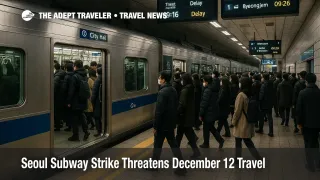
Seoul subway strike December 12 fears are already reshaping how visitors move around the city, because a work to rule slowdown on Seoul Metro lines 1 to 8 began on December 1 2025 after wage and staffing talks collapsed. Tourists and business travelers who rely on the subway to reach Seoul Station, Gimpo International Airport, and major hotel districts like Myeongdong, Hongdae, and Gangnam now face a higher baseline risk of crowded platforms and minor delays, especially in rush hour. Anyone arriving in Seoul this month should start building extra buffer time into airport, KTX, and tour transfers and have at least one backup route that does not depend on a single subway line.
At its core, this is a wage and staffing dispute between Seoul Metro and three labor unions that has already triggered a work to rule slowdown from December 1 and comes with a clear warning that a Seoul subway strike on December 12 will follow if the city and company do not improve their offer, creating a risky window for December travel.
What Is Happening On The Seoul Subway In Early December
Seoul Metro, the operator of subway lines 1 through 8, has confirmed that two of its three unions, together representing roughly three quarters of staff, started a work to rule protest with the first trains on December 1. Instead of volunteering overtime or taking shortcuts to keep trains on time, drivers and station staff are now strictly following safety rules, taking longer dwell times at busy platforms, and refusing tasks that fall outside formal regulations.
For commuters, that typically means slightly slower journeys rather than full cancellations. Korean media and Seoul Metro officials say that on the first morning there were no major disruptions, but some trains on lines 1 to 8 already saw longer stops and small delays, and experience from a similar action in 2024 suggests that more than a hundred trains can end up more than 20 minutes late on a bad day.
All three unions have secured the legal right to strike after mediation failed, and they have already voted strongly in favor of industrial action. The largest union announced that a full scale strike will begin on December 12 if the Seoul Metropolitan Government does not halt restructuring, commit to more hiring, and move closer to wage demands. A third union for younger workers and a second mainstream union are also preparing their own strike schedules around that date, which makes it plausible that much of the network could shut down at once.
The gap is wide. Unions want wage increases aligned with or above the governments 3 percent public sector guideline and argue that job cuts and hiring freezes have already stretched staff and undermined safety, while Seoul Metro says its finances only allow a 1.8 percent raise and insists that restructuring is needed to reduce chronic deficits. The unions claim that city plans would remove around 2,200 positions, leaving fewer workers to run and maintain trains as veterans retire.
Which Lines And Hubs Matter Most For Visitors
Seoul Metro lines 1 through 8 form the backbone of city transport, interlinking with Korail main line services, Airport Railroad Express, and bus terminals. Line 1 and Line 4 feed directly into Seoul Station, the main hub for KTX high speed trains and the Airport Railroad Express service to Incheon International Airport.
Line 2, the busy green circle line, connects many of the neighborhoods most visitors focus on, including Hongik University, City Hall, Euljiro, Gangnam, Jamsil, and Dongdaemun History and Culture Park, and is repeatedly cited as one of the most useful lines for tourists. Other Seoul Metro lines link to business districts on Yeouido, bus interchanges, and suburban branches that carry commuters in from Gyeonggi Province.
Gimpo International Airport has its own integrated station served by Seoul Metro Line 5, Line 9, and the Airport Railroad All Stop service, which makes it sensitive to any cutbacks in metro frequency or staffing. Even though the Airport Railroad itself is run by a separate operator, most rail trips from central Seoul to both Incheon and Gimpo begin on Seoul Metro lines 1, 2, 4, 5, or 9 before passengers transfer to the airport trains.
For December visitors, that means slowdowns or a strike will not just affect sightseeing trips under the city center. They will ripple out into airport transfers, day trips by KTX, and evening returns to hotels near Line 2 or along the Han River.
How A December 12 Strike Could Play Out
If the unions follow through, a full strike from December 12 would likely shut or severely reduce service across lines 1 to 8, leaving only limited replacement buses and shifting vast numbers of commuters onto Seoul's already busy roads. Past transport strikes in Korea and current commentary around the subway dispute warn that this usually produces heavy road congestion around central business districts, major bridges, and approaches to Seoul Station.
Airport access would become more fragile. Many travelers currently ride Metro lines 1 or 4 to Seoul Station and then transfer to the Airport Railroad Express for Incheon, or use lines 5 and 9 to reach Gimpo Airport Station. If those metro lines are shut, the burden shifts to airport limousine buses, regular city buses, and taxis, which would all sit in the same congested traffic as everyone else. Travelers on tight schedules could easily miss flights or KTX trains even if airports and long distance rail services remain fully operational.
Train to train connections are also at risk. KTX schedules at Seoul Station are built around normal subway access. During a strike, KTX trains may still run, but visitors coming in from hotel zones like Myeongdong, Gangnam, or Jamsil will need far more time to reach the station by bus or taxi, and should be ready to switch to later departures if delays stack up.
How Serious Is The Slowdown Phase
For now, the work to rule phase is a warning shot rather than a full travel meltdown. On the first day, both Korean and English language reports describe only minor delays and normal rush hour crowding at many downtown stations, and Seoul Metro has said it is deploying extra staff to keep services stable.
However, past experience and independent risk assessments suggest that peak hour delays can scale quickly if the action drags on, especially when passenger volumes spike or small incidents choke transfer stations. A private advisory notes that previous work to rule campaigns in Seoul have produced noticeable delays at major interchanges such as Seoul Station, City Hall, Gangnam, Jamsil, and Yeouido, and that congestion is usually worst in the first few days while both management and unions test their tactics.
From a traveler's point of view, that means you should not cancel a Seoul trip purely because of the slowdown, but you should assume that subway rides may take longer, platforms may feel more crowded, and any incident such as a stalled train could snowball faster than usual.
Practical Strategies For December Visitors
The safest response is to reduce your dependence on any single metro line, especially on and around December 12. If your plans are flexible, avoid planning first or last day activities that rely on the subway on that date. Build in at least 60 to 90 extra minutes to reach Seoul Station or Gimpo Airport, and two hours or more to reach Incheon Airport, particularly if you are traveling in the morning or evening peaks.
Hotel location can help. Staying near Seoul Station or along Line 2 at hubs like City Hall, Hongik University, Gangnam, or Jamsil gives you more options, including walking to some attractions and switching between multiple lines or bus corridors without long transfers. If you are already booked into a different area, identify the nearest major transfer station and practice the route during a quieter time of day so you know where to go if conditions deteriorate.
It is also smart to learn non subway options in advance. Seoul's airport limousine buses serve many major hotel clusters and operate independently from the metro. City buses can fill some gaps during a strike, although route maps are denser and stops can be harder for short term visitors to interpret. Taxis and ride hail will be in high demand on strike days, so budget for longer journeys and potential surcharges, and do not count on being able to grab a cab at the last minute for a tight flight.
For visitors with mobility needs, a strike or slowdown can be particularly challenging, because many stations involve long walks, stairs, or crowded lifts. In that case, consider booking accommodation close to Seoul Station or a Line 2 stop with good elevator access, and prearrange accessible taxis or private transfers for airport runs and key intercity connections.
Travelers who want a deeper structural view of how transport strikes affect the city can pair this alert with an evergreen guide to navigating public transport stoppages in Seoul, for example Adept Travelers own explainer on Seoul public transport strikes, plus related coverage of recent Incheon Airport labor disputes that shows how quickly airport access can tighten when staff walk out.
What To Watch In The Coming Days
Negotiations could still move. Previous threatened subway strikes in Seoul have been called off at the last moment, sometimes after overnight talks. For December 2025, the pattern will likely be similar, with deadlines focused around December 12 and public messaging that may shift quickly. Visitors should therefore check Seoul Metro announcements, city travel advisories, and local news again two or three days before any critical trip, then adjust buffers and backup plans based on whether the strike goes ahead, is narrowed, or is suspended.
If a deal is reached and the strike is called off, the work to rule action may still resume or continue in modified form until full agreements are signed, so it is worth keeping conservative assumptions about journey times for the rest of December even if headlines turn more positive.
Sources
- Delays expected for Seouls subway services as workers stage work to rule protest
- Seoul Metro unions begin work to rule protest over wage hike
- Seoul Subway unions begin work to rule action today, no disruptions during morning commute
- Unionized Seoul subway workers to launch full scale strike on December 12
- Seoul Metro unions begin work to rule action from 01 December
- Commuter chaos awaits as Seoul subway unions vote to strike in December
- Seoul TOPIS subway information
- Getting to Seoul from Incheon Airport
- Airport Railroad Express and KTX connections
- Gimpo International Airport station overview