

Tanzania December Protests Risk Travel Disruption
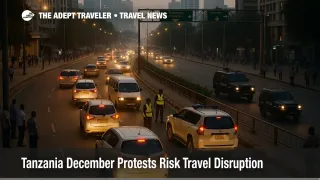
Travelers heading to Tanzania for early December safaris, Zanzibar beach stays, or connections through Dar es Salaam now need to treat a new Tanzania December protests travel advisory as a core planning constraint, because multiple governments are warning that nationwide anti government demonstrations could peak around December 9, 2025, with unrest possible from December 5 onward. Visitors with tight internal flights between Kilimanjaro and Zanzibar, overland transfers through major cities, or single night stopovers near key hubs are most exposed to sudden curfews, roadblocks, and communication shutdowns. Most travelers will not need to cancel trips outright yet, but they should add buffer time, avoid same day cross country connections, and be ready to reroute if local security deteriorates.
The Tanzania December protests travel advisory signals that planned anti government demonstrations and possible security crackdowns could disrupt safaris, Zanzibar trips, and flights through Dar es Salaam and Kilimanjaro in the December 5 to 9 window, especially for itineraries that rely on precise timing.
What The New Security Alerts Actually Say
On November 28, 2025, the U.S. Embassy in Dar es Salaam issued a security alert stating that there are ongoing calls for nationwide anti government demonstrations on December 9, but that protest activity could begin as early as December 5. The alert warns that demonstrations may turn violent, urges U.S. citizens to avoid areas of protest, and explicitly advises people to stock several days of food, water, and medicine, maintain a low profile, and review their personal evacuation and communication plans.
A separate U.S. State Department travel advisory now rates Tanzania at Level 3, "Reconsider travel," citing unrest, crime, terrorism, and targeting of gay and lesbian individuals, and notes that demonstrations often occur on holidays and large events and can turn violent with little warning. The United Kingdom and Australia have also updated their advice, warning that calls for protests on December 9, Independence Day, have been widely shared on social media, and that further demonstrations and firm responses by security forces are possible, including curfews and movement restrictions announced at short notice.
Regional and African media summarizing the alerts highlight scenarios that go beyond routine marches, including possible roadblocks, suspension of public transport, internet slowdowns, and even flight cancellations if unrest spreads to key urban centers or approaches airports.
Where Protests And Disruption Are Most Likely
Official notices do not publish detailed protest maps, but most emphasize that demonstrations are likely in "major urban areas" and politically symbolic locations. In practical terms, travelers should assume the highest risk in:
Dar es Salaam, the commercial capital, especially central districts, government buildings, and busy corridors linking the downtown and port with Julius Nyerere International Airport (DAR). Security checkpoints and ad hoc roadblocks on main arteries can cripple traffic to and from the airport even if flights continue to operate.
Dodoma, the political capital, where opposition calls for a "mega protest" on December 9 focus on institutions that symbolize central authority. Demonstrations there can disrupt intercity bus routes and internal flight connections that feed safari gateways.
Arusha and Moshi, which are core hubs for the northern safari circuit, where protests or aggressive policing in city centers could interfere with transfers between hotels, Kilimanjaro International Airport (JRO), and park gates.
Zanzibar City and Stone Town, which combine tourism, government, and port facilities in a compact area, meaning that even localized marches or roadblocks can ripple into ferry timetables, airport access to Abeid Amani Karume International Airport (ZNZ), or evening movements around historic districts.
Secondary cities such as Mwanza and Tanga may see smaller but still disruptive events, particularly near universities and busy transport hubs.
In all of these locations, the main operational risk for travelers is not being targeted personally, but being caught behind a checkpoint, trapped by a sudden curfew, or unable to reach an airport, ferry, or park gate in time.
How This Affects Safaris, Zanzibar Stays, And Flights
Most national parks and safari camps are in remote areas that may remain physically quiet even when cities are tense. However, almost every Tanzania itinerary still flows through a city or transport hub on the way to the bush or the beach.
For many northern circuit trips, that means at least one night in Arusha or Moshi and flights through Kilimanjaro International Airport. If protests or roadblocks lock down those cities, travelers could find themselves unable to reach or depart JRO, even if the runway and terminal stay open. In the south and along the coast, beach and business trips often depend on smooth flows through Dar es Salaam and its port area, so disruptions there can cascade into missed safari connections in Selous, Ruaha, or Mafia Island.
Domestic airlines and safari carriers can usually adapt to pockets of unrest, for example by altering departure times, consolidating services, or using alternative airstrips. The problem for visitors is that these changes may be communicated late, and that reaching or leaving a given strip may depend on local roads that are subject to checkpoints or vehicle searches. Travelers who have built complex chains of flights, ferries, and long road transfers within one or two days are therefore at far higher risk of a partial or complete itinerary failure.
Internationally, the main risk is knock on disruption if staff cannot reach airports, if fuel delivery schedules are disrupted, or if security forces decide to restrict movements near aviation facilities during peak protest hours. Government travel advisories already mention the possibility of flight cancellations or limited schedules during major demonstrations.
Background, Election Unrest, And Canceled Independence Day
These alerts are landing in a country that is still absorbing severe trauma from the October 29, 2025, general election. Observers from the African Union reported that the polls did not comply with democratic standards, pointing to ballot stuffing, multiple voting, and the exclusion of opposition parties. The main opposition group and human rights organizations allege that security forces killed hundreds or even more than 1,000 protesters during the post election crackdown, although the government disputes the numbers.
In that context, the Tanzanian government has canceled this year's official Independence Day celebrations on December 9 and said that funds will be redirected to repair infrastructure damaged in the unrest. Opposition activists and youth movements have instead called for a nationwide "mega protest" on the same date, demanding the president's resignation and new elections. The combination of grief, anger, and hardened security posture explains why embassies are now warning that even peaceful gatherings could see aggressive responses.
Practical Planning For December Itineraries
For travelers who still plan to visit Tanzania in early December, the core strategy is to reduce dependency on any single day or route.
Build large buffers into internal legs. If you are booking your own flights, avoid same day combinations like arriving at Julius Nyerere in the morning, then expecting to catch a domestic flight to JRO and drive into a park by sunset. Aim to arrive in country at least one full day before any must make safari departure or cruise embarkation, and consider overnighting at airport area hotels rather than downtown when tensions are highest.
Keep routing options open. Where possible, choose international tickets that can be rerouted via Nairobi, Addis Ababa, Kigali, or Johannesburg if flights into Tanzania are disrupted. Tour operators who work across East Africa can often help pivot a safari from one country to another if conditions deteriorate, but only if your flight and insurance terms allow changes.
Avoid problem locations and times. Do not enter areas where protests are announced or underway, do not take photos of security forces, checkpoints, or demonstrators, and do not plan nonessential night movements in cities during the December 5 to 9 window. Many advisories stress that foreigners who happen to be nearby may still be caught in crowd control operations that use live ammunition, tear gas, or mass arrests.
Prepare for communications and cash disruptions. Assume that mobile data, social media platforms, or messaging apps could be throttled or switched off temporarily, as they have been during unrest in other countries, and that card payments may fail if networks are unstable. Travelers should keep essential phone numbers written down, arrange daily check in routines with family or operators, and carry enough local cash for several days of food, water, fuel, and basic lodging.
LGBTQ+ travelers and anyone who is visibly aligned with opposition movements or foreign media should be particularly cautious. The U.S. advisory explicitly cites targeting of gay and lesbian individuals, and wider reporting documents treason charges and harassment of activists, opposition politicians, and journalists. This increases the value of low profile behavior, conservative dress in rural and peri urban areas, and a strict policy of avoiding political discussion with strangers.
When To Reroute Or Postpone
Travelers who are uncomfortable with the possibility of curfews, roadblocks, and forceful crowd control should speak frankly with tour operators and airlines now rather than waiting to see how December 9 unfolds. Given the Level 3 and similar advisories, many insurers may already treat Tanzania as higher risk for cancel for any reason coverage, so it is important to read terms carefully before making new payments.
If you are traveling purely for leisure and have flexible dates, one conservative option is to move Tanzania trips into mid or late 2026, then repurpose December 2025 plans to a neighboring country with more stable conditions but similar safari or beach offers. For those who must travel, for example to visit family or for critical work, routing via hubs like Nairobi or Addis Ababa and minimizing nights in central Dar es Salaam, Dodoma, and Arusha during the protest window may help reduce exposure.
Finally, anyone who decides to proceed should treat embassy and foreign ministry channels as primary information sources, monitor local media closely, and revisit daily whether conditions remain acceptable. Adept Traveler's broader guide to planning around protests and political unrest can help you structure those decisions across multiple destinations, not only Tanzania. See Guide to Travel During Protests and Political Unrest for a deeper framework.
Sources
- Security Alert, U.S. Embassy Dar es Salaam, November 28, 2025
- Tanzania Travel Advisory, U.S. Department of State
- Tanzania travel advice, UK Foreign, Commonwealth & Development Office
- Tanzania Travel Advice and Safety, Australian Smartraveller
- US Embassy Issues Travel Warning Ahead of December 9 Protests in Tanzania
- US warns of potential nationwide anti govt protests in Tanzania
- Tanzania redirects Independence Day funds for post election repairs
- Tanzania cancels Independence Day celebrations after election unrest
- Tanzania vote violated democratic values, AU observers say
- Tanzania police arrest opposition party official after deadly election protests
- Tanzania Catholic Church condemns killings of protesters following disputed election
- Protest and Crackdown in Tanzania