

Patagonia Blizzard Hits Torres del Paine O Circuit
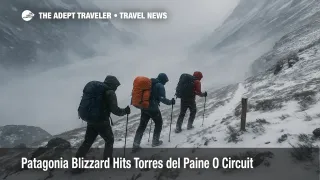
A sudden Torres del Paine blizzard on November 17, 2025, turned the park's famous O Circuit into a disaster zone for roughly 30 trekkers near the Los Perros camp in Chilean Patagonia. Five foreign visitors were killed in the storm and four more who were initially reported missing were later found alive. Survivors describe hurricane force winds, whiteout conditions, and locked emergency huts on the exposed approach to John Garner Pass, with little ranger presence on the trail. For future visitors, this moves Torres del Paine's shoulder season from "adventurous" to "conditional," especially on multi day routes that commit hikers to high passes.
The Torres del Paine blizzard effectively showed that O Circuit treks in November behave more like serious mountaineering routes than casual backpacking trips, and plans now need to reflect that reality.
What Happened On The O Circuit
According to Chilean authorities, the group caught in the storm included tourists from Germany, Mexico, and the United Kingdom, all trekking the O Circuit section between Los Perros camp and the John Garner Pass, one of the route's most remote and exposed stretches. Reports indicate that five trekkers died of hypothermia in the blizzard while four others from the same cluster were rescued alive once conditions allowed search teams to reach the area.
Los Perros is the last camp before the long climb to John Garner Pass, a roughly 1,241 meter high col that sits close to the Southern Patagonian Ice Field and is known for brutal winds even in normal conditions. It is several hours from the nearest vehicle access and multiple days from the main park entrance, which means that any incident there quickly becomes a high consequence rescue.
How The November 17 Storm Escalated
Detailed survivor accounts published in international media and mountaineering forums describe a group of about 30 trekkers leaving Los Perros between roughly 500 a.m. and 700 a.m. on November 17 in light rain and moderate wind, conditions that are not unusual for Patagonia. As they climbed higher toward John Garner Pass, winds reportedly intensified to well over 100 miles per hour, temperatures dropped below freezing with severe wind chill, and snow began to fall horizontally, rapidly erasing the trail.
Multiple survivors say campsite staff had indicated that the pass was safe to attempt that day. As conditions deteriorated, groups struggled to advance or retreat on ice covered slopes while being blown off balance. Some parties decided to turn back toward Los Perros, while others pressed on and became trapped near locked emergency huts or unstaffed ranger posts.
Compounding the weather, survivor narratives and local reporting note that ranger coverage was thin, partly because November 16 was Chile's presidential election day and staff were required at polling stations. That left hikers effectively self rescuing for many hours, improvising shelters, treating hypothermia, and attempting CPR in storm conditions before formal rescue teams could arrive.
Closures, Investigations, And New Scrutiny
In the immediate aftermath, authorities temporarily closed the section of the O Circuit between the Dickson and Paso camps to support search and recovery operations and to keep additional trekkers out of the high risk zone. Chile's National Forestry Corporation, CONAF, which manages national parks, opened an internal probe, while regional prosecutors launched a criminal investigation into potential negligence or failure to assist persons in danger.
Local reports suggest that new O Circuit reservations were briefly suspended while officials took statements and reviewed protocols, although short front side routes such as the popular W trek reopened first. Survivors have publicly called for clearer severe weather procedures, mandatory ranger presence on major pass days, and better systems for tracking who is on the trail, where, and on which schedule.
Separately, the United States Embassy issued a Weather Alert for the Magallanes Region, including Torres del Paine, on November 19, warning of potential extreme winds, snowfall, and rapid weather changes, and urging travelers to check forecasts, follow local authority guidance, and prepare for disruptions. That alert reinforces that the November 17 event is not a one off anomaly but part of a pattern of volatile spring conditions in southern Chile.
When The O Circuit Is Realistically Appropriate
The O Circuit is a roughly 80 mile loop that encircles the Paine Massif and combines long distances, heavy packs, and several days far from road access or quick evacuation. Even in stable summer weather, it is a serious undertaking, not a first backpacking trip.
In shoulder season windows such as late October and November or March and early April, the risks rise sharply. Cold fronts can drag polar air over the Southern Patagonian Ice Field, creating storms that look manageable from low elevation camps but collapse into blizzard conditions at passes like John Garner within hours.
Given what emerged from this tragedy, the O Circuit in November or March is realistically appropriate only for:
- Trekkers with prior multi day winter or high mountain experience, including comfort navigating in poor visibility.
- Groups carrying full four season equipment, including rigid tent structures, mountaineering grade shells, and redundant insulation.
- Parties with independent navigation and communication tools, like GPS tracks, paper maps, and at least one satellite communicator per group.
Travelers whose experience is limited to guided day hikes, low elevation summer treks, or hut to hut routes with frequent road access should strongly favor either the W trek at the height of summer or entirely different destinations when their trips fall into spring or autumn.
Questions To Press On Before You Book
The storm also exposed gaps in how risk was communicated and how operators and concessionaires handled a marginal weather day. Before committing to an O Circuit booking, future hikers should press for specific answers from both park authorities and any tour operator or outfitter. Useful questions include:
- How do you decide when John Garner Pass is closed, and who makes that call on the day.
- When forecasts show gale or storm force winds, will guided groups ever be allowed to start toward the pass, or is there a hard threshold for postponement.
- Are emergency huts and refuges on the route kept unlocked during bad weather, and who is responsible for checking them.
- How do you track which trekkers are on the O Circuit each day, by name and by expected section.
If an operator cannot explain their go or no go criteria in simple terms, or if they minimize the storm as a freak event rather than treating it as a planning lesson, that should be a red flag.
Building A Safer Torres del Paine Itinerary
Most international visitors will route through Arturo Merino Benitez International Airport (SCL) in Santiago, then connect to Presidente Carlos Ibañez del Campo International Airport (PUQ) in Punta Arenas or Teniente Julio Gallardo Airport (PNT) in Puerto Natales before transferring by road to the park. Given how hard it can be to rebook long haul flights at short notice, it is critical to build extra slack into the schedule.
Travelers should:
- Plan at least one, and preferably two, buffer nights in Puerto Natales or Punta Arenas after finishing the O Circuit before any long haul flight out of Santiago.
- Avoid separate tickets on tight schedules, for example a domestic segment booked independently from a transcontinental return.
- Consider structuring the trip so that high consequence hikes like the O Circuit sit in the middle of a longer Chile itinerary rather than at the very end, which makes delaying the start by a day or two less painful.
Insurance is another weak point. Standard trip insurance often assumes resort or city travel and may not cover expensive helicopter evacuations or rescues in wilderness areas. Hikers should look for policies that explicitly include mountaineering or remote trekking evacuation and confirm coverage limits that make sense for Patagonia, where distances are long and weather can further complicate rescue.
Gear, Communications, And Personal Responsibility
While questions about CONAF, concessionaires, and ranger staffing are valid and investigations may eventually lead to reforms, trekkers still carry a large share of responsibility in patrolled but remote national parks. For Torres del Paine, that means treating the O Circuit like a serious alpine trip.
A realistic packing list for November and March should include four season tents, full waterproof and windproof shells, multiple insulating layers, glacier ready gloves, goggles that can handle spindrift, and redundant navigation tools. Satellite communicators or satellite phones are important, especially for independent parties, since cellular coverage is limited or nonexistent along much of the route.
Finally, hikers should rehearse conservative decision making, including the willingness to turn back from a pass even after paying high permit and logistics costs. The costs of an abandoned trek are frustrating. The costs of pushing into a sudden Patagonia blizzard are now painfully clear.
Sources
- Five tourists killed in snowstorm in Chile's Patagonia
- Five Tourists Killed in 110 MPH Blizzard at Remote National Park, 4 Others Rescued Alive
- Patagonia trekking deaths raise urgent questions over safety at Torres del Paine National Park
- 'Fearing for our lives': Australians tell of Chilean mountain horror where five hikers perished
- The Torres del Paine Tragedy: A Timeline of What Happened
- Las Torres Patagonia notifies closure of O Circuit while search operations are carried out in the park
- Weather Alert - Magallanes and Torres del Paine (November 19, 2025)
- Five People Needlessly Died in Torres del Paine 17 November 2025
- Sudden Blizzard on Patagonia's "O" Circuit Leaves Five Hikers Dead