

TSA Record Crowds At US Airports November 30, 2025
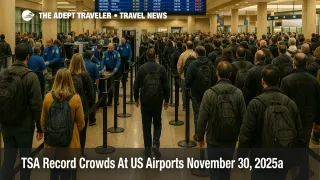
The Transportation Security Administration, TSA, says November 30, 2025, has become the TSA busiest day November 30 on record, with 3,133,924 people screened at airport checkpoints across the United States as travelers flew home from Thanksgiving trips. That single day now ranks as the heaviest screening day in TSA s 23 year history, edging out previous summer and holiday peaks. For travelers, the new record confirms what many already feel at the checkpoint, baseline traffic is higher, peaks are sharper, and tight margins for security, boarding, and connections are getting thinner.
In plain terms, the new TSA record means that major U.S. airports are consistently operating closer to their practical capacity, especially on holiday Sundays, and that travelers should plan for longer queues, tighter gate changes, and less forgiveness for late arrivals at security.
Why November 30 Broke The Record
Official checkpoint data show that TSA officers processed 3,133,924 individuals on Sunday, November 30, 2025, across all U.S. airports. That figure beats the previous record of about 3,096,797 travelers screened on June 22, 2025, a peak summer Sunday at the start of the July Fourth travel period.
TSA had already warned that the Sunday after Thanksgiving would be one of the busiest days in its history, projecting more than 3 million passengers and noting that many of its top 10 days were clustered around summer holidays such as Memorial Day, Juneteenth, and Independence Day. AAA also forecast that 81.8 million people would travel at least 50 miles from home over the Thanksgiving window, a new record that set the stage for heavy airport volumes when everyone returned at once.
On the ground, those numbers translated into long but generally moving security lines at large hubs such as Hartsfield Jackson Atlanta International Airport (ATL), Dallas Fort Worth International Airport (DFW), and Chicago O Hare International Airport (ORD), where local airport authorities reported heavy but manageable flows thanks to extra staffing and lane openings. While some airports experienced localized delays from weather and air traffic control constraints, the bigger story was raw volume.
A Top 10 Now Defined By 3 Million Plus Days
The new record also reshuffles TSA s internal leaderboard. Agency graphics and media summaries show that all of TSA s top 10 busiest days have now exceeded 3 million travelers and have all occurred since July 2024, with eight out of the 10 landing in 2025.
Earlier peaks included December 1, 2024, which briefly held the record with 3,088,836 passengers screened, and multiple summer Sundays in 2025, including June 22 and several July dates that clustered just above 3 million. Industry analysts point out that what used to be exceptional days above 2.9 million are now routine, and that the average daily volume in 2025 is roughly 2.48 million passengers, up from about 2.47 million in 2024.
In practical terms for travelers, that means more days where security, boarding, and baggage systems run at peak utilization for extended stretches. Even if operations hold up, any disruption such as a thunderstorm, a staffing gap in security screening, or a short term checkpoint closure is more likely to produce visible queues and ripple effects when the baseline is already near record levels.
Why December Holidays Feel Packed Even Without A New Record
The Thanksgiving period concentrates demand more than almost any other U.S. holiday. Travelers often leave within a narrow two to three day window and then return on the same Sunday, which is why November 30 produced such an extreme single day peak. December holidays such as Christmas, Hanukkah, and New Year s Eve also drive heavy demand, but the departure and return patterns stretch across two full weeks, with school breaks, flexible vacation windows, and varied work schedules spreading traffic out instead of forcing everyone through on one Sunday.
Historical TSA data from 2024 illustrate the pattern. December 1, 2024, the Sunday after Thanksgiving, produced more than 3.08 million screenings and briefly held the record, while the busiest pre Christmas and post Christmas days sat lower, in the high two million range, despite feeling crowded. For December 2025, travelers should expect sustained high volumes rather than a single new record, especially on the Fridays and Sundays on either side of Christmas and New Year s.
The result on the concourse can feel similar to a record day, particularly during morning and late afternoon departure banks, even if the national tally does not crack the top 10 list. Security lanes feeding banks of flights to popular winter destinations, including Florida, Colorado ski towns, and Caribbean gateways, often stack passengers in waves when several departures cluster in the same hour.
How Record TSA Volumes Change Trip Planning
For individual travelers, TSA s new record is less about bragging rights and more about adjusting expectations. When daily volumes above 2.5 million become normal and 3 million plus spikes show up repeatedly in a single year, old rules of thumb about when to arrive at the airport start to look optimistic.
On domestic flights through large hubs, a two hour airport arrival remains the minimum, not the ideal, especially for families, travelers checking bags, or anyone who needs to reprint boarding passes or adjust seat assignments. At airports with known bottlenecks at security or check in, building in two and a half to three hours during peak holiday windows is often the safer call. For international departures through major gateways such as Dallas Fort Worth or Chicago O Hare, three hours remains the standard, with four hours a reasonable buffer when connecting from a separate ticket or a regional flight that is vulnerable to delay.
Programs such as TSA PreCheck, CLEAR, and airline priority lanes can still shave time off the process, but record volumes have narrowed the advantage on the busiest days. On a Sunday like November 30, some airports reported PreCheck queues that were shorter than regular lines but still long enough to eat 20 to 30 minutes, and CLEAR members still had to wait for elevators, escalators, or document checks feeding the expedited lanes. Travelers should treat these programs as risk reducers, not guarantees.
Adept Traveler readers who want a deeper dive into how airport operations respond to holiday peaks can pair this piece with our daily U.S. delay outlook, including the latest breakdown of Flight Delays And Airport Impacts for December 1, 2025, and with our evergreen guide to navigating U.S. airport security and TSA screening, which explains lane types, staffing patterns, and common bottlenecks in more detail.
REAL ID Rules Now Fully In Play
The 2025 Thanksgiving period was also one of the first major U.S. holiday windows under active REAL ID enforcement. Federal rules state that, beginning May 7, 2025, Federal agencies, including TSA, began card based REAL ID enforcement, which means they may only accept state issued driver s licenses and identification cards that meet REAL ID standards for official purposes such as boarding commercial flights, or else an alternate acceptable document such as a passport, a DHS trusted traveler card, or certain military and tribal IDs.
TSA has signaled that enforcement is being rolled out in a phased way, with some travelers without compliant IDs still allowed to fly after additional screening or after presenting alternate documents, but both TSA and the Department of Homeland Security have warned that passengers who arrive at the checkpoint with non compliant IDs and no backup may be denied boarding.
For December holiday trips, that makes ID preparation as important as packing. Travelers should check whether their driver s license or state ID carries the appropriate REAL ID marking and, if not, bring a passport or another accepted document for domestic flights. Families should remember that children under 18 do not need ID when traveling with an adult on domestic itineraries, but adults in the party do, and a missing compliant ID from one person can still derail the entire trip at the checkpoint.
What Travelers Should Do Before The Next Record
The pattern behind TSA s new record suggests that similar peaks will keep appearing. Strong demand, dense summer and holiday schedules, and a growing baseline of everyday travelers mean that 3 million plus days may become normal rather than rare. That has several practical implications for planning.
First, treat Sunday afternoons and evenings around major holidays as high risk slots for long lines and potential delays, especially at big hubs. If your schedule allows, shifting departures to Monday morning, Tuesday, or a midweek afternoon can reduce time spent in queues and lower the odds of rolling delays.
Second, be conservative with connections. For domestic to domestic transfers at hubs such as Hartsfield Jackson Atlanta, Dallas Fort Worth, or Chicago O Hare, aim for at least two hours of scheduled connection time when traveling in peak periods and avoid separate tickets unless you can tolerate an overnight if something goes wrong. For domestic to international connections, especially when clearing exit controls or changing terminals, three hours remains a safer target.
Third, make the security checkpoint as smooth as possible by pre packing liquids, electronics, and outerwear for easy removal, wearing shoes that come off quickly, and reviewing TSA s current prohibited items list before you leave home. TSA s own holiday travel guidance emphasizes emptying pockets, following officer instructions, and having boarding passes ready to keep lanes moving.
Finally, recognize that the system itself is evolving. TSA continues to roll out new scanning lanes, computed tomography scanners, and identity verification tools, while airlines and airports adjust staffing and flight schedules to handle higher volumes. For readers, that means that paying attention to local airport advisories, airline app alerts, and Adept Traveler s daily U.S. delay coverage is one of the best ways to stay ahead of the next record breaking day.
This article follows Adept Traveler s current editorial and visual style guides for Travel News reporting and hero imagery.
Sources
- TSA checkpoint travel numbers
- Golden Age of Travel, TSA prepared to screen more than 3 million Thanksgiving travelers
- TSA sets all time record for daily screenings
- Thanksgiving 2025 breaks TSA s all time daily traveler record
- AAA Thanksgiving travel forecast 2025
- About REAL ID, Transportation Security Administration
- TSA begins REAL ID full enforcement on May 7
- Minimum standards for driver s licenses and identification cards, Federal Register