

Smart Baggage Tracking On Turkish Airlines Flights
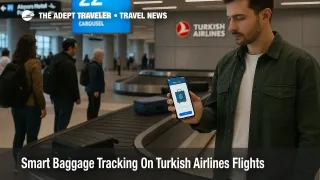
Turkish Airlines baggage tracking is getting a SmartTag upgrade from December 1, 2025, as the Istanbul, Türkiye based carrier rolls out a new Smart Tagged Baggage Service in partnership with Samsung. The program lets passengers who attach a Galaxy SmartTag to their checked bags use Samsung SmartThings Find to share live location data with the airline when luggage goes missing. For travelers this means another layer of visibility and a better chance of fast recovery, although it still pays to build buffer time into connections and keep essentials in carry on bags.
In plain terms, the new Turkish Airlines baggage tracking service uses SmartThings Find and Galaxy SmartTag devices to help locate checked luggage more quickly when it is delayed, misrouted, or temporarily lost.
How Smart Tagged Baggage Service Works
The Smart Tagged Baggage Service is built on Samsung SmartThings Find, the same platform many Galaxy users already employ to find phones, tablets, watches, earbuds, and other items. SmartThings Find uses Bluetooth Low Energy and ultra wideband signals, plus a crowd network of more than 700 million Galaxy devices worldwide, to pinpoint the general location of tags and supported devices even when they are out of direct Bluetooth range of your own phone.
To use the new service, a traveler attaches a Galaxy SmartTag to each checked suitcase, registers the tags in SmartThings Find, and enables sharing. If a bag does not arrive as expected, the passenger can generate a secure tracking link in the app and share that link with Turkish Airlines baggage staff as part of the lost baggage report. Staff can then see updated tag locations on a map, which makes it easier to work out whether the bag is still at the departure airport, sitting in a transfer hub, or already on the way to the final destination.
The partnership goes beyond simple dots on a map. SmartThings Find includes a Change Device Image feature, which allows passengers to upload a photo of their actual luggage. When airline staff view the shared tracking data, they can match the reported location with a visual reference that shows the color, shape, and distinctive marks of that specific suitcase instead of hunting for yet another generic black roller bag.
Who Can Use The Service
For now, the service is aimed at Samsung Galaxy users who already live in the SmartThings ecosystem. You need a compatible Galaxy smartphone, a Galaxy SmartTag or SmartTag2, and the SmartThings Find app configured in advance of your trip. The SmartTag stays inside or securely attached to your checked bag, while your phone acts as the control panel that can trigger sharing and monitor location updates.
Turkish Airlines has positioned itself as the launch airline partner for SmartThings Find in baggage tracking, which means the integration between airline and tech platform is deeper than a traveler simply carrying a consumer tracker on their own. In theory, any traveler can put a tag in their bag and check an app, but this partnership formalizes how baggage agents access shared location links and how the carrier can incorporate that information into its internal tracing process.
At launch, the service is expected to apply across the Turkish Airlines network where standard checked baggage services are offered, although exact rollout details may vary by route and airport. Travelers should still review carrier baggage rules for specific itineraries, especially when codeshares or interline partners are involved, because only Turkish Airlines staff will be able to use the SmartThings links within their own systems.
What This Changes For Mishandled Bags
The biggest practical change is speed. When a bag is delayed today, airline staff typically rely on barcoded tags, baggage handling system scans, and calls to other stations to figure out where it went. With Smart Tagged Baggage Service, they can supplement those systems with live location data from the traveler's own tag, narrowing the search to a particular airport area or even a specific carousel or storage zone.
For travelers, this can reduce some of the uncertainty while you wait. Knowing that your bag is still at the origin airport and now loaded on a later flight is different from facing an information vacuum and hoping it turns up. For the airline, faster confirmation of location can mean fewer replacement purchases, fewer long hotel stays caused by baggage issues, and more efficient use of tracing staff.
However, it is important to understand what the service does not do. SmartThings Find does not move your luggage for you, and it does not override airline rules about delayed or lost baggage compensation. The tag also depends on other Galaxy devices passing near your bag, so coverage will be strongest in major airports and urban logistics nodes and weaker in remote locations or small regional fields.
Background, SmartTrackers And Airline Policy
Consumer trackers in luggage are not new, and many travelers already use devices such as Galaxy SmartTag or competing products in checked bags as a personal backup. What is new here is that Turkish Airlines has formally embraced one of these tools, designed a process for staff to receive and act on tracking links, and signaled that this is part of a broader digital transformation strategy rather than a one off experiment.
The airline has emphasized that it sees SmartThings Find within a passenger first innovation roadmap. Samsung, for its part, is openly treating Turkish Airlines as the first step in a wider aviation play, stating that it plans to expand SmartThings Find collaborations to more airlines over time.
How Travelers Should Use The New Tool
If you are a Samsung Galaxy user booked on Turkish Airlines after December 1, 2025, the most practical way to benefit from this partnership is to treat SmartTagged baggage as an extra safety net, not a replacement for good packing habits. Before your trip, set up SmartThings Find, register each Galaxy SmartTag, and add a clear photo of each suitcase, including any unique straps or stickers that make it stand out on a belt.
At the airport, keep essentials, medicines, and one change of clothes in your cabin bag, and tag any checked suitcase that would be painful to lose or delay. When checking bags through Istanbul Airport (IST) or other hubs on tight connections, continue to allow generous transfer windows, especially on separate tickets where the airline owes you less protection. The SmartTag will help you and Turkish Airlines see where a late bag ended up, but it will not magically place it on the earlier connection you chose.
Finally, use the airline's official channels first if a bag is missing at arrival, then add SmartThings Find data as a supplement. File a proper delayed baggage report at the airport, keep your property irregularity report number and receipts, and only then share the SmartThings tracking link so staff can cross check it with their own systems. That way you get the benefit of both the formal baggage tracing framework and the new Smart Tagged Baggage Service working together rather than in parallel.