

TSA Confirm.ID Fee For U.S. Airport Security February 2026
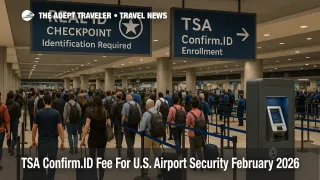
U.S. airport security checkpoints will soon charge some passengers a new TSA Confirm.ID fee without REAL ID, after the Transportation Security Administration announced a nonrefundable $45 identity verification charge starting February 1, 2026. The change applies to domestic flyers age 18 and older who arrive without a REAL ID compliant license, passport, or other acceptable identification at checkpoints nationwide. Travelers should update their IDs well before trips, carry a passport as backup, or build in extra time and budget if they must rely on the Confirm.ID process.
The new Confirm.ID fee for travelers without acceptable ID turns what used to be a free, manual identity check into a paid, technology driven backup that can add both cost and screening time to domestic itineraries.
How The TSA Confirm.ID Fee Works
Confirm.ID is TSA's modernized alternative identity verification system for passengers who show up at a checkpoint without an acceptable ID, for example a compliant driver's license or passport. Instead of answering questions and showing ad hoc documents as in the old process, travelers who opt in will pay a $45 fee and have their identity checked electronically using a mix of biographic data and biometric tools that tap government and commercial databases.
The $45 Confirm.ID payment is valid for a 10 day travel window, not for a calendar year. That means a single fee can cover a round trip or several flights within that 10 day span, but a second trip beyond that window will require a new payment and, if needed, another verification. TSA has made clear that the fee is nonrefundable, and paying it does not guarantee that a traveler will be cleared to fly, since the agency can still deny access to the sterile area if identity cannot be verified.
To reduce congestion at checkpoints, TSA is urging travelers who know they lack acceptable ID to prepay online through its website, which will route them to a government payment portal and generate proof of enrollment to present at the airport. For those who arrive unprepared, most airports will offer QR codes or kiosks near security that link to the same payment flow, but any on site Confirm.ID enrollment will add time before a traveler can even join the main screening line.
TSA estimates that a typical Confirm.ID verification will take roughly 10 to 15 minutes, but warns that some cases can stretch to 30 minutes or longer, especially at busy airports or when records are hard to match. In limited humanitarian or emergency situations, such as immediate family bereavement travel, officials say the fee may be waived, although those exceptions are expected to be rare.
Children younger than 18 still are not required to present ID at checkpoints when traveling with an adult on a domestic itinerary, so they are not directly affected by the new charge. The policy is aimed at adults who either never obtained REAL ID, or who forget, lose, or damage their documents before flying.
Who Must Pay, And Who Can Skip Confirm.ID
The Confirm.ID fee only applies when an adult traveler shows up at the checkpoint without any acceptable identification. TSA's press materials stress that passengers who present a valid REAL ID compliant license or one of several alternative documents will be screened as usual without any extra charge.
Acceptable IDs include REAL ID compliant driver's licenses and state ID cards that carry the star marking in the upper corner, state issued Enhanced Driver's Licenses and Enhanced IDs, valid U.S. passports and passport cards, and Department of Homeland Security trusted traveler cards such as Global Entry, NEXUS, SENTRI, and FAST. U.S. Department of Defense IDs, permanent resident cards, border crossing cards, and certain photo IDs issued by federally recognized Tribal Nations also qualify, along with Transportation Worker Identification Credential badges, U.S. Merchant Mariner Credentials, and Employment Authorization Cards (Form I 766).
Foreign passports and Canadian provincial driver's licenses are accepted as well, which is important for cross border travelers who may not have a U.S. state license. In addition, TSA now allows some mobile or digital IDs in Apple Wallet, Google Wallet, or Samsung Wallet at a growing list of airports, and those digital credentials count as acceptable identification when properly provisioned.
A key detail for travelers is that temporary paper licenses issued while a plastic card is in the mail generally do not count as valid ID on their own at TSA checkpoints. The Department of Defense and travel industry guidance already urge travelers with temporary credentials to carry a passport or other acceptable ID to fly, a practice that becomes even more important once the Confirm.ID fee takes effect.
REAL ID Enforcement And The Jump From $18 To $45
The Confirm.ID rollout builds on full REAL ID enforcement, which began for air travel in May 2025 after years of extensions. Under the REAL ID Act, federal agencies, including TSA, may not accept state licenses and IDs that do not meet specific security standards for boarding commercial flights.
When TSA first outlined its modernized alternative identity verification program in a Federal Register notice in November 2025, the agency floated an $18 fee to cover the cost of background checks, technology, and staffing for passengers without acceptable ID. After refining its cost estimates, TSA raised the final Confirm.ID fee to $45, citing higher expenses for biometric tools, vendor contracts, and operations than initially projected.
Agency officials argue that roughly 94 percent of passengers already travel with REAL ID compliant or otherwise acceptable identification, so the new fee targets a relatively small share of travelers while limiting the burden on taxpayers who fund airport security. Critics point out that the jump from $18 to $45 represents a steep increase, and that the charge will fall hardest on those who are less organized or have fewer resources, especially if they face multiple trips within a short period.
What This Means For Itineraries And Airport Time
For most travelers, the practical impact is a new worst case scenario rather than a daily expense. A traveler who realizes the night before a flight from Los Angeles International Airport (LAX) to Chicago that their license is non compliant, or who discovers at the curb that a wallet is missing, can still fly if they pass Confirm.ID and pay the $45 fee, but they will need to arrive earlier than usual and accept the risk that verification might fail.
Because Confirm.ID happens before a traveler can enter the regular TSA line, the system effectively inserts an extra queue for those without ID. That added step raises the risk of missed departures, particularly on tight connections through major hubs or on itineraries built on separate tickets that leave little buffer for delays. Frequent flyers, business travelers on same day trips, and families who depend on precise timing for onward ground transport are the groups most exposed to knock on effects if a Confirm.ID session runs long.
The 10 day validity window also matters for planning. A traveler who pays the fee for a February 1 flight home from a work trip can use the same enrollment for a February 8 return, but not for a February 20 conference, which would require another $45 payment if they still lack acceptable ID. Advisors should treat that window as a hard limit when building multi leg or multi city itineraries for clients likely to rely on Confirm.ID.
What Travel Advisors And Travelers Should Do Now
From a practical standpoint, the best way to avoid the Confirm.ID fee is still to carry proper documents. Advisors and airline partners should update pre travel checklists, confirmation emails, and app notifications to highlight that as of February 1, 2026, adults without acceptable ID will face both a $45 charge and potential delays of up to half an hour before security.
Advisors can also segment their messaging. Clients who travel several times a year within the United States should be strongly encouraged to obtain a REAL ID compliant license or state ID and to keep a valid passport as backup. In client notes, it is worth flagging travelers who recently moved states, changed names, or renewed licenses, since those are moments when documentation can easily be out of sync.
For infrequent flyers who may not have a passport or for travelers facing near term trips before they can secure REAL ID, it may be sensible to walk them through Confirm.ID as a contingency, including how to prepay online, what information they will need to provide, and how the 10 day window works. However, advisors should be clear that Confirm.ID is designed as a last resort and not as a convenient substitute for proper ID.
On the content side, travel planners and advisors may want to link clients to up to date REAL ID guidance and airport security explainers, including Adept Traveler's planned REAL ID and U.S. airport security guide and any future coverage of how the Confirm.ID rollout affects day to day checkpoint operations. Over the next year, those resources will be key to helping travelers make sense of the mixed landscape of REAL ID cards, passports, enhanced licenses, and digital IDs.
Background: Why REAL ID And Confirm.ID Exist
The REAL ID Act dates back to a 2005 recommendation from the 9 11 Commission that called for national security standards for driver's licenses and identification cards. Over time, DHS tied those standards to access for several federal purposes, including boarding commercial flights. Implementation has been delayed for years as states upgraded systems and documentation rules, which is why full enforcement for air travel did not begin until May 7, 2025.
Confirm.ID is the logical extension of that framework, giving TSA a structured, fee funded way to verify identity when someone appears at the checkpoint without acceptable documents. TSA says this allows it to maintain security while reducing the chance that a forgotten wallet or a delayed REAL ID card in the mail leaves a traveler completely stranded, although the new fee clearly signals that relying on the backup process will carry a real financial and time cost.
For travelers and advisors, the bottom line is straightforward. Treat the TSA Confirm.ID fee without REAL ID as an emergency safety net, not a feature, and use the remaining months before February 1, 2026, to move as many clients as possible into the fee free category with compliant IDs or valid passports.
Sources
- TSA introduces new $45 fee option for travelers without REAL ID starting February 1
- Acceptable Identification at the TSA Checkpoint
- Travelers Without REAL ID Will Soon Have to Pay a $45 Fee. Here's What to Know
- US air travelers without REAL IDs will be charged a $45 fee
- US agency will charge $45 fee for air passengers without REAL IDs
- TSA Modernized Alternative Identity Verification User Fee