

Africa Regional Flight Cancellations Hit Holiday Routes
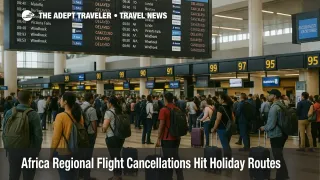
Africa regional flight cancellations on December 3, 2025, hit key routes between Abidjan, Accra, Dakar, Banjul, Johannesburg, and Durban, as Air Côte d'Ivoire, South African Airways, and Air Sénégal scrubbed short haul services and logged roughly a dozen delays. Regional business travelers, diaspora flyers heading home, and holidaymakers bound for beach resorts such as Cap Skirring and coastal Gambia were left rebooking at the last minute or abandoning side trips. Anyone planning multi stop itineraries in West or Southern Africa now needs more buffer, backup routings, and clearer contingency plans.
The Africa regional flight cancellations on December 3 show how a small cluster of scrubbed legs at Félix Houphouët Boigny International Airport (ABJ), Kotoka International Airport (ACC), Blaise Diagne International Airport (DSS), Banjul International Airport (BJL), O. R. Tambo International Airport (JNB), and King Shaka International Airport (DUR) can ripple across holiday plans, forcing travelers to rebuild connections or shift to larger carriers with more slack.
Where Flights Were Cancelled
Flight tracking data compiled by Travel And Tour World from FlightAware logs point to at least six cancellations and around twelve delays on December 3 involving Air Côte d'Ivoire, South African Airways, and Air Sénégal. On the West African side, Air Côte d'Ivoire cancelled a pair of Dash 8 services between Abidjan and Accra, cutting a core trunk link between Côte d'Ivoire and Ghana that many travelers use to stitch together multi city itineraries across Francophone and Anglophone West Africa.
In Senegal and The Gambia, Air Sénégal scrubbed several ATR 72 flights between Dakar and Cap Skirring and between Dakar and Banjul, directly affecting winter sun itineraries that combine Dakar with the resorts of the Casamance region and Gambia's coastline. These routes often have limited same day alternatives, which means a single cancelled sector can wipe out a carefully planned long weekend or force passengers into expensive, multi stop routings via other West African hubs.
Further south, South African Airways cancelled at least two Airbus A320 flights on the busy Johannesburg to Durban corridor, including services identified as SAA535 and SAA542 between O. R. Tambo International Airport and King Shaka International Airport. That domestic shuttle is a backbone for both corporate travelers and leisure passengers connecting to Durban's beaches or onward regional flights, so any loss of frequency pushes more pressure onto remaining departures and competing carriers.
Although the disrupted flights are all short haul, they sit inside larger itineraries. A cancelled morning turboprop from Cap Skirring to Dakar can break an evening departure to Europe, while a scrubbed Abidjan to Accra leg can strand travelers booked onward to North America or the Middle East from Kotoka International Airport.
Why Regional Airlines In Africa Are So Fragile
The pattern on December 3 is not just bad luck. It is a symptom of structural stress in African regional aviation.
IATA and industry analyses show that African airlines operate on some of the thinnest margins in the world, with projected net profit of about 0.2 billion dollars on the continent in 2025, equivalent to roughly 1.30 dollars in profit per passenger and around a 1.1 percent net margin. At the same time, operators face higher jet fuel prices, steeper airport and navigation charges, and more expensive maintenance and spare parts than many global peers.
Air Sénégal illustrates how these pressures land on a single carrier. Reporting through 2024 and 2025 describes the airline as heavily indebted, having returned several leased aircraft, trimmed long haul routes such as Dakar to New York, and required repeated state support and restructuring plans to keep operating. Recent government proposals include resizing the fleet and network and creating a new domestic focused subsidiary to restore basic connectivity.
When fleets are that small, one aircraft lost to maintenance, a crew duty time issue, or a missed lease payment can remove a large share of available capacity. Unlike mega carriers that can swap in another jet or borrow a spare from a partner, a regional airline with a handful of ATRs or Dash 8s has almost no slack. That is how a missing turboprop in Dakar or Abidjan turns into a broken chain of connections across multiple countries.
Smaller regional aircraft also spread costs over fewer seats, which makes each ticket more expensive to produce and increases the pressure to cancel or consolidate lightly booked legs when fuel costs rise. Combined with a global backlog in new aircraft deliveries that hits African buyers especially hard, the result is a fragile system where operational issues quickly become network wide disruptions.
Routing Strategies For West And Southern Africa
For travelers, the lesson from December 3 is that regional sectors inside Africa should be treated as risk points, not afterthoughts.
On West African routes, consider whether a slightly longer itinerary via a large hub with multiple daily frequencies might be more robust than a single thin regional leg. For example, some itineraries from Europe or North America to Banjul or Cap Skirring can be built via Dakar, Casablanca, or Lisbon, rather than relying on a once daily turboprop that has little backup if something goes wrong. In Southern Africa, it can be safer to route through Johannesburg or Cape Town on larger carriers with dense schedules and alliance partners, even if that means an extra connection.
Travelers who must use small regional airlines can reduce risk by avoiding last flights of the day where possible. Morning and midday departures leave more room for same day reaccommodation if something slips, and they are less likely to be the first services cut when airlines consolidate schedules. For safari or resort trips that rely on a specific domestic sector, such as Cap Skirring to Dakar or Johannesburg to Durban, it is worth building at least one full extra night at the hub before any long haul departure.
Multi country itineraries that string several regional hops together, for instance Abidjan to Accra to Dakar to Banjul, are particularly exposed. These trips should be treated like expedition itineraries rather than simple city breaks, with flexible hotel bookings, refundable or changeable fares on the long haul segments, and clear fallbacks via alternative hubs if one regional leg fails.
Passenger Rights, Refunds, And Insurance
Legal protections on these routes are weaker and patchier than many travelers from Europe or North America might expect. Most of the cancelled flights on December 3 operate entirely within Africa, outside the scope of European Union Regulation EC 261 on passenger compensation, and local consumer protection frameworks vary widely by country.
In practice, passengers can usually expect a refund for a cancelled sector or a rebooking on a later flight operated by the same airline, but cash compensation for hotel nights, meals, and lost connections is less certain unless the ticket terms or local law are very clear. Travelers should read fare conditions carefully before purchase, paying attention to whether tickets are nonrefundable, whether schedule change or involuntary refund clauses are included, and how the airline defines extraordinary circumstances.
Travel insurance and premium credit card protections become more important in this environment. Policies that cover trip interruption and missed connections on separately ticketed legs can be the difference between absorbing several hundred dollars in extra costs and having some of those expenses reimbursed. However, insurers may require proof that the airline cancelled the flight rather than the traveler voluntarily changing plans, so it is essential to keep boarding passes, written cancellation notices, and receipts for hotels and meals.
How Travelers Should Adjust Future Plans
The December 3 pattern will not be the last time regional flights in Africa falter. As long as airlines operate with razor thin margins, limited fleets, and uneven access to aircraft and parts, disruptions will recur during peak seasons.
Travelers planning 2025 and 2026 trips that combine African capitals with beach resorts or safari lodges should assume that domestic and regional segments are the weakest link and design itineraries accordingly. That means booking critical regional sectors on a single ticket with the long haul where possible, adding generous layovers in hubs such as Johannesburg or Dakar, and avoiding tight same day connections from small airports like Cap Skirring or Banjul onto intercontinental flights.
Advisors and tour operators can help by steering clients toward routings that concentrate risk on larger carriers and hubs, even if headline flight times look a little longer. On the ground, it is wise to monitor flight status through both airline apps and independent trackers, since local communication from smaller carriers can be slow. When a cancellation does hit, flexibility and a clear understanding of your rights and coverage will matter more than loyalty status or lounge access.
Sources
- Passengers Stranded Across South Africa, Ghana, Senegal and Others as Air Senegal, South African Airways and Cote D' Ivory face 12 Delays and 6 Cancellations, Disrupting Travel
- Félix Houphouët Boigny International Airport
- Kotoka International Airport
- Blaise Diagne International Airport
- Banjul International Airport
- O. R. Tambo International Airport
- King Shaka International Airport
- Cap Skirring Airport
- Africa travels on razor thin margins
- Cost disadvantage of African airlines
- As global aircraft supplies stall, Africa's airlines pay the price
- Air Senegal battles financial turmoil and operational challenges
- Air Sénégal sinking despite various recovery plans
- Interministerial meeting addresses the future of AIBD SA and Air Senegal SA