

Belgium Strikes And Storms Disrupt Brussels Flights, Trains
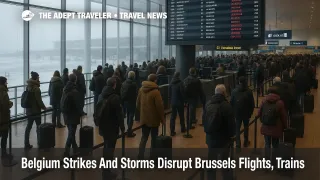
Belgium strikes Brussels flights and trains hardest around November 24 to 26, when a three day national walkout shut all departures at Brussels Airport (BRU) and forced airlines to cancel or reroute hundreds of services. The same action cut more than half of arriving flights and slowed public transport across Belgium, including key feeder routes into the capital. A week later, early December fog, snow, and de icing queues brought fresh cancellations and long waits at Zaventem, turning Brussels into a fragile hub choice just as holiday traffic ramps up.
In practical terms, this means that travelers using Brussels as a December connection point face a higher than usual chance of missed flights and broken air rail combinations, especially if they rely on short connection windows or same day Eurostar transfers.
The core change for travelers is that the three day national strike around November 24 to 26, followed by a winter storm and ongoing rail works, has made Brussels a riskier place to schedule tight connections, even on days without active strike calls.
How The November 24 To 26 Strike Hit Brussels Flights
Belgian trade unions called a nationwide strike for November 24 to 26 to protest government austerity and pension reforms. Brussels Airport announced on November 19 that all departing flights on November 26 would be cancelled because security and ground handling staff were joining the walkout, warning that arriving services could also be affected.
On the day itself, the airport saw a complete shutdown of departures and cancellations of more than half of scheduled arrivals, while Brussels South Charleroi Airport (CRL) also suspended operations due to a lack of staff to run safely. Airlines including British Airways, Ryanair, and Brussels Airlines cancelled multiple services to and from the United Kingdom and other markets, pushing affected passengers onto later dates or alternative airports.
A mix of sources suggest that well over 200 flights were cancelled or heavily disrupted across the three day window, with November 26 the worst of the period. While air traffic control remained available, the lack of security and handling capacity meant airlines had little room to improvise on the day, so many passengers faced forced overnight stays or reroutes via other hubs such as Amsterdam, Paris, or Frankfurt.
Rail And Eurostar Disruptions Around Brussels
The strike wave did not stop at the airport perimeter. During the same week, national rail services and local public transport were reduced or halted on various days, limiting options for getting to and from the airports and for connecting across Belgium.
On December 1, a separate overhead line failure at Brussels South station temporarily suspended Eurostar high speed services between Brussels and Paris, creating delays of 30 to 60 minutes and forcing some passengers to rebook. Although that incident was not caused by the strike itself, it compounded the sense that Brussels is a brittle node when several small failures stack up.
At the same time, infrastructure manager Infrabel has been carrying out major engineering works in the rail tunnel south of Brussels Airport station since November 15, reducing the number of trains serving the airport by as much as 40 percent until December 9. Official notices from B Europe, which markets international services, tell passengers to expect fewer direct airport trains and to plan for longer travel times to and from Zaventem.
Taken together, this means a traveler arriving at Brussels Airport in early December not only has to worry about flight disruption, but also about reduced rail capacity to reach central Brussels, Antwerp, Ghent, or Liège, and a less resilient Eurostar connection to Paris, London, and beyond.
Winter Storms Add Weather Risk At Zaventem
Barely a week after the strike period, a winter storm brought fog and snow to Brussels. At Brussels Airport, operators scrubbed flights to Frankfurt and other hubs, while ground handlers warned that de icing queues would stretch turnaround times for the rest of the day. Airport officials urged departing passengers to arrive at least three hours before their flights and to monitor airline updates closely.
Although the number of cancelled flights was far smaller than during the strike, the weather event showed how quickly Brussels can gridlock when a single constraint is added on top of already tight schedules and reduced ground resources. With winter only just starting in Western Europe, more fog and low cloud events are likely through December and January.
Official Warnings And Holiday Season Risk
The U.S. Embassy in Belgium issued a message to U.S. citizens ahead of the late November walkouts, warning that strikes on November 24 to 26 could disrupt air travel and public transportation, and encouraging travelers to verify arrangements with airlines and rail operators. A later worldwide travel alert from the U.S. State Department singled out Belgium as a place where labor unrest had already produced hundreds of flight cancellations, fewer trains, and large street demonstrations, and cautioned that similar disruption could reappear around the December holidays.
Other governments, such as Australia s Smartraveller service, remind visitors that general strikes are a recurring feature of Belgian politics and can cause significant unplanned disruption nationwide.
For December planners, the key takeaway is that even if no new strikes are formally announced, the same conditions that produced the late November actions have not been resolved, and future calls could land with only limited notice.
How Risky Is Brussels Compared With Nearby Hubs
Compared with Amsterdam Schiphol Airport (AMS), Paris Charles de Gaulle Airport (CDG), and Düsseldorf Airport (DUS), Brussels currently combines several overlapping vulnerabilities, recent nationwide strikes, ongoing rail tunnel works that cut train frequencies to the airport, and an early season storm that exposed how quickly operations can slow in poor visibility.
Amsterdam and Paris have had their own strike and weather episodes in recent years, but for the first half of December 2025 they operate without the same specific combination of active engineering works at the airport station and very recent nationwide strike action. For a traveler designing a multi stop European itinerary, that makes Brussels the least resilient of the four locations for tight same day connections in the near term.
This does not mean Brussels must be avoided at all costs. It does mean that travelers should treat it as a higher risk hub for complex itineraries than usual through at least mid December, particularly if they depend on national rail links or on Eurostar to reach London or northern France.
Practical Planning Advice For December Itineraries
If you already hold tickets that connect through Brussels in early to mid December, start by checking whether your airline has issued any flexible change policies related to the strike or to weather. Some carriers have allowed free date or routing changes for passengers affected by the November 26 shutdown, which might give you room to re route via Amsterdam, Paris, or Frankfurt without extra cost.
Next, audit every connection at Brussels Airport that is shorter than three hours. When possible, move these to longer connecting times, especially if you need to clear passport control or transfer between Schengen and non Schengen gates. For same day air rail combinations, such as a morning flight into Brussels followed by an afternoon Eurostar departure, consider moving one leg to the previous or following day to reduce misconnect risk.
On the ground, assume that airport trains may run less frequently until at least December 9 and that some services could be crowded or delayed. Build in extra time to reach the airport by rail, and have a backup plan involving taxis, rideshares, or coach services if engineering works or strikes interrupt the line.
Travelers with more flexibility might choose to avoid Brussels as a hub entirely for December trips. Routes that can be re booked via Amsterdam, Paris, or Düsseldorf often preserve similar total travel times with lower operational risk during this window. For more regional background on how coordinated labor actions affect travel patterns, you can compare this situation with our coverage of Italy s December transport strikes, and our evergreen guide to European rail and transit strikes.
Whatever route you choose, monitor airline and rail operator alerts in the days before departure, reload boarding passes after schedule changes, and be prepared to adapt quickly if Belgium s political or weather conditions add new constraints. That mix of vigilance, extra buffer, and backup routes will matter more than usual if you use Brussels in December.
Sources
- Brussels Airport cancels all departing flights on Nov 26 due to strike
- Belgian national strike disrupts schools, flights and public transport
- Brussels Airport cancels all departing services on 26 Nov 2025 due to strike action
- Flights grounded and trains cancelled as Belgium faces three day national strike
- Brussels Airport rail tunnel overhaul slashes train frequencies until 9 December
- Traffic disruptions and works, Brussels Airport Zaventem
- Power supply fault halts Eurostar trains in and out of Brussels South
- Winter storm shuts down flights at Brussels Airport amid Europe wide cancellations
- Air Travel and Public Transportation Disruptions, U.S. Embassy Belgium
- U.S. travel alert flags strike related disruptions in Belgium ahead of holiday rush
- Belgium travel advice and safety