

Cuba Blackout Disrupts Havana Hotels And Winter Trips
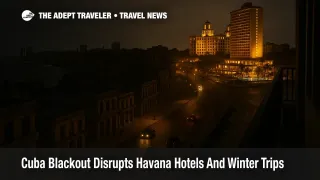
A Cuba blackout in Havana hotels on December 3, 2025 is the latest sign that the island's energy crisis is now a core travel risk, not just a local inconvenience. A partial collapse of the national grid before dawn left the capital and much of western Cuba in the dark for hours, with only scattered hotels and hospitals lit by generators while traffic lights, phone service, and most neighborhoods went dark. For winter travelers, that means factoring power reliability into every decision about where to stay, how long to visit, and when to choose alternatives in the wider Caribbean.
The Cuba blackout in Havana hotels on December 3 shows that chronic grid failures and fuel shortages are now directly shaping winter travel plans, from room comfort and food safety to airport operations and onward connections.
How The December 3 Blackout Unfolded
According to Cuban officials, a main transmission line connecting Havana with the Antonio Guiteras power plant in Matanzas failed at around 5:00 a.m., cutting power across at least four western provinces from Pinar del Río through Mayabeque. By midday, the government said roughly 40 percent of Havana had been reconnected to the grid, but large swaths of the city and surrounding areas remained without power, and authorities warned that generation still covered only about two thirds of demand.
Reporters on the ground described Havana's seafront skyline largely dark before sunrise, with just a few towers and hospitals glowing thanks to generators, while street lights, traffic signals, and many homes were completely blacked out. The outage, which lasted close to 12 hours in some areas before partial service returned, shut schools, snarled traffic, and reduced mobile data and internet access across western Cuba.
The United States Embassy in Havana issued a same day security alert stating that a total blackout had affected Havana and western provinces and warning that Cuba's electrical grid is "increasingly unstable," with frequent long outages since a nationwide collapse in October 2024. The alert also cautioned that even services tied to generators can fail because fuel is scarce.
A Systemic Energy Crisis, Not A One Off Incident
The December 3 event slots into a wider pattern. Cuba's grid has suffered multiple partial and nationwide collapses since 2024, often triggered by failures at key power plants or substations, and exacerbated by fuel shortages that leave oil fired units idle.
Energy analysts note that the government poured far more investment into tourism infrastructure, including new hotels, than into modernizing the power system in the years before the current crisis. One recent review of official statistics estimates that from 2010 to 2024 about 32 percent of total investment went into tourism related projects, compared with only 12 percent into energy, leaving a club of gleaming hotels dependent on a neglected grid.
Residents and visitors now report routine daily blackouts, sometimes 20 hours long in some provinces, with Havana, once shielded, now facing around 10 hours a day without electricity during peak deficits.
How This Hits Havana Hotels And Winter Escapes
For travelers, the headline risk is not only that lights go out, but how long hotels can keep critical systems running. Foreign ministries like Canada's now warn that Cuba schedules long daily power cuts to relieve the grid and that sudden nationwide outages may last more than 24 hours, adding that while most large hotels and resorts have generators, fuel limits can reduce what they can actually provide.
Independent reporting has already documented hotels operating at half capacity or shuffling guests between properties when generators or fuel cannot keep up with demand, especially outside the top tier international chains. Pool pumps, elevators, and air conditioning may be rationed, kitchens may run reduced menus, and water pressure can drop if pumps fail during long cuts.
On December 3, visuals from Havana showed classic cars rolling through dim streets and an oceanfront skyline where only a handful of high rises, likely hotels with their own backup power, remained lit while entire districts lay dark. For a visitor, that gap means that picking the wrong property can turn a winter escape into a long, hot night with no fan, limited food options, and patchy connectivity.
Which Provinces And Resort Zones Are Most Exposed
The latest blackout primarily affected western Cuba, including Pinar del Río, Artemisa, Havana, Mayabeque, and Matanzas, which hosts the major beach resort strip at Varadero. That aligns uncomfortably with where many Canadians and Europeans book winter packages.
Western resort hubs like Varadero and, farther east, Holguín have already seen enough outages to trigger goodwill policies from tour operators. Air Canada Vacations, for example, issued a specific advisory in October 2024 after a power outage in Varadero and Holguín, offering customers change options or future travel credit. Sunwing's travel alerts similarly flagged intermittent outages across Cuba and later updates about power restoration in the same resort regions.
Eastern and central beach areas such as the Cayos can be less directly affected when a failure is regional instead of nationwide, but they are tied into the same stressed National Electric System and have already experienced rolling cuts and at least one full island blackout.
Airports, Transfers, And The Grid
On the aviation side, Cuba's main gateways have so far managed to keep basic operations going during major blackouts by prioritizing backup power. During a nationwide grid collapse in September 2025, state media and Reuters reporting noted that airports and hospitals were among the first to receive generator support, even while most households remained in the dark.
José Martí International Airport (HAV) in Havana relies on dedicated backup systems, but a prolonged or repeated outage can still affect check in, baggage systems, and air conditioning in terminals. Travelers may find some check in desks offline, longer manual processes, and limited retail and food options if tenant spaces lose power. Regional airports serving Varadero and Holguín have similar vulnerabilities, and tour operator advisories suggest that power issues are now a recognized operational risk at Juan Gualberto Gómez Airport (VRA) and Frank País Airport (HOG), not just in town centers and resorts.
Road transfers are another weak point. When street lighting, traffic signals, and some fuel stations go dark, nighttime drives between airports, resorts, and cities become slower and less predictable, which matters for early morning departures or tight cruise connections.
Advisories Are Catching Up With Reality
Foreign governments have gradually hardened language around Cuba's infrastructure. Germany's Foreign Ministry has warned would be visitors to take note of repeated blackouts and fuel shortages that can affect hotels and transport. Canada's official advisory now spells out that long scheduled cuts and unexpected nationwide outages are part of normal life, and that generator backed services may themselves be constrained by fuel.
The United States Embassy's latest alert, tied to the December 3 collapse, frames the grid as "highly unstable" and notes that multiple nationwide outages have occurred since October 2024, shifting blackouts from a background annoyance to an explicit security concern.
Travel media have also started to push back against casual Cuba marketing, arguing that repeated grid failures, food and fuel shortages, and visa complexities make the island a difficult sell for 2026 compared with other Caribbean options.
Who Should Still Consider Cuba, And On What Terms
In practical terms, Cuba can still be a viable winter destination for travelers who tolerate heat well, are flexible about amenities, and are willing to do real homework on where they stay. That means prioritizing properties with credible, recent reviews about how they handled outages, ideally with clear statements on generator capacity for rooms, kitchens, water pumps, and cooling in at least some common areas.
Travelers with health conditions that depend on stable air conditioning, refrigeration for medicines, or powered medical devices should treat much of Cuba as high risk until the grid stabilizes. Even high end hotels cannot guarantee unbroken power if fuel deliveries falter, and backup systems usually prioritize a limited set of functions.
Families with very young children, travelers who need to work remotely, and anyone who sees reliable connectivity as non negotiable may find that they get better value by choosing more stable Caribbean islands this season. Recent blackouts, the December 3 collapse included, highlight how quickly Cuba can shift from postcard beaches to uncomfortable realities when the lights go out.
Practical Strategies If You Decide To Go
If you still plan a Cuba trip this winter, start by aligning your expectations with the grid. Assume daily cuts, build in the possibility of a multi day outage, and pick travel dates and flight times that allow daylight transfers and at least one buffer night before any hard commitments such as cruises or long haul flights home through José Martí.
Research hotels by reading the newest reviews and by contacting properties directly about how they handled previous outages. Ask whether room air conditioning and basic lighting are on the generator circuit, how long fuel stocks can support full hotel operations, and what happens if that fuel runs low. In cities, consider smaller guesthouses only if they can credibly explain their contingency plans.
Pack for an uneven grid. That means power banks, a small flashlight or headlamp, a battery powered fan if heat is a concern, and printed copies of key documents and directions in case mobile data fails. Keep devices topped up whenever power is available, and carry a small stash of shelf stable snacks in case kitchens scale back service during long cuts.
Finally, keep a backup plan for your winter escape itself. If your chosen resort or city experiences repeated outages before departure, use flexible tickets, tour operator waivers, or travel insurance options where available to pivot to more stable alternatives such as Jamaica, the Dominican Republic, or Mexico's Caribbean coast. Articles on nearby destinations, like Negril's post storm reopening in Jamaica, show how quickly the region can offer substitutes if Cuba's grid remains fragile.
Sources
- Cuba begins restoring power to Havana, provinces after partial grid collapse
- Massive power outage hits Cuba's western region as grid crumbles
- Security Alert, U S Embassy Havana, Cuba, December 3, 2025
- Travel advice and advisories for Cuba
- Cuba's Energy Crisis, A Systemic Breakdown
- Tourism, Cuba's Economic Engine, Remains in Decline
- Cuba tourism struggles as blackouts and shortages deter visitors
- Varadero Holguín power outage travel advisory
- Sunwing travel alerts, Cuba power restoration
- Why You Should Not Visit This One Country In 2026