

Security Risks Sahel And West Africa Overland Travel
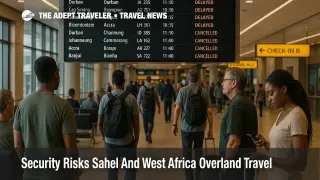
In December 2025, Sahel overland travel security remains one of the most volatile parts of the wider Africa travel picture, with sections of Burkina Faso, Mali, Niger, eastern Democratic Republic of the Congo, and northern Mozambique still classified as no travel or avoid all travel by multiple governments. The same pattern extends offshore, where the Gulf of Guinea continues to carry piracy and kidnapping for ransom risks for commercial shipping and some coastal cruising. For travelers, that means separating reasonably stable gateway cities from higher risk overland corridors and being honest about which routes are simply not worth attempting.
In practical terms, the change for travelers is that overland itineraries in parts of the Sahel and coastal West and Central Africa now require a security first planning mindset rather than a pure logistics and weather approach, and Sahel overland travel security should be treated as a hard constraint, not a soft advisory.
Sahel security hotspots for overland travel
Across the central Sahel, attacks by armed groups and terrorist networks have increased in recent months, particularly in Burkina Faso, Mali, and Niger. A December 2025 forecast from the UN Security Council system notes a marked rise in assaults on civilians, local authorities, and security forces, along with ambushes on roads in rural areas. Several governments now designate much or all of these countries as Level 4 do not travel, or the equivalent, due to terrorism, kidnapping, and political instability.
For travelers, the key point is that the difference between a capital city and the surrounding countryside can be stark. Advisories stress that routine and even emergency consular services may be unavailable outside cities such as Bamako in Mali or Niamey in Niger, and that road travel between towns can face checkpoints, ambushes, or improvised explosive devices. Self drive trips that look simple on a map, for example a loop north from Ouagadougou, can cross multiple zones where foreign ministries explicitly tell their citizens not to travel at all.
Travelers who do have an essential reason to be in the region usually work through specialist operators who layer local guides, vetted drivers, and in some cases armed escorts, and who actively monitor route closures and short notice curfews. General leisure travelers and independent overlanders should read that as a clear sign that most tourist grade land trips into these areas are not appropriate at present.
Eastern Democratic Republic of the Congo
Eastern Democratic Republic of the Congo remains one of Africa s most complex security environments. U.S., Canadian, and Australian advisories all highlight the presence of more than 100 to 120 armed groups across provinces including North Kivu, South Kivu, Ituri, Tanganyika, and parts of Maniema and Haut Uele, with regular clashes between militias, government forces, and foreign elements.
These same advisories warn of endemic crime, kidnapping, and the risk of attacks on roads and in rural settlements. Even when major cities such as Goma or Bukavu have some international presence, the road corridors that connect them to national parks, mining regions, or neighboring borders can pass through zones with active fighting or banditry. Some governments explicitly recommend that foreign nationals leave affected eastern areas when it is safe to do so, and flag the possibility of short notice airspace closures or evacuation challenges if conflict escalates.
In practical terms, someone planning to fly into Kinshasa and then travel onwards into the east by road is now stepping into an area where many embassies judge they cannot reliably assist if something goes wrong. For most travelers, safer options are to confine trips to lower risk cities, or to shift wildlife or trekking plans to neighboring countries with more stable security environments.
Northern Mozambique and coastal corridors
Northern Mozambique continues to grapple with an insurgency centered on Cabo Delgado, where Islamic State linked fighters have carried out coordinated attacks that have displaced tens of thousands of people in 2025 alone. Canada, Australia, Ireland, and several European states advise avoiding all travel to Cabo Delgado and to specific districts of neighboring Nampula Province, citing the risk of militant attacks, ambushes, and kidnappings.
These warnings matter even for itineraries that only touch the region briefly. Driving a coastal route that skirts the edge of Cabo Delgado, or detouring into rural areas for beach stays, can cross through zones that foreign ministries explicitly classify as unsafe for visitors. Travel insurance may not cover trips that ignore these warnings, and operators may refuse bookings or insist on last minute changes when security alerts change.
Further south, Mozambique s main tourism and business hubs, including Maputo and popular beach destinations, may remain at lower advisory levels, but road trips that cross transition areas between provinces deserve extra scrutiny. Travelers should read the fine detail of provincial level advisories, not just national headlines, before committing to long self drive routes.
Maritime risks in the Gulf of Guinea
Offshore, the Gulf of Guinea remains a key piracy and armed robbery hotspot. A June 2025 advisory from the U.S. Maritime Administration states that piracy, armed robbery, and kidnapping for ransom continue to pose significant threats to vessels and crews operating in the region, including mariners transiting to or from anchored ships. While the overall number of successful attacks has fluctuated year to year, the pattern of armed boardings and crew kidnappings for ransom has not disappeared.
For travelers, this is most relevant in two scenarios. The first is coastal cruising, including small ship expedition itineraries and repositioning cruises that move between ports like Lagos, Cotonou, Lomé, Tema, and Takoradi. The second is private yacht deliveries, where informal offers may propose routes that cut straight through high risk boxes to save time or fuel. U.S. State Department boating safety guidance emphasizes that piracy and armed robbery at sea can occur in multiple world regions, and that operators should follow regional best practices, transit schemes, and reporting protocols.
Prudent travelers booking cruises or yacht passages along West Africa s coast should ask direct questions about how operators interpret and implement maritime security advisories, including whether they use naval reporting centers or rerouting when risk profiles change. A reputable operator will be able to explain route choices and mitigation measures without downplaying the threat.
Background: How governments flag high risk areas
Government travel advisories use a small set of levels to describe risk, usually ranging from exercise normal precautions through reconsider travel to do not travel. The critical trap for travelers is to read only the headline country level and not the detailed provincial breakdown, where specific districts or regions may be flagged as avoid all travel due to insurgency, terrorism, or widespread banditry.
Embassy guidance also typically explains how limited consular support is in red or orange zones. When an advisory notes that staff cannot travel outside the capital, or that evacuation assistance may not be possible in certain areas, that is a strong signal that private travelers should not be there either. In the Sahel, eastern DRC, and northern Mozambique, these constraints are explicit, and they underpin many airlines and tour operators internal decisions about where they will sell itineraries.
Practical planning for higher risk regions
For travelers building complex Africa itineraries, this is a planning problem more than a navigation one. A safer pattern is to treat high risk provinces as no go zones for discretionary travel, to avoid cross border road trips that pass through them, and to favor flying between relatively stable cities rather than driving remote links. That means, for example, using Ouagadougou International Airport (OUA) or Bamako Modibo Keita International Airport (BKO) as simple transit points rather than springboards for deep rural road trips, and treating Maputo International Airport (MPM) as a southern gateway while avoiding long drives north into insurgency affected districts without robust local support.
For coastal cruising or yacht deliveries, the practical step is to work only with operators who explicitly reference current Gulf of Guinea, Red Sea, and other regional maritime security advisories in their planning, and who have clear policies on armed guards, rerouting, and reporting contacts with suspicious vessels. Travelers should avoid informal, lightly documented repositioning offers that cross known high risk areas without a clear mitigation plan.
Finally, travelers should assume that security conditions in these regions can shift faster than booking lead times. Checking advisories at the time of booking is necessary but not sufficient. Re checking them in the weeks and days before departure, and being prepared to cancel or re route rather than push ahead through a new avoid all travel notice, is now part of responsible planning for Sahel overland travel security and coastal West Africa itineraries.
Sources
- U.S. Maritime Advisory 2025 008, Gulf of Guinea, Piracy Armed Robbery Kidnapping for Ransom
- U.S. Maritime Administration, Maritime Security Communications with Industry Advisories
- Government of Canada, Travel advice and advisories, Burkina Faso
- Government of Canada, Travel advice and advisories, Mozambique
- Australian Government, Smartraveller, Mozambique travel advice
- Australian Government, Smartraveller, Democratic Republic of the Congo travel advice
- U.S. Department of State, Travel advisory, Democratic Republic of the Congo
- U.S. Embassy Niger, Travel Advisory October 31, 2025
- UN Security Council Report, West Africa and the Sahel, Monthly Forecast, December 2025
- AP News, Islamic State linked fighters displace over 46,000 people in northern Mozambique
- U.S. Department of State, Boating Safety and Piracy