

Typhoon Risk Alters Southeast Asia December Cruise Sailings
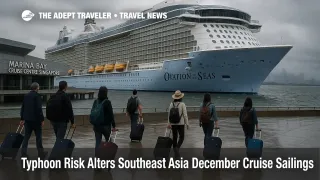
Royal Caribbean's Ovation of the Seas has already shown how fast a Southeast Asia cruise typhoon itinerary change can unfold, after a three night Singapore to Penang sailing that left on November 27, 2025 dropped its Malaysian port call and spent the weekend at sea to steer clear of a developing tropical system. Guests still returned to Singapore on November 30 as scheduled, but shore days vanished and the voyage turned into a cruise to nowhere. For travelers booked on December sailings out of Singapore, this is a clear signal to treat current storms and flooding in Indonesia, Malaysia, and Thailand as a live operational risk, not a distant headline.
In practice, this Southeast Asia cruise typhoon itinerary change was a textbook example of how lines will skip or reshuffle ports when a cyclone threatens crowded coastal approaches and narrow straits, keeping ships and guests clear of strong winds, heavy rain, and swollen harbor traffic even if it means disappointing passengers who had planned time ashore in Penang or nearby destinations.
Typhoon Forces Ovation Of The Seas To Skip Penang
According to cruise industry reports, the Ovation of the Seas departed Singapore's Marina Bay Cruise Centre on November 27, 2025 for a three night itinerary that was supposed to include Penang, Malaysia. As Tropical Cyclone Senyar, spelled Sanyar in some coverage and cruise statements, consolidated near the western coast of Malaysia and moved across the region, Royal Caribbean's onboard announcement told guests the Penang call would be canceled in favor of an extra day at sea in order to avoid the storm's projected path.
The ship remained at sea on Friday and Saturday, then returned to Singapore on Sunday, November 30, 2025, keeping its original disembarkation time and allowing flights and hotel plans at the homeport to go ahead with minimal disruption. Royal Caribbean refunded pre purchased shore excursions as onboard credit, with any unused refundable balance to be sent back to guest credit cards within 14 business days, which fits the industry pattern where port charges and line sold tours are reimbursed, but broader compensation for missed ports is limited when weather is involved.
Background: Rare Malacca Strait Cyclone And Regional Flooding
Meteorological agencies and regional analysts note that Tropical Cyclone Senyar was a rare system that formed in or near the Malacca Strait, a busy shipping corridor between Sumatra and the Malay Peninsula that typically sees few full fledged cyclones because of its proximity to the equator. As Senyar and companion systems Koto and Ditwah pulled moist air into the region, torrents of rain triggered widespread floods and landslides in Indonesia, Malaysia, Thailand, and Sri Lanka, killing more than 1,100 people across South and Southeast Asia and displacing hundreds of thousands.
Indonesia alone has reported over 600 deaths and more than 1.5 million people affected, with 28,000 homes damaged, while southern Thailand and parts of Malaysia have also seen severe flooding, damaged infrastructure, and long running power or water outages. Even once the immediate storm threat to ships passes, recovery work on roads, ports, and tourist areas can take weeks, which means cruise lines and shore excursion operators may need to alter plans at short notice.
For cruise travelers, this matters because late season storms in Southeast Asia are not just a sea state problem. Flooded roads, damaged piers, and strained local emergency services can all influence whether a ship can safely dock or whether it is responsible to bring thousands of tourists into a recovering community.
What This Means For December Cruises From Singapore
From early December through the New Year period, Ovation of the Seas is scheduled to operate a mix of three and four night cruises from Singapore that typically call at Penang and Phuket, plus a special eight night New Year itinerary with stops at Indonesian ports such as Bali, Lombok, and Celukan Bawang. Schedules have not been publicly canceled, but the November itinerary change shows that routes hugging Malaysia's west coast and the Andaman Sea will be adjusted if new systems form or if local recovery lags.
Travelers booked on December cruises should therefore plan on the possibility of port swaps, shortened calls, or extra sea days, especially on shorter itineraries where a single port call makes up most of the land time. If a port like Penang becomes difficult to serve because of weather, swell, or regional transport issues, the line may substitute another port with better conditions, or simply opt for a sea day if alternatives are not feasible within the ship's fuel and timing constraints.
Guests with back to back sailings or long haul flights tied closely to embarkation and disembarkation days should also consider that heavy rain and flooding inland can slow transfers to and from the port, even when the ship itself sails as scheduled. Singapore's infrastructure is relatively robust, but connecting flights through storm hit cities in Indonesia, Malaysia, or Thailand might be delayed or rerouted, creating knock on effects for cruise arrivals.
How Cruise Lines Handle Typhoons In Asia
Cruise lines have fairly standard playbooks for typhoon and cyclone seasons in Asia. They monitor meteorological data and model tracks with in house or contracted meteorologists, then adjust itineraries to keep ships on the safe side of forecast wind and swell, even if official warnings are still evolving.
Common tools include skipping one or more ports, reordering calls so that ships arrive earlier or later than planned, switching to a more sheltered alternative, or converting a port day into a sea day. In some extreme cases, embarkation or disembarkation ports may be moved, but for Southeast Asia short cruises out of Singapore, lines usually prefer to preserve the homeport and adjust intermediate stops, as in the Ovation of the Seas example.
Under most cruise contracts, weather related itinerary changes are treated as force majeure. That means travelers are not entitled to full refunds simply because a specific port is missed, though taxes, fees, and port charges tied to that call are normally refunded, and line sold excursions are either refunded or converted into onboard credit. Additional goodwill gestures, such as future cruise credits, tend to be reserved for more severe events or when onboard experience is heavily degraded.
Travel Insurance, Shore Excursions, And Independent Plans
From a traveler standpoint, the big question is how much financial risk they carry when a Southeast Asia cruise typhoon itinerary change wipes out a port day. Standard trip insurance often provides little or no benefit for missed ports alone, unless the policy includes specific missed port coverage or the disruption also causes a covered trip delay, such as forcing an extra hotel night or additional flights. Policies that do cover missed ports usually have limits per port and per trip, and require documentation of the official change.
Shore excursions booked through the cruise line are typically the least risky, because they are automatically refunded or rebooked if the ship does not dock. Independent tours, private guides, or prepaid tickets to attractions in port are where travelers can lose money, since local providers may not offer refunds when a ship skips a call due to weather. Choosing operators with flexible cancellation policies, and using credit cards that offer some trip protection, can soften the blow.
Travelers who have tied flights or nonrefundable hotels to an extended pre cruise or post cruise stay in Malaysia, Thailand, or Indonesia should also pay attention to the broader flood situation and not only the ship's movements. Even if their cruise sails, landslides or damaged roads could complicate side trips to inland areas that would normally be straightforward.
Practical Planning Tips For Upcoming Sailings
If you are booked on a December Southeast Asia cruise out of Singapore, start by checking Royal Caribbean's official travel updates page and your cruise planner for any pre sailing notices about itinerary monitoring or changes. Make sure your contact details in the booking are correct so that any last minute emails or app notifications reach you quickly.
When planning shore time, favor refundable or pay on the day activities for ports like Penang, Phuket, and smaller Indonesian stops, at least until the current storm cluster and regional floods have clearly eased and local infrastructure is back on solid footing. Build in slack around embarkation and disembarkation by arriving in Singapore at least one day before your cruise, avoiding last flight of the day arrivals, and leaving a cushion before onward flights after you disembark, especially if your route home relies on connecting flights through storm affected countries.
For insurance, review your policy's wording on weather, missed ports, and trip interruption to understand what is and is not covered in the event of another Southeast Asia cruise typhoon itinerary change. If protection is thin and you have not yet sailed, you may still be able to upgrade coverage or add a cancel for any reason rider, though those products come with higher costs and stricter timelines.
Finally, manage expectations. In a season when a rare Malacca Strait cyclone has caused severe flooding and loss of life across Indonesia, Malaysia, and Thailand, cruise itineraries are likely to remain fluid for some time. Treat the ship itself and any sea days as the primary product, and see port intensive plans and specific destinations as bonuses that may shift as safety and regional recovery demand, rather than as fixed promises.
Sources
- Singapore, Malaysia, Thailand, and Indonesia See Itinerary Change as Royal Caribbean's Ovation of the Seas Alters Course Due to Typhoon Threat
- Royal Caribbean Ship Offers Cruise to Nowhere Due to Cyclone
- Ovation of the Seas Forced to Sail to Nowhere Due to Tropical Cyclone
- Southeast Asia storm deaths near 800 as scale of disaster revealed
- Southeast Asia hit by deadly widespread flooding with three tropical cyclones, including rare Malacca Strait cyclone
- How cyclones and monsoon rains converged to devastate parts of Asia
- Travel Updates