

US Shutdown Flight Cuts End, Airports Still Tight
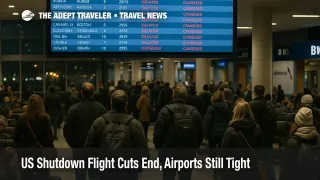
A long federal government shutdown in October and November forced the Federal Aviation Administration to order airlines to cut traffic at 40 of the busiest US airports, with reductions reaching 10 percent of scheduled flights before being lifted in mid November. The emergency order has now expired and airlines have restored normal schedules, but tens of thousands of passengers have already faced delays and cancellations and the episode exposed how little slack remains in the air traffic control system at major hubs heading into winter. Travelers planning December trips should treat the shutdown as a warning signal, not a closed chapter, and build extra buffer into connections at key airports.
In practical terms, the US shutdown flight cuts reduced capacity at high traffic airports between November 7 and roughly November 16, 2025, with reductions ramping from 4 percent to 10 percent of flights as air traffic control, ATC, centers coped with unpaid staff working overtime or calling out. Even with the formal cap gone, staffing and weather together will keep delay risk elevated at northern and central hubs through at least mid December. Travelers whose winter plans involve Chicago, Boston, New York, Denver, or Detroit need to assume rolling disruption is a live possibility, not a remote threat.
How the shutdown flight cuts worked
During the shutdown, Transportation Secretary Sean Duffy and FAA officials issued an emergency order covering 40 high volume airports, mostly drawn from the Core 30 list of the country's busiest hubs. The plan required airlines to submit reduced schedules and to phase in cuts across several dates, starting with roughly a 4 percent reduction on November 7, then 6 percent by November 11, 8 percent by November 13, and a full 10 percent by November 14.
The order focused on domestic operations and exempted most international flights at first, but in practice the squeeze affected connections throughout the network. Hubs ranging from Ted Stevens Anchorage International Airport (ANC) and Hartsfield Jackson Atlanta International Airport (ATL) to Boston Logan International Airport (BOS), Chicago O Hare International Airport (ORD), Los Angeles International Airport (LAX), and Seattle Tacoma International Airport (SEA) all saw schedules trimmed, with ripple effects at secondary airports that rely on feed traffic.
By mid November, after Congress passed a funding bill and the shutdown ended, the FAA eased the cap to around 3 percent and then lifted it fully around November 16 to 17 once controller staffing stabilized. However, the period left a mark. Over the course of the shutdown and the reduction order, more than 10,000 flights were delayed and at least several thousand were canceled nationwide, straining crews, aircraft rotations, and traveler confidence.
FAA investigation into airline compliance
The story did not end when the caps disappeared from daily operations. In early December, the FAA opened a formal investigation into whether airlines complied with the reduction order or tried to squeeze in more flights than allowed at constrained airports. According to reporting based on agency letters to carriers, airlines that operate more than 10 daily flights at any of the 40 airports have been asked to show that they cut the required share of operations on each day the order was in force. The FAA has signaled it can levy fines of up to roughly $75,000 per excess flight if airlines are found to have ignored the mandate.
For travelers, the investigation itself does not directly change day to day flying, but it reinforces that regulators consider the margin between safe staffing and overload to be thin. If a similar political impasse or budget shock emerges later, the agency now has a clear precedent for cutting schedules quickly, and airlines know their responses will be scrutinized after the fact. That makes it more likely that carriers will preemptively trim or consolidate flights rather than gamble on running tight schedules with little slack.
Why the system stays tight into winter
Even before the shutdown, air traffic control staffing was under pressure, with long training pipelines and years of hiring gaps leaving the FAA several thousand controllers short of internal targets. During the shutdown, 13,000 controllers and tens of thousands of security screeners worked without pay, leading to rising absenteeism and visible bottlenecks at major hubs. That workforce is now getting paid again, but fatigue, morale, and training backlogs do not reset overnight.
At the same time, seasonal forecasts for winter 2025 to 2026 show a cold and snowy pattern across much of the northern United States and southern Canada, particularly in December and January. Recent outlooks highlight higher than usual snowfall risk for the Midwest, Great Lakes, and Northeast, with storms like Winter Storm Bellamy already targeting the Chicago and Detroit corridors and promising heavy snow and near blizzard conditions on some weekends. That means hubs such as Chicago O Hare, Denver International Airport (DEN), Detroit Metropolitan Wayne County Airport (DTW), and the New York airports are likely to see more frequent weather related ground delay programs and de icing holds.
Put bluntly, the shutdown cuts briefly lowered demand to match constrained ATC capacity. Now that schedules are back to normal, the same staffing base has to handle full traffic plus the added friction of winter weather. That is why the system feels tight even though the formal emergency order has expired.
Practical takeaways for US travel through mid December
Travelers flying through northern and central hubs over the next couple of weeks should assume that weather, not shutdown politics, will be the main trigger for disruption, but that underlying staffing strain will make it harder for the system to bounce back on busy days. On days when the FAA issues alerts for high winds, low ceilings, snow, or thunderstorms at key airports, it is smart to avoid the last flight of the night into or out of those hubs whenever possible.
For itineraries that require a connection, especially those that touch two of the 40 previously constrained airports on the same day, keep at least two hours of scheduled connection time for domestic to domestic legs and more for international arrivals. Self connecting on separate tickets through Chicago O Hare, Boston Logan, John F Kennedy International Airport (JFK), Newark Liberty International Airport (EWR), or LaGuardia Airport (LGA) is particularly risky if winter storms are in the forecast, because airlines are less obligated to protect onward travel when separate tickets are involved.
Where possible, book through itineraries on a single carrier or alliance so that one airline has clear responsibility for rebooking if your first leg misconnects. This matters more than ever when fleets and crew rotations are already stretched by earlier disruptions from the shutdown and ongoing winter weather. If you have expensive, time sensitive commitments after arrival, such as a cruise departure, long haul tour, or nonrefundable event, plan to reach the embarkation city at least one full day before those fixed start times.
It is also worth watching airline travel alerts, not only for waivers tied to specific storms, but for any lingering schedule adjustments as carriers rebalance fleets after the shutdown period. Major US airlines have already shown during the crisis that they will proactively cut flights if the FAA tightens the screws again, and that pattern will likely repeat in future funding standoffs. For ongoing context on daily delay risks, travelers can cross check FAA advisories with operational coverage, including our daily Flight Delays And Airport Impacts updates and earlier reporting on the shutdown flight caps.
Background
The FAA's reduction order drew heavily on its existing toolkit of ground delay programs, ground stops, and slot style caps at congested airports, but applied them more broadly and for staffing, not just weather. The 40 affected airports included the busiest hubs by scheduled traffic and connectivity, which is why the percentage cuts translated quickly into missed connections and crowded rebooking lines even for travelers who were not flying to Washington, D C, or other obvious political centers.
For day to day travelers, the main lesson is that the US aviation system does not have a large reserve of extra capacity at its biggest nodes. Whether the trigger is a political shutdown, a winter storm, or another type of shock, the same airports tend to absorb the most pressure and pass it on down the line. Building itineraries with that reality in mind is the best way to keep a bad day from turning into an avoidable overnight stay.
Sources
- DOT and FAA announce temporary 10 percent reduction in flights at 40 airports
- FAA Emergency Order 11 6 25
- Exclusive, US orders 10 percent flights cut at major US airports due to shutdown
- 2025 United States federal government shutdown
- Delta says government shutdown cost airline $200 million
- Delta says government shutdown dented profit by $200 million
- FAA ramps up probe on airlines flight reductions during government shutdown
- Seasonal predictions show a strong start of the 2025, 2026 snow season across North America
- Winter Storm Bellamy impact, a foot of snow forecast to blanket Midwest and Great Lakes
- NOAA Winter 2025, 26 Outlook