

Europe 2025 Travel Rules Tighten Borders And Costs
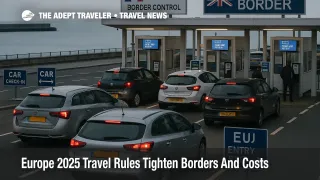
Across Europe in 2025, travel rules are tightening at borders, in city centers, and even on ski slopes, and those changes will shape trips through at least 2026. Non EU visitors are starting to register fingerprints and photos at digital kiosks, while UK bound travelers face a firm deadline for a new electronic permit. At the same time, tourist taxes, behavior fines, and airline rule changes are raising the cost of getting around and increasing the risk of surprise friction for budget focused travelers.
Taken together, Europe 2025 travel rules mean more digital checks at borders, higher local levies, and stricter codes of conduct that travelers will need to factor into itineraries, connections, and budgets.
Border Controls, Permits, And Digital Checks
The biggest structural change is the long delayed Entry Exit System, EES, the EU wide digital border regime that started operating on October 12, 2025. Over a six month rollout, 29 European countries that apply Schengen rules are phasing in biometric checks for non EU nationals at their external borders, including Iceland, Norway, Switzerland, and Liechtenstein, but not Ireland or Cyprus. Instead of a manual passport stamp, travelers will have their passport scanned and provide fingerprints and a facial image that are stored for three years in a central database.
The goals are to enforce the 90 day in 180 days visa free rule, track overstays, and tighten security checks by automatically flagging travellers already in watchlist systems. In practice, the first months have produced uneven queues. Early reports from Channel crossings say processing per car can stretch from under a minute to several minutes while travelers leave vehicles to enroll at kiosks, and the Port of Dover has delayed EES checks for private cars until early 2026 to avoid Christmas gridlock.
Two linked systems will sit on top of this new border layer. ETIAS, the European Travel Information and Authorisation System, is now expected to launch in the last quarter of 2026 rather than 2025. Once live, it will require visa exempt visitors from countries such as the United States, Canada, and the United Kingdom to apply online in advance, pay a 20.00 (EUR) fee, and receive a three year authorisation valid for stays of up to 90 days within any 180 day window.
Separately, the United Kingdom is tightening its own border rules through a mandatory Electronic Travel Authorisation, ETA, for visa exempt visitors. After a long soft launch, the UK Home Office has confirmed full enforcement from February 25, 2026, with a strict no permission, no travel policy. Most visitors from 85 countries will need to apply online, pay 16.00 (GBP), about 18.20 (EUR), and receive a two year digital permit before airlines or ferries will allow boarding.
For travelers, the border trend line is clear. First time EES registration will take longer than a simple passport stamp, especially at constrained sites such as Channel ports and Eurostar terminals. ETIAS and UK ETA add another pre trip task, and carriers will be expected to deny boarding to anyone who shows up without authorisation. Trips that combine EU and UK segments, such as a Paris plus London itinerary, will need special attention to make sure both digital permissions are in place.
Rising Tourist Taxes And Travel Costs
While border controls move online, travel costs on the ground are creeping up through a patchwork of tourist taxes and sector specific price rises. Iceland reinstated its accommodation tax at the start of 2024, charging about 600 Icelandic krona per hotel room night, roughly 4.25 (EUR), with lower rates for campsites and a separate 1,000 krona tax per cruise passenger. In October 2025 Iceland signalled that further increases are likely as visitor numbers hit record highs.
Norway followed in June 2025, approving a national framework that lets municipalities levy up to 3 percent on overnight stays and cruise passengers in areas particularly affected by tourism, with collection expected from summer 2026. In the United Kingdom, Edinburgh has passed the country s first comprehensive overnight visitor tax, a 5 percent levy due to phase in from May 2025 and be fully enforced by July 2026, while Manchester already charges a 1.00 (GBP) per room per night city visitor fee. The UK government is now moving to let other English cities, including London, introduce their own tourism taxes as part of a wider devolution package.
Venice remains a test case for more aggressive day trip controls. In 2025 the city reinstated its 5.00 (EUR) entry fee for day trippers on 54 high demand days between April 18 and July 27, and began charging double for tickets bought within three days of arrival. Overnight guests continue to pay a separate hotel based tourist tax, but do not pay the day entry fee.
Skiers have taken an especially hard hit. Recent analysis suggests that the cost of skiing in Europe has risen 34.8 percent above inflation since 2015, with Swiss, Austrian, and Italian resorts especially responsible, and Italian watchdog Assoutenti warning that some day passes are up about 40 percent compared with 2021. For many families, that turns a once regular winter week on the slopes into an occasional luxury. When stacked with accommodation taxes and higher food and energy costs in mountain towns, the uplift can be dramatic.
New Codes Of Conduct And Fines
Price signals are only part of Europe s push toward what many officials now call quality tourism. Cities are also writing stricter rules into local ordinances to curb noise, litter, and drunkenness in crowded districts, and to give residents more leverage when tourist behavior spills into everyday life.
San Sebastian in Spain is moving ahead with a ban on smoking on all of its beaches, along with limits on loudspeakers and clearer rules for pets, with implementation expected in 2026. In Portugal, the resort city of Albufeira has approved a new code of conduct that penalises wearing swimwear away from beaches or pools, street drinking, public nudity, and other nuisance behavior, with fines ranging from hundreds to as much as about 1,800.00 (EUR).
Palma on the island of Mallorca is going further on the structural side. From 2026, the city will ban all new holiday rentals, tighten hostel rules, and prohibit party boats from docking along its seafront, explicitly to reduce noise, crowding, and the pressure on local housing. Similar crackdowns on short term rentals are underway or under debate in other hot spots such as Barcelona and parts of the French Riviera, often coupled with stronger enforcement of existing caps.
France has shifted enforcement into the air. New rules allow fines up to 10,000.00 (EUR) for serious first offences and up to 20,000.00 (EUR) for repeat offenders who obstruct crew, ignore safety instructions, or use prohibited devices, with the worst cases facing flight bans of up to four years on any French licensed carrier. For travelers, unruly behavior that once might have resulted in a warning or a single airline ban can now carry Europe wide consequences.
Passenger Rights And Airline Policies
Parallel to these crackdowns, the rules that protect passengers when things go wrong are under active renegotiation. EU Regulation 261, the long standing air passenger rights law, still grants compensation of 250.00 to 600.00 (EUR) when flights are cancelled or delayed by more than three hours for reasons under an airline s control. However, in June 2025 EU member states agreed on a Council position that would raise delay thresholds to four hours for short haul flights and six hours for long haul journeys, while slightly increasing short haul payouts and reducing long haul ones.
Consumer groups say this would strip many travelers of compensation, since most delays fall between two and four hours, while airline associations want even looser rules. As of early December 2025, negotiations between the Council and the European Parliament have yet to produce a final law, so the current three hour threshold still applies, but travelers should expect eventual changes to when and how much they can claim.
Airline policies are also shifting. Ryanair recently stopped accepting printed boarding passes, requiring passengers to use digital passes in its mobile app, only to be warned by Portugal s aviation regulator that it cannot refuse boarding to passengers holding physical boarding passes or charge extra fees for them under EU rules. That clash highlights a broader tension between carriers pushing digital only processes and regulators insisting on fallback options for passengers without smartphones or stable connectivity.
How To Plan Europe Trips Under 2025 Rules
For travelers planning trips in 2025 and 2026, the practical implications of Europe 2025 travel rules are clear. First, anyone who will cross an external Schengen border should assume extra time for EES registration at least once, and should avoid planning tight same day connections immediately after arrival, especially when connecting to separate tickets or long distance trains. Returning visitors whose data are already in the system should still allow some cushion, since queues will depend heavily on how quickly each border post ramps up.
Second, visitors from visa exempt countries should map out when ETIAS and UK ETA will affect them. A multi stop trip that includes both Schengen and the UK may eventually require two separate pre travel authorisations, applied for via different systems, with separate fees and validity periods. Until ETIAS is live, travelers still follow the familiar passport plus 90 in 180 days rule, but should monitor official EU travel channels for the confirmed start date.
Third, budget calculations need to account for destination specific extras. A week in Iceland or a Norwegian fjord town will now include per night accommodation taxes and, for cruise passengers, per call levies that can add a meaningful percentage to overall costs. City breaks in places like Edinburgh, Manchester, or eventually London will carry visitor charges that might tip the balance when comparing hotel rates with similar cities that do not yet levy taxes.
Finally, anyone drawn to party resort zones or historic city centers should read up on new codes of conduct and enforcement. Walking from the beach into town in swimwear, smoking on certain beaches, or joining a late night boat party may now bring heavy fines, bans, or, in the most serious aviation cases, long term flight restrictions. Keeping behavior in line with local norms, carrying both digital and printable copies of boarding passes where possible, and leaving room in schedules for slower border checks will go a long way toward making these new rules something to manage rather than a source of ugly surprises.
Sources
- Entry Exit System, European Commission
- Travel to Europe, EES and ETIAS overview
- Council sets position on clearer and improved rules for air passengers
- EU lawmakers fail to agree on new air passengers rights law
- Iceland to propose higher tourist tax following record visitors
- Norway to introduce tourist tax amid record visitor numbers
- Edinburgh to introduce tourist tax for overnight stays
- Venice tourist fee returns and will double for last minute day trippers
- Soaring ski pass prices are making Europe s slopes unaffordable
- San Sebastian smoke free beaches and new rules
- Albufeira tourist behavior fines
- Palma bans new tourist rentals and party boats
- France to hit disruptive air passengers with fines and flight bans
- Portugal warns Ryanair cannot refuse passengers with paper boarding passes
- No permission, no travel, UK ETA enforcement