

India Domestic Flight Cancellations Disrupt Travel
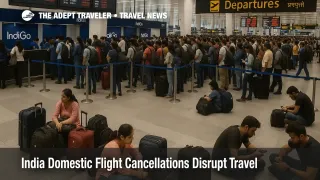
India domestic flight cancellations linked to new pilot rest rules at IndiGo have left passengers stranded across New Delhi, Mumbai, Bengaluru, Hyderabad, and Chennai on December 5, 2025, with roughly 500 flights scrubbed today and more than 1,000 affected since Tuesday. The disruption is concentrated at India's largest carrier, IndiGo, which operates around two thirds of domestic seats, but it is rippling across the wider market as alternative flights sell out and fares spike. Travelers with India trips in the next two weeks, especially those connecting onward to Europe, the Gulf, or Southeast Asia, now need to rethink routings, add buffer time, or move to other airlines where they can.
The bottom line is that India domestic flight cancellations driven by crew duty rules, and IndiGo's planning mistakes, are reshaping short term travel inside India and through its hubs, so anyone with near term itineraries should treat IndiGo as a risk factor and plan around a longer recovery window than the headline three to five day fix.
Where IndiGo Cancellations Are Hitting Hardest
IndiGo controls roughly 60 to 65 percent of India's domestic market, with dense schedules linking major metros and feeding international departures at key hubs. On December 5, the airline cancelled about 500 flights nationwide, with more than four days of heavy disruption that began earlier in the week and has already affected over 1,000 services.
Indira Gandhi International Airport (DEL) in New Delhi, one of the airline's largest bases, has gone as far as cancelling all domestic IndiGo departures until midnight, a rare step that effectively writes off the carrier's domestic operation at the capital for the day. At Chhatrapati Shivaji Maharaj International Airport (BOM) in Mumbai, Kempegowda International Airport (BLR) in Bengaluru, Rajiv Gandhi International Airport (HYD) in Hyderabad, and Chennai International Airport (MAA), departures and arrivals boards show dozens of cancellations, with terminals crowded and queues snaking around check in and rebooking desks.
The impact is most intense on core domestic trunk routes, such as Delhi to Mumbai, Bengaluru, Hyderabad, and Chennai, where IndiGo normally operates high frequency service throughout the day. Secondary cities that rely heavily on IndiGo for connectivity, including many tier two and tier three airports, are seeing thin or no same day alternatives and sharply higher fares on the airlines that do still operate.
International flights are less affected in absolute numbers, but the cancellations are still punching holes in itineraries that depend on IndiGo to feed long haul departures on other airlines. Passengers booked on separate tickets, for example a domestic IndiGo leg into Delhi followed by a Gulf carrier to Dubai or Doha, or a European airline to London or Frankfurt, face the highest misconnect risk, since long haul operators are under no obligation to wait for IndiGo's delayed or cancelled feeders.
What Changed In The Pilot Rest Rules
The immediate trigger for this crisis is a set of new Flight Duty Time Limit, FDTL, rules that India's Directorate General of Civil Aviation, DGCA, began rolling out earlier this year, after years of complaints about pilot fatigue and a Delhi High Court order to tighten protections. The second phase of these norms came into force on November 1, 2025, and required airlines to provide at least 48 consecutive hours of weekly rest, count leave separately from that rest, extend the definition of night duty, and cut the number of allowed night landings from six to two per week.
Other Indian airlines adjusted rosters gradually and, so far, have not experienced similar meltdowns. IndiGo, by contrast, tried to preserve much of its pre rule schedule while working within the tighter limits, then ran out of rested, legal crews this week as peak season fog schedules and holiday demand overlapped with the new constraints. The airline has publicly blamed "misjudgment and planning gaps" for the scale of cancellations, a rare admission that points more to internal rostering decisions than to the rules themselves.
Facing crowded terminals, angry passengers, and mounting political pressure, the aviation ministry has now put key parts of the new regime in abeyance for IndiGo. The DGCA has granted a one time exemption on night duty limits and allowed the airline to treat some pilot leave as part of the required weekly rest, effectively relaxing the protections that had just been introduced. The exemptions run through February 10 according to filings noted in official and media reports, which is also the date IndiGo has given the regulator as its target to fully restore the schedule.
For travelers, the important detail is not the precise wording of the FDTL clauses, but the reality that IndiGo's crew planning is stretched, and that the government's fix trades some of the new rest protections for an urgent, temporary recovery in capacity. That makes it reasonable to expect further disruption while the airline rebuilds rosters, even if daily cancellation counts begin to drop.
IndiGo Rebooking, Refunds, And How Rivals Compare
IndiGo has announced a range of measures for passengers affected between December 5 and 15, including automatic refunds for cancelled flights, no fee rescheduling in many cases, and support such as hotel rooms, food vouchers, and lounge access for certain stranded travelers, particularly seniors. The airline is also arranging some ground transport on busy corridors where flights have been pulled.
Policies can vary by ticket type, channel, and whether a passenger is on a purely domestic itinerary or an international one with IndiGo providing a feeder leg. In practice, travelers are reporting long waits to reach call centers, limited same day options, and difficulty securing clear written confirmation of hotel or meal coverage, so it is wise to capture screenshots of any offers shown in the app or on email before accepting changes.
Other Indian airlines, including Air India, Vistara, Akasa, and SpiceJet, remain largely unaffected operationally by the FDTL rules, but they are now operating into a market where thousands of passengers a day are trying to rebook. On core routes where IndiGo normally fields multiple flights, remaining seats on rival carriers are priced significantly higher than average, with some domestic one way fares reportedly climbing into the equivalent of several hundred dollars.
Most of these carriers have not announced broad, systemwide waivers tied to IndiGo's issues. If you voluntarily move from a functioning rival airline to escape a risky IndiGo connection, you will usually be subject to the normal fare rules for that ticket, including any change fees and fare differences. That makes it important to distinguish between legs that have been formally cancelled, where consumer protection rules and airline policies are strongest, and flights that are still scheduled but at risk.
Travel advisors and experienced travelers should also watch how this episode fits into a broader pattern of strained aviation systems. For example, Adept Traveler recently examined how cancellations exposed regional airline fragility in parts of Africa, and how floods have disrupted travel across Asia, both of which echo the lesson that concentrated carriers and thin staffing can make entire regions vulnerable when one player stumbles. Those pieces can be useful context for understanding why India's market is reacting so sharply to a single airline's meltdown. See Adept Traveler's coverage of Africa regional airline fragility and Asia floods and travel disruption for structural parallels, and our Asia travel advisories and visa extension guidance for a wider look at regional risk management.
Planning India Trips And Long Haul Connections In The Next Two Weeks
IndiGo's CEO has publicly said the airline expects cancellations to drop below 1,000 on Saturday, and that operations should "normalise" between December 10 and 15. Regulators, however, are working off a longer horizon, with the February 10 target aligned to the temporary rule exemptions. For practical planning, that suggests a two stage approach.
Through roughly December 10 to 15, assume that IndiGo's operation will be unstable, with days of relatively smooth flying mixed with fresh pockets of cancellations as crew assignments, weather, and fog season at northern airports interact. New bookings on IndiGo for high stakes travel in this window, for example a wedding, a once a year business meeting, or a nonrefundable tour departure, should be made only with large time buffers or with a fully backed up alternative.
If you already hold a ticket on IndiGo in this period, first confirm whether your flight is among those cancelled or retimed, then use any no fee rebooking offers to move to less critical days or earlier departures. When possible, reroute onto carriers that are not relying on IndiGo's domestic network, even if that means routing via Dubai, Doha, Abu Dhabi, Singapore, or other hubs outside India before returning.
From mid December to early February, IndiGo's schedule may look more stable on paper, but the airline will still be balancing crew availability, altered duty limits, and seasonal weather. For trips booked in this period, consider IndiGo for simple nonstop domestic legs where there is backup service on other airlines, but continue to be cautious about using it as a critical feeder into long haul flights on separate tickets. Where the long haul segment is on the same ticket as the domestic one, the through carrier has stronger obligations to reroute you if something goes wrong.
For complex itineraries that mix multiple airlines and self made connections, a conservative approach is to arrive at your international gateway at least one calendar day before any non changeable cruise departure, tour start, or major event. This is similar to our guidance for other disruption prone markets and mirrors the advice in our regional pieces on Asia floods and Africa's airline network vulnerabilities.
Background: Why IndiGo's Size Makes This Different
India's aviation market has grown rapidly in recent years, and IndiGo's strategy of operating a large, low cost fleet on dense domestic routes has made it the dominant player. That dominance means that any severe disruption at IndiGo has an outsize effect on the entire system, since rivals cannot quickly add enough capacity to absorb tens of thousands of displaced passengers in peak season.
The pilot rest rules at the heart of the crisis were intended to address real fatigue concerns, which have surfaced globally as airlines rebuilt schedules post pandemic and then pushed productivity hard. India is not alone in trying to recalibrate that balance, but the combination of a tight labor market, one very large carrier, and relatively thin redundancy in regional capacity has made this a particularly visible test case.
For travelers and advisors, the episode underlines a few structural lessons. First, in markets where one airline carries a majority of traffic, any shock to that airline, whether from IT outages, strikes, or regulatory changes, can behave more like a network wide event than an isolated problem. Second, safety driven rule changes can still have messy transitional periods, especially if airlines underestimate the impact on crew rosters. Third, once regulators relax rules to stabilise operations, debates about pilot fatigue and risk can continue in the background, which may be relevant for risk averse travelers even after schedules appear "normal" again.
IndiGo's meltdown will not stop most travel to, from, or within India, but it should change how travelers think about routing, buffer time, and airline choice over the next several weeks. Treat this as an opportunity to harden your itineraries, learn how your tickets are structured, and decide where you are comfortable trading time and money for resilience.
Sources
- Reuters, Indian air travel crippled as IndiGo hit with operational crisis
- Associated Press, India withdraws pilot restrictions after largest airline cancels flights and disrupts airports
- Reuters, India grants one time exemption to IndiGo from pilot night duty rules
- Deccan Herald, IndiGo crisis, Aviation ministry puts new FDTL norms on hold, orders high level probe into what went wrong
- Mint, IndiGo meltdown, Shashi Tharoor backs DGCA, raps airline
- NDTV, IndiGo Flights Disruption Live Updates, Situation To Normalise Between December 10 And 15, Says CEO
- Indian Express, IndiGo Flight Cancellations Live Updates, IndiGo CEO apologises for inconvenience caused to passengers
- Hindustan Times, IndiGo meltdown, DGCA caves in, freezes crew duty rules amid flight disruptions
- Times of India, IndiGo flight crisis, what went wrong and when normalcy may return, explained
- Gulf News, IndiGo flight cancellations, over 500 flights hit Friday, other airlines warn of delays