

Lufthansa Hidden Disabilities Sunflower Support Onboard
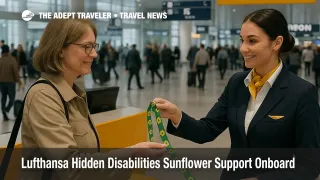
Lufthansa has become the latest major European carrier to join the Hidden Disabilities Sunflower Program, a global scheme that uses a simple green lanyard with yellow sunflowers to signal that a traveler may need extra time, patience, or support. The airline confirmed that it joined the program on December 1, 2025, and is rolling it out first at its Munich hub, with Frankfurt to follow from January 2026. For travelers with invisible disabilities, that means more staff awareness at key points of the journey and a clearer way to ask for understanding, without having to explain their situation repeatedly.
In practical terms, the Lufthansa Hidden Disabilities Sunflower program adds a recognized accessibility tool on top of existing assistance services, especially for passengers connecting through Munich Airport (MUC) and Frankfurt Airport (FRA), where the airline and airport partners are now part of the wider Sunflower network. It does not change flight schedules or priority rules, but it can make crowded check in areas, security lanes, and boarding gates less stressful if staff understand at a glance that a traveler may need a little more time.
Background, The Hidden Disabilities Sunflower Program
The Hidden Disabilities Sunflower is an international initiative, launched at London Gatwick Airport in 2016, that lets people with non visible disabilities choose to wear a green lanyard decorated with yellow sunflowers. The symbol has spread across transport systems, supermarkets, universities, and other high traffic spaces, and is now recognized at hundreds of airports and by more than twenty airlines worldwide. The core idea is voluntary disclosure, trust, and respect, not certification or proof of disability.
A hidden or non visible disability can include long term physical, mental, or neurological conditions, such as chronic pain, autism, ADHD, some mental health conditions, or sensory impairments. The World Health Organization estimates that around 1.3 billion people worldwide live with some form of disability, and many of those disabilities are not obvious at a glance. The Sunflower lanyard gives these travelers a way to flag that they may need time to process instructions, clearer communication, help managing crowds, or flexibility if they become overwhelmed, without having to disclose personal details to every staff member they encounter.
How The Sunflower Works At Lufthansa
Under the new program, Lufthansa passengers with non visible disabilities can wear a Sunflower symbol, typically as a lanyard with a pendant, so that airline and airport staff recognize that additional support may be appropriate. Lufthansa has briefed and trained ground and cabin crews on what the sunflower means and how to respond, with a focus on patience, clear explanations, and practical help rather than special treatment or fast tracking.
The airline stresses that wearing the lanyard is completely optional, and that it does not replace existing services such as wheelchair assistance or formal escorts. Travelers who need guaranteed physical support or transfers must still request assistance through normal channels, either via the airline or airport accessibility service, and within the required lead times before departure. The Sunflower is a communication tool, not a service booking in itself, so travelers should think of it as a complement to, not a substitute for, official support.
At the same time, the program encourages airport and airline staff to take the initiative once they see the lanyard. That can mean offering extra time at check in, using simpler language, suggesting quieter waiting areas, or stepping in faster if a traveler appears distressed in a queue or boarding line. For many passengers with invisible disabilities, this kind of proactive, low friction support can reduce the stress of air travel more than any formal policy change.
Munich And Frankfurt, First Home Hubs To Implement The Scheme
Munich Airport, operated by FMG, is already an active Sunflower member. The airport provides lanyards free of charge and without proof at information desks and mobility service points in both Terminal 1 and Terminal 2, and staff are trained to recognize the symbol throughout the terminal. With Lufthansa now formally aligned to the program, passengers who use the lanyard can expect consistent recognition from both airport and airline staff on the same journey through Munich.
In Frankfurt, where Fraport operates Lufthansa's larger hub, the program is slated to go live in January 2026. Once implemented, Sunflower lanyards will be available at airport information or special services counters and at Lufthansa special services points. That means travelers who begin or end their trip at Frankfurt will have similar access to free lanyards and trained staff as those connecting through Munich, although the exact pickup points and signage may differ between terminals.
Lufthansa's move fits into a wider pattern inside the group. Austrian Airlines, Eurowings, and SWISS are already Sunflower members, and the Lufthansa Group says its goal is for all group airlines to join the program by the end of 2026, creating a more consistent experience for customers who fly multiple brands within the same family.
Accessibility Beyond The Lanyard
The Sunflower rollout is only one part of the group's accessibility work. Lufthansa has created an Accessibility Customer Advisory Committee that includes travelers with reduced mobility, as well as visual, hearing, and cognitive impairments, and is using their feedback to review products, onboard experiences, and digital services. That committee can highlight where small changes, such as clearer wayfinding, better pre flight information, or more consistent handling of mobility aids, might matter just as much as formal accessibility statements.
The airline also frames the Sunflower within wider corporate responsibility and product improvement efforts, linking the initiative to its broader push for more inclusive travel. For frequent travelers with invisible disabilities, that matters because it shows this is not just a one off announcement, but part of a longer process of adjusting policies, training, and information to real world needs.
For travelers who want a deeper structural overview of flying with disabilities, it is still important to review official airline and airport accessibility pages, and to understand how pre booked assistance, seating policies, and mobility device rules work on their chosen route. Resources such as a dedicated guide to accessible air travel or region specific airport accessibility explainers can help set expectations before booking and reduce surprises on the day of travel.
Practical Tips For Travelers Using The Sunflower With Lufthansa
If you already use a Hidden Disabilities Sunflower lanyard, you can wear your existing lanyard when flying with Lufthansa Group, including at Munich and, from early 2026, Frankfurt. Staff in participating airports are trained to recognize the symbol regardless of where you received it.
If you do not yet have a lanyard, you can pick one up free of charge at Munich Airport's main information desks and mobility service points in Terminal 1 and Terminal 2. Once Frankfurt Airport completes its rollout, similar collection points will be available at information counters and Lufthansa special services desks. You may keep the lanyard for future trips, and you can generally use it at other Sunflower airports worldwide.
Travelers should still build realistic buffers into their itineraries, especially if queues, security procedures, or sensory overload are particular stressors. The lanyard should help unlock a more understanding response from staff, but it will not bypass security screening rules, immigration controls, or boarding cut off times. Where possible, choosing less congested departure times, avoiding extremely tight connections, and planning for quieter waiting spaces can be just as important as wearing the sunflower itself.
Finally, if you are comfortable doing so, consider contacting the airline in advance when booking or after ticketing to note any specific accessibility needs, such as seating preferences, storage of mobility aids, or communication accommodations. Combining pre trip communication with the Sunflower lanyard in the terminal gives staff more than one signal to work with, which tends to produce more consistent support from check in to arrival.
Sources
- Making invisible disabilities visible, Lufthansa joins the Hidden Disabilities Sunflower Program
- Munich Airport, Sunflower Program information
- Munich Airport and Lufthansa join Sunflower program, press information
- Hidden Disabilities Sunflower, official site
- Lufthansa joins the global Sunflower movement, Travel PR News summary