

Milan Key Box Ban From 2026 For Short Term Rentals
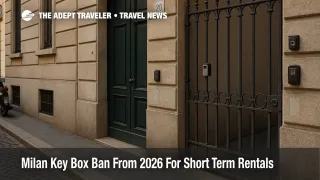
From January 2026, Milan key box ban rentals will make it illegal for short term rental hosts to hang self check in lockboxes on public land across Milan, Italy, with fines of up to €400.00 (EUR) and the cost of removal for those who ignore the new rules. The change affects owners who have been relying on key boxes attached to poles, fences, and building fronts to hand over keys without meeting guests. Travelers who book apartments in Milan will increasingly need to plan for hosted or live video check ins instead of anonymous code based access.
In practical terms, this means anyone relying on a short term rental in Milan, including visitors arriving late at night, people on business trips, and families using apartments instead of hotels, will see tighter identification checks and fewer self service arrivals. Hosts have a limited window to remove devices that sit on public space, and guests will need clearer communication about exactly how and when they will receive keys or digital access. If you are used to landing, entering a code, and letting yourself in, Italy is moving away from that model.
The Milan key box ban rentals, which takes effect in January 2026, formalizes a citywide crackdown on self check in devices attached to public structures and folds Milan into a broader Italian push for in person or visually verified guest identification at short term rentals.
Milan's New Rules On Key Boxes
Milan's city council resolution bans key boxes used for short term rentals when they are placed on street furniture, road signs, fences, gates, light poles, or any other structure on public land. Hosts who continue to use them face administrative fines between €100.00 (EUR) and €400.00 (EUR), plus the cost of having the municipality remove the devices. Flat owners have 30 days to comply and remove boxes once notified, after which the city can step in and charge for removal.
The city frames the ban on two fronts, urban decorum and security. Officials argue that rows of metal lockboxes hanging on historic facades or railings represent an improper private occupation of public space, visually cluttering streets and effectively turning sidewalks into extensions of rental businesses. The resolution also cites recent judicial investigations suggesting that some key boxes have been repurposed for illegal activities, including storing or passing drugs, which pushes Milan to treat them as a public safety issue as well as an aesthetic one.
For travelers, the important detail is that the ban targets the hardware in public view, not short term rentals as such. Apartments can still be rented to tourists, and hosts can still use internal key safes or digital access systems as long as they comply with guest identification rules and do not occupy public land. However, the disappearance of key boxes from doorways and railings will make it more common that a host, a property manager, or at least a live video agent has to see your face and your ID before you are checked in.
How Italy's Check In Rules Are Evolving
Milan's move sits inside a shifting national framework for self check in. Italy's Interior Ministry issued a circular in November 2024 that effectively banned unattended self check in for tourist rentals nationwide, insisting that hosts verify guests' identity in person and treating unmonitored key boxes as incompatible with public security rules.
In May 2025, the Lazio Regional Administrative Court (TAR Lazio) annulled that ministry directive, calling the blanket ban on remote check in disproportionate and insufficiently justified, a decision welcomed by short term rental platforms and host associations. The Interior Ministry promptly appealed, and in November 2025, Italy's Council of State reversed course again, confirming that guest identification must still be carried out in person, or via methods that offer equivalent visual verification, and making clear that purely anonymous key box handovers are not acceptable.
That legal backdrop matters for travelers because it explains why cities such as Rome, Florence, Bologna, Venice, and now Milan have devoted so much attention to key boxes. Local removal campaigns in Rome were already underway when a deputy prosecutor criticized early seizures as procedurally flawed, not because key boxes were considered harmless, but because investigators had not yet tied each box to a specific accommodation and operator. Municipalities are now aligning their enforcement with the clarified national rule, focusing on boxes visible from public space and on verifying that every guest has been identified with a face matching a documented ID.
Other Cities Already Clamping Down
Milan is joining a path already taken by Florence and other tourist hubs. Florence's local government ordered the removal of self check in key boxes from holiday rental properties in February 2025, forcing owners to take boxes down by late February or risk fines up to €400.00 (EUR) and forcible removal. Local police there have since carried out early morning inspections, cut off non compliant boxes, and framed the effort as part of a wider campaign against overtourism and loss of residential housing in the historic center.
Rome, Venice, and other high demand cities have run similar operations, especially in central districts where short term rentals cluster along tight medieval streets. Residents' groups in neighborhoods such as Trastevere in Rome have gone further, sometimes sabotaging or covering key boxes with stickers and posting photos online to protest what they see as the hollowing out of local communities by overtourism and speculative rentals. In Milan and Florence, citizen committees have used petitions, neighborhood walks, and social media campaigns to pressure municipalities to act faster when new boxes appear on facades or gates.
What This Means For Travelers Using Rentals In Milan
For visitors, the headline is simple, from early 2026 you should not expect to access a Milan apartment by picking up keys from a lockbox hanging on a pole, a fence, or an exterior gate. If a listing still advertises self check in via external key box, that is a red flag that the host has not updated their practices, and the device itself may be removed without warning if inspectors or neighbors report it.
Instead, check in will increasingly follow one of three patterns. First, traditional in person check in, where the host or an agent meets you at the property and verifies your ID. Second, in building solutions, where a keypad or key safe is installed inside common areas with condominium approval and is not used solely for hospitality, which some local rules still allow when clearly separated from tourist access. Third, live remote verification workflows, where you show your face and documents over a video call or a dedicated app before you receive a digital key or an access code, designed to satisfy the "visual verification" standard mentioned by the Council of State.
Travelers should also be prepared for tighter timing. Where anonymous key boxes once allowed almost unlimited flexibility for very late arrivals, hosts now have to organize staff or availability windows to verify identity. If your flight lands in Milan after midnight, you should not assume you can simply let yourself into a rental; confirm check in hours in writing and ask explicitly what will happen if your flight is delayed. For itineraries with heavy uncertainty, such as winter operations or complex multi leg journeys, a hotel with staffed reception may be the safer choice for at least the first night.
Background: Why Cities Are Targeting Key Boxes
Key boxes have become a visible symbol of the short term rental boom in Italy. They solve a real problem for hosts who live far from their properties or manage multiple units, and for guests who value flexibility, but they also make the scale of tourist rentals tangible on every block. Local officials argue that the explosion of boxes marks buildings where long term apartments have been converted into tourist accommodation, driving up rents and pushing residents and traditional businesses out of historic centers.
From a security perspective, Italian authorities link anonymous key box access to a perceived risk of properties being used as safe houses or short stay bases by individuals who never undergo proper identification. Even critics of the earlier nationwide ban concede that once keys sit in a box on the street, it becomes harder to know exactly who is entering a building and when. By insisting on in person or visually verified check in, and by stripping key boxes from public land in cities such as Milan and Florence, authorities are trying to close that accountability gap while still leaving some room for digital tools that identify guests as rigorously as a front desk.
For now, the balance is shifting toward more regulation, not less. Italy has backed away from removing a controversial tax break for some small scale hosts, but at the same time, it is lowering income thresholds that trigger business treatment and higher tax rates, which will push larger operators toward more formal compliance and away from informal key box based workflows. Travelers planning Milan stays in 2026 should expect more hosted check ins, more ID checks, and fewer anonymous keys on gates, and should treat any listing still advertising external key boxes with caution, since it may be forced to change access methods on short notice.
Sources
- City Council, Key Lockboxes Banned, Fines Up To €400 For Those Installing Them On Poles And Gates
- Milan Bans Self Check In Key Boxes For Short Term Rentals Starting In 2026
- Milan Bans Check In Keyboxes For Short Term Rentals
- Florence Bans Check In Keyboxes As Italy Acts Against Overtourism
- Florence Bans Keyboxes For Short Term Rentals, What To Know
- Italy's Rules On Self Check Ins Have Changed Again
- Goodbye To Self Check In And Key Boxes, New Regulation In Italy Changes The Rules
- Italy Court Cancels Ban On Remote Check Ins For Short Term Rentals