

Punjab Rail Blockade To Disrupt Trains December 5
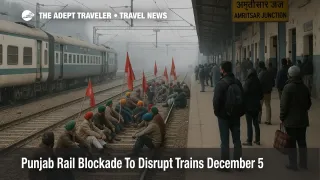
Travelers planning to cross northern India by train on December 5, 2025 now face a concentrated disruption risk, because Punjab farm unions have called for a statewide rail blockade that will halt trains at dozens of locations in the state. The Punjab rail blockade December 5 is scheduled from 100 p.m. to 300 p.m. IST at 26 sites across 19 districts, including key junctions that feed Delhi, Chandigarh, Ludhiana, Jalandhar, and Amritsar. Anyone booked on midday services through Punjab, especially long distance trains that tie into flights or overnight connections, should plan for significant delays, forced rebookings, or last minute changes.
At its core, the Punjab rail blockade December 5 is a symbolic two hour rail roko protest against India's draft Electricity Amendment Bill 2025, the spread of prepaid electricity meters, and the proposed sale of state electricity assets, but even a short stoppage can cause hours of residual delay on already crowded winter schedules.
How The Punjab Rail Blockade Will Work
The Kisan Mazdoor Morcha, a prominent farmer front that has been central to recent protests, has announced that farmers and allied labor groups will sit on tracks at 26 specified locations in 19 Punjab districts on December 5. The action is explicitly advertised as a two hour rail roko from 100 p.m. to 300 p.m. IST, rather than an open ended blockade, and is framed as the first major escalation in a month long anti bill campaign.
Organizers say the sites will include lines or stations in Amritsar, Gurdaspur, Pathankot, Tarn Taran, Ferozepur, Kapurthala, Jalandhar, Hoshiarpur, Ludhiana, Patiala, Sangrur, Fazilka, Moga, Bathinda, Muktsar, Mansa, Faridkot, Malerkotla, and Rupnagar. That footprint touches almost every major rail corridor running across Punjab toward Delhi, Jammu, and Rajasthan, and it means trains are likely to be held short of protest sites, diverted where junctions allow, or cancelled in advance on some segments.
Although the formal window is only two hours, experience from previous Punjab rail roko protests shows that trains can be delayed for much longer, because crews and rolling stock become out of position once the system restarts. In December 2024, for example, a three hour rail roko around Mohali and Dappar delayed the Vande Bharat Express by over an hour and the Paschim Express by about three hours, with other services cancelled or diverted.
Which Train Routes Are Most Exposed
The highest operational risk sits on the main lines that cross Punjab between Delhi and the western and northern borders. These include Delhi to Chandigarh and Kalka services, Delhi to Amritsar and Attari routes, Delhi to Jammu and Katra trains that pass via Ludhiana and Jalandhar, and some services linking Rajasthan and Haryana with Jammu and Himachal Pradesh. Where rail roko sit ins occur directly on these lines, Indian Railways is likely to halt trains well away from protest points, then restart them in convoys once the blockade ends.
Travelers on premium services, such as Vande Bharat Express trains between Delhi and Chandigarh or Delhi and Katra, Shatabdi Express services into Chandigarh and Amritsar, and important mail or express trains that cross Punjab in the early afternoon, should assume that a punctual run through the state on December 5 is unlikely. Even where services are not formally cancelled, a single long hold can consume most of the built in recovery time in the timetable, which pushes delays into the evening peak.
Because the Punjab rail blockade overlays routine winter disruption, the system has less slack than usual. Indian Railways has already preemptively cancelled 56 trains in North India between December 1, 2025 and March 1, 2026 due to persistent fog risk, including several services on Punjab routes such as the Chandigarh Amritsar Express and the Kalka Vaishno Devi Express. With these trains already out of the schedule, there are fewer alternative departures and arrivals available to absorb passengers from any services that are cancelled for protest reasons.
Domestic And International Connections At Risk
For domestic travelers, the most fragile itineraries are those that rely on a midday Punjab train to reach an evening flight or overnight train. This includes plans such as a 1200 p.m. or 100 p.m. departure from Amritsar, Ludhiana, or Jalandhar toward Delhi, then a same day international or domestic flight from Indira Gandhi International Airport, or a northbound afternoon service from Delhi that connects with a later train at Jalandhar or Jammu. Even if a particular train is scheduled to pass through Punjab just before or after the official 100 p.m. to 300 p.m. IST window, small delays at origin can push it into the blockade period, leading to an extended stop outside the state.
International travelers in particular should be wary of using Punjab rail routes as the last leg into a flight home on December 5. On previous rail roko days, trains that were physically stopped by protests or held as a precaution have arrived several hours late, leaving passengers stranded or forced to buy new tickets. Because many long haul flights depart late evening from Delhi, Mumbai, and Bengaluru, the safest strategy for those leaving India on December 5 is either to reach their departure city the evening of December 4, or to route to the airport by road or air rather than by rail across Punjab.
How This Fits Into The Wider Electricity Bill Protests
December's rail blockade is not a stand alone action, rather it is one step in a rolling campaign against the draft Electricity Amendment Bill 2025 and related state policies. Farmer organizations and power sector unions argue that the bill will open the door to deeper privatization of power distribution, weaken state utilities, and ultimately raise tariffs for farmers and low income consumers once cross subsidies are reduced.
The Kisan Mazdoor Morcha and allied unions began this phase of protest with memoranda to district commissioners on December 1, plan to return prepaid meters to power offices on December 10, and have announced larger sit ins at district headquarters on December 17 and 18. If their demands are not met, they have also threatened a broader rail roko across Punjab on December 19, which could be more disruptive than the symbolic two hour blockade on December 5.
For travelers, this means that December 5 is both an immediate operational risk and a potential preview of bigger rail disruptions later in the month if negotiations fail. Anyone planning multi stop rail itineraries in North India in mid December should watch for fresh protest calls and ticket waivers, and consider building more schedule flexibility than they might in a normal winter.
Practical Strategies For Travelers On And Around December 5
The simplest way to reduce risk is to avoid Punjab rail travel during the early afternoon entirely. Travelers who must journey through the state on December 5 should move departures to before about 1000 a.m., or after 500 p.m., to give trains enough time to clear the protest window. Booking an early morning train from Amritsar, Jalandhar, Ludhiana, or Chandigarh into Delhi, and then planning a late evening flight, creates more room for delays than catching a midday service that runs directly into a blockade.
Where itineraries are still flexible, it is safer to shift key rail segments one day earlier or later. A Delhi to Amritsar trip that departs on December 4 or December 6 will face normal winter fog risks, but no planned track blockages. Similarly, leisure travelers considering circuits like Delhi, Amritsar, and Dharamshala in the first half of December may want to rearrange their order of stops so that Punjab rail segments do not fall on the 5th, or replace them with road transfers on that day.
Some travelers will be better off switching modes altogether. For example, those connecting between Delhi and Chandigarh or between Delhi and Amritsar can consider intercity buses, private cars, or even short flights, trading rail fare savings for greater control over timing. Where trains are the only realistic option, it is important to treat tickets as conditional, monitor PNR status in the Indian Railways apps and on the National Train Enquiry System, and be ready to accept rebooking or refunds if services are cancelled or terminated short.
Travel advisors should also flag the overlap with seasonal fog and the preemptive train cancellations that are already in place. This combination reduces redundancy in the network and makes it harder to recover from a sudden two hour stoppage, so travelers who might normally risk a tight two or three hour rail to flight connection should instead look for at least four to six hours of buffer, or an overnight in the gateway city.
Background: Farmer Rail Roko Actions In Punjab
Rail roko protests have become a familiar tool in Punjab's farmer movements since the nationwide farm law agitations began in 2020. In December 2024, a three hour rail roko over minimum support price demands disrupted services at multiple junctions, pushing major trains to delay or diversion and leaving passengers stranded in cities like Chandigarh, Moga, and Mohali. Earlier actions in 2023 saw cancellations and diversions ripple as far as Jammu and Katra.
Those earlier episodes provide the closest operational template for December 5. Indian Railways usually tries to keep some services technically running by slowing or short terminating trains rather than cancelling the entire day's schedule, but from a traveler's perspective the effect is similar when arrivals slip by multiple hours and onward connections are missed. The December 5 rail roko, limited to two hours, may be less severe than past three or four hour blockades, yet with winter fog already constraining capacity, even a symbolic stoppage is enough to turn tight itineraries into missed trips.
Travelers planning to base themselves in Punjab or to use the state's rail lines for broader North India journeys in December should therefore treat the Punjab rail blockade December 5 as a hard constraint around which to build their plans, not as a minor inconvenience. For broader patterns on how Indian protests and strikes affect transport, see Adept Traveler's India strikes and protests guide, which tracks how rail roko, bandhs, and road blockades tend to play out, and how to plan buffers and alternate routes. A previous Adept Traveler report on earlier Punjab rail roko actions also illustrates how delays propagated across the network in 2024, which can help travelers visualize similar risks this year.
Sources
- Farmer body announces statewide rail blockade against Electricity Amendment Bill
- Kisan Mazdoor Morcha to hold statewide 'rail roko' protest in Punjab on Dec 5
- Punjab farmers plan rail roko, meter returns to oppose Electricity Amendment Bill
- Fog ahead: Chandigarh Amritsar Express among 56 trains cancelled
- 3 hour 'Rail Roko' protest by farmers begins in Punjab
- Rail roko, unwanted halt for 3 key trains
- Farmers' 'Rail Roko' protest disrupts train services in Punjab
- Nationwide protest, privatisation and power bill
- Inside the Punjab protests against Centre's new power law