

Qantas A380 Boosts Sydney Dallas Flights From 2026
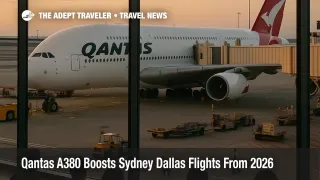
Qantas A380 Sydney Dallas flights will see a capacity boost after the airline returned its tenth and final Airbus A380 to Sydney on December 5, 2025, following nearly six years in storage. The aircraft, VH OQC, is named Paul McGinness after one of Qantas founders and has just completed what the carrier describes as the largest maintenance check in its 105 year history. During the Christmas peak the superjumbo will act as an operational spare, then from January 1, 2026 it is scheduled to operate daily on the ultra long haul Sydney to Dallas Fort Worth route, adding hundreds of seats per day on one of the world longest flights.
In practical terms, the return of Paul McGinness means Qantas A380 Sydney Dallas flights will move to daily A380 operation from January 1, 2026, increasing capacity and giving travelers more chances to secure upgraded cabins on this key transpacific link.
The heavy check for Paul McGinness was unusually complex. Qantas says the jet spent roughly three years stored in the California desert during the pandemic, then another two and a half years in Abu Dhabi undergoing extensive work, for a total absence of close to 2,000 days from Australian soil. Engineering teams across multiple countries completed more than 100,000 labor hours, including landing gear replacement, extensive systems checks, structural inspections, and a full cabin refurbishment, before the aircraft returned to Sydney. Qantas calls it the single largest maintenance check in its history, and positions the project as a milestone in its broader fleet renewal program.
Background
Qantas grounded and stored its Airbus A380 fleet during the COVID 19 collapse in long haul demand, including parking aircraft in the United States desert storage facilities. Over the past several years the airline has progressively brought ten of its original twelve A380s back into service after deep refurbishment, while permanently retiring two frames. Each returning aircraft has received a reconfigured cabin with more premium seats and updated soft product, which aligns with the carrier strategy to push higher yield long haul traffic as capacity gradually normalizes.
On the hardware side, the refreshed A380s now carry 14 First suites, 70 Business seats, 60 Premium Economy seats, and 341 Economy seats in their latest four class layout, giving a total of 485 passengers. First and Business have seen updated finishes and larger entertainment screens, while Premium Economy and Economy inherit newer seat designs and upgraded cushions borrowed from Qantas Boeing 787 and Airbus A330 cabins. The upper deck lounge has also been reworked as a more practical social space for premium cabins on long flights.
How The Sydney To Dallas A380 Will Work
Qantas Flights 7 and 8 connect Sydney, New South Wales, with Dallas Fort Worth International Airport (DFW) in Texas, forming one of only a handful of non stop links between Australia and the central United States. The route is already a workhorse for both business and leisure traffic, and through the American Airlines partnership Qantas can sell one stop itineraries that continue onward to more than 230 destinations across the U.S., from major hubs to secondary cities.
From January 1, 2026 the return of Paul McGinness to the international fleet should allow Qantas to schedule an Airbus A380 every day on Sydney to Dallas and back, rather than mixing in smaller aircraft or leaving the schedule at a lower weekly frequency. That translates into a large increase in daily premium capacity, particularly in First, Business, and Premium Economy, which are often the first cabins to sell out on ultra long haul services. It also gives the airline more resilience when another A380 needs unscheduled maintenance, since this aircraft will initially serve as a spare during the peak festive period.
For travelers, the most immediate effect will be greater availability of nonstop seats between eastern Australia and the central U.S. This can be significant for anyone currently forced to route through Los Angeles or San Francisco because Sydney to Dallas non stops were sold out or only available in less convenient cabins. Frequent flyers aiming for reward seats or upgrades in premium cabins should pay close attention to January through March availability once the daily A380 schedule is fully loaded, since that additional capacity often opens up more award inventory.
Cabin Experience And First Class Enhancements
Qantas is treating the A380 as a flagship for its long haul customer experience. In addition to the hard product changes, the airline is rolling out new touches in First on these aircraft, including elevated dining options, refreshed Aesop amenity kits, Bollinger champagne, and redesigned pajamas tuned specifically for long overnight flights. Combined with the refurbished lounge area on the upper deck, the goal is to make the A380 feel clearly distinct from smaller long haul types, especially for high yielding travelers.
Even in the rear cabins, there are practical differences compared with older layouts. Premium Economy gains additional seats and updated recliners similar to those on the 787, which should improve sleep on the long overnight eastbound sector from Dallas to Sydney. Economy travelers benefit from refreshed entertainment hardware, improved cushions, and multiple self service snack areas, which collectively soften the impact of spending more than 15 hours in the air on a single leg.
Booking Strategies For Qantas A380 Sydney Dallas Flights
If you want to make sure you are actually on the A380 once daily operation begins, the simplest check is to look at the aircraft type field in Qantas or partner booking channels and verify that the flight is listed as Airbus A380 rather than Boeing 787. That detail is usually visible on the results screen and again in the fare rules section before purchase. Travelers with specific seat preferences, such as the First window suites on the lower deck or certain Premium Economy rows on the upper deck, should also consult the updated A380 seat map and select seats as early as their ticket type allows.
Award travelers should expect competition for the new premium seats, especially around Australian school holidays and major U.S. events, but the added capacity can still make marginal dates more viable. If your dates are fixed, consider booking a backup 787 itinerary through another U.S. gateway, such as Los Angeles, then wait list or monitor for A380 space on Sydney to Dallas and switch if an upgrade clears. As always with long haul connections through Dallas Fort Worth, building in at least two to three hours for onward flights is sensible, since immigration, customs, and inter terminal transfers can add variability even on a good day.
Because this is an aircraft assignment rather than a brand new route, equipment swaps remain possible if maintenance or operational issues arise. Travelers who are specifically paying for the A380 experience, especially in First or Business, should keep an eye on their booking in the days before departure and be prepared to call Qantas or a travel advisor if the aircraft type changes. In many cases it will still be better to stick with the nonstop even if downgauged, but some passengers may prefer to reroute via another hub to preserve a particular cabin product.
For broader context on conditions for travel to and within Australia this summer, Adept Traveler readers can also review our recent coverage of heatwaves and bushfire related travel impacts in the region, which may intersect with peak demand for these long haul services. That separate piece outlines how extreme weather can affect airport operations, flight reliability, and last mile connections in Australia. See, for example, our recent report on Australian heatwave and Tasmanian bushfire impacts on travel.
Finally, ultra long haul flying takes a toll regardless of aircraft type. Travelers eyeing the new daily A380 Sydney to Dallas option should still plan simple steps to manage fatigue, such as choosing overnight timings that align with their body clock, reserving aisle seats if they move frequently, pre ordering special meals if needed, and allowing at least one recovery day on arrival before critical meetings or events. For more detailed strategies, our evergreen guide to planning ultra long haul trips between Australia and North America remains a useful companion when building complex itineraries.
Sources
- QANTAS COMPLETES A380 FLEET RENEWAL AS FINAL SUPERJUMBO RETURNS TO INTERNATIONAL FLYING
- Qantas Airbus A380 Fleet And Cabin Details
- Qantas A380 Superjumbo Returns After Six Years In Storage
- Qantas Flights 7 And 8 Route Profile
- Qantas Final A380 Returns To Sydney After Largest Maintenance Check
- Qantas Welcomes Back Tenth And Final A380 After Major Overhaul