

Benin Coup Attempt Raises Cotonou Airport Flight Risk
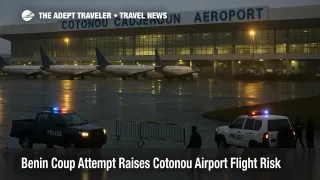
Travelers woke up on 7 December 2025 to an unsettling scene in Benin as soldiers appeared on state television announcing that President Patrice Talon had been removed, the constitution suspended, and that the country's borders and airspace were closed, a sequence that briefly raised the specter of stranded passengers at Cardinal Bernardin Gantin International Airport, also known as Cotonou Cadjehoun Airport (COO), and at key land crossings. Within hours, loyal forces moved to retake control, and by midday the interior minister was on air saying the coup attempt had been foiled, even as gunfire, military patrols, and embassy alerts kept Cotonou residents indoors. For travelers on Benin routes, the Benin coup attempt Cotonou airport disruption risk has shifted from total shutdown to a period of heightened uncertainty, where flights may continue to operate, but are more exposed to short notice security measures, diversions, or schedule changes.
In practical terms, the Benin coup attempt Cotonou airport situation on 7 December 2025 has created an elevated but still manageable level of risk for air and land travel, especially in and around Cotonou, while leaving longer running terrorism and banditry risks in northern safari regions unchanged but more visible to trip planners.
What Happened In Benin Hour By Hour
In the early hours of 7 December, a small group of soldiers attacked targets in Cotonou, including the area around President Talon's residence, then seized the national broadcaster. On air they identified themselves as the Military Committee for Refoundation, declared that Talon had been removed, announced the dissolution of state institutions, and claimed that all borders and the country's airspace were closed, language that, if fully enforced, would have instantly disrupted every scheduled flight, and every land border crossing, including routes to Nigeria and Togo.
As morning progressed, residents and journalists reported gunfire in several Cotonou districts, with soldiers visible around state television facilities, government buildings, and some strategic intersections. The French embassy publicly urged its nationals to stay at home and avoid movement, while the United States embassy said it was monitoring reports of gunfire and advised people to avoid crowds and keep a low profile.
By late morning to midday, Interior Minister Alassane Seidou appeared in a video message saying the coup attempt had been "foiled," describing it as a mutiny by a small group of soldiers, and stressing that the armed forces remained loyal to the republic. Reports from Reuters, AFP, and others quoted security sources saying that roughly a dozen soldiers, including alleged leader Lieutenant Colonel Pascal Tigri, had been arrested, though numbers may shift as investigations continue.
During the afternoon, President Talon himself addressed the nation, saying the situation was "totally under control" and promising that those involved would face consequences. Regional bloc ECOWAS announced that troops from Ghana, Ivory Coast, Nigeria, and Sierra Leone would deploy as a standby force to support Benin's government, while Nigeria confirmed that it had sent air force assets to assist loyal forces, including precision strikes on fleeing coup elements outside Cotonou.
By evening, Benin's government and regional partners were presenting the coup as a contained, failed attempt, but the combination of televised claims about closed borders, verified gunfire in the capital, and foreign air power operating in Benin's airspace is enough to keep travel risk elevated in the near term, particularly if there is any hint of a second attempt.
Are Flights At Cotonou Cadjehoun Airport Still Operating
The televised statement from the coup group explicitly mentioned border and airspace closures, which for a few hours created a worst case planning assumption that Cotonou Cadjehoun Airport might shut down with no notice. However, early independent checks by aviation data providers and security consultancies noted that there were no confirmed, system wide flight cancellations attributable to an enforced airspace closure, and that scheduled traffic into and out of Cotonou appeared to continue with delays rather than a complete standstill.
Cotonou Cadjehoun Airport is Benin's main international gateway, and as of late 2025 it hosts roughly a dozen airlines with direct routes to regional hubs such as Accra, Lagos, Lomé, Libreville, Casablanca, Addis Ababa, and to European gateways including Paris and Istanbul. That connectivity means most long haul itineraries into Benin pass through a major hub, so any decision by airlines to suspend Cotonou services would quickly ripple into rebookings across the wider network.
For now, the signals point to continued operations with heightened security rather than a formal shutdown. Travelers should still behave as if short notice interruptions are possible, especially in the first several days after the coup attempt. That means confirming flight status directly with airlines and through airport or tracker websites on the day of travel, arriving earlier than usual to clear checkpoints, and treating tight self booked connections as risky.
Land Borders, Regional Rerouting, And Alternate Airports
Even before the 7 December events, Benin's northern border with Niger was already affected by a separate dispute and security crisis, with Niger keeping its side closed to goods and Benin periodically restricting flows, a situation that has complicated trade and road movements for months. For travelers, that meant that overland trips into Niger, and even some trans Sahel freight and bus routes, were already constrained long before the coup attempt.
The coup announcements went further, claiming that all borders were closed. While there is, at this stage, little hard evidence that every land crossing was sealed in a systematic way, travelers should assume that security forces may increase checkpoints, temporarily shut certain crossings, or divert traffic, especially on main corridors toward Nigeria and Togo. This is particularly relevant for passengers who pair flights into Cotonou with road transfers to Lagos or Lomé, or who transit Benin by bus on longer overland itineraries.
If airlines or governments begin suspending Cotonou flights, two nearby airports matter most for rerouting. Lagos Murtala Muhammed International Airport (LOS) in Nigeria is roughly 100 kilometers from Cotonou, and Lomé Tokoin Airport (LFW) in Togo is about 125 kilometers away, and both are served by a larger mix of carriers and long haul routes. In a worst case scenario where Cotonou flights are paused, travelers could potentially rebook to Lagos or Lomé, then connect by road with a vetted, security conscious operator once conditions on the ground permit safe transfers.
For now, that level of disruption has not materialized, but trip planners should build a plan B that includes: fully refundable or changeable tickets where possible, awareness of alternates like LOS and LFW, and a willingness to adjust routing on short notice if airlines or embassies signal rising risk.
Safari Itineraries And Northern Benin
The coup attempt unfolded in Cotonou and the political center, but many international travelers think of Benin primarily as the gateway to some of West Africa's most significant wildlife areas, including Pendjari National Park and the Beninese sector of the W National Park, part of the wider W Arly Pendjari complex that straddles Benin, Burkina Faso, and Niger.
Even before 7 December, these parks were under heavy scrutiny from security analysts and conservation groups because of jihadist activity and cross border attacks in the wider region, with some reports already describing Pendjari and Park W as off limits to tourists, and major governments advising against all travel in large swathes of northern Benin, including areas that cover these parks.
In practice, this means that most reputable safari operators have already scaled back or paused itineraries that rely on long overland drives from Cotonou into the north, or that cross the borders into neighboring Burkina Faso or Niger. The coup attempt does not suddenly make these destinations unsafe, because they were already high risk, but it does add a fresh layer of political uncertainty, and it increases the chances that security forces and regional partners will tighten controls on movement, especially around military installations and main roads.
Travelers who currently hold bookings for safari focused trips that start at Cotonou Cadjehoun Airport and then head north to Pendjari or W National Park should speak to their operators about deferring to a later date or rebooking to alternative parks in West or East Africa that do not sit inside active advisory zones. It is reasonable in the current climate to treat non essential safari travel into northern Benin as highly postponable until both security conditions and official travel advisories show clear, sustained improvement.
City Breaks, Beach Stays, And Short Trips To Cotonou
For travelers planning short visits to Cotonou itself, or to southern coastal destinations such as Ouidah and Grand Popo, the risk picture is more mixed. The attempted coup involved gunfire, military patrols, and at least temporary control of state television in Cotonou, and embassies urged people to stay indoors, but there have not yet been reports of widespread, indiscriminate violence targeting foreigners.
Canada's travel advisory for Benin, updated on 7 December, now explicitly flags the attempted coup, describes the security situation nationwide as tense and potentially deteriorating, and warns that enhanced security measures and travel disruptions, including flight cancellations, are possible. United Kingdom guidance for Benin already highlighted the potential for political unrest and advised travelers to avoid demonstrations and follow any curfews or security instructions that might be imposed at short notice.
If you are already in Cotonou or on the coast, the most conservative approach is to remain in secure accommodation, limit movements to essential errands, and follow local news, embassy alerts, and hotel guidance, especially at night. If your departure is scheduled for the next day or two, plan to keep it, but maintain close contact with your airline and be ready to shift flights forward or backward if the carrier offers free changes in response to events.
Travelers whose trips are still several days or weeks away have more room to maneuver. While it is not yet clear whether this coup attempt will be a one off shock or the start of a longer period of volatility ahead of the April 2026 election, it is reasonable to: book flexible fares and accommodation, avoid separate tickets that rely on tight self made connections, and, for purely discretionary holidays, consider sliding dates back a week or more while the political situation and travel advisories stabilize.
What Travelers Should Do Next
In the short term, travelers with exposure to Benin should divide their decisions into three buckets.
First, those already in Benin, especially in Cotonou, should prioritize safety over sightseeing, staying informed via embassies and local media, and obeying any curfew or checkpoint instructions from security forces. Second, travelers with imminent flights should confirm every segment directly with airlines, avoid unnecessary side trips that could leave them stranded away from the airport, and build extra time into road transfers given the likelihood of checkpoints and diversions. Third, anyone planning new or discretionary trips involving Cotonou Cadjehoun Airport, Benin's land borders, or northern safari regions should seriously consider deferring until after the April 2026 political calendar becomes clearer, or reworking itineraries around regional hubs like Lagos and Lomé.
Taken together, these steps can turn a sudden, unsettling news event into a manageable travel planning problem, one that stays focused on concrete questions such as flight status, road conditions, and advisory levels, rather than on speculation about politics.
Sources
- Reuters, Benin government says armed forces foil coup attempt
- Al Jazeera, Attempted coup in Benin, updates and analysis
- Associated Press, Benin's interior minister says a coup has been foiled
- Government of Canada, Travel advice and advisories for Benin
- Riley Sentinel, Benin Coup Attempt Flash Report
- FlightConnections, Flights from Cotonou (COO)
- Africa Geographic, W and Pendjari, Benin