

France Cruise Passenger Tax From 2026 Adds €15 Per Call
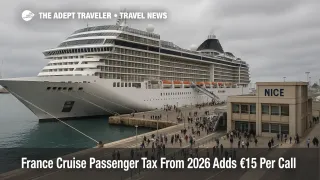
France cruise passenger tax 2026 plans just cleared their first hurdle in Paris, France, after the Senate voted on December 1, 2025, to add a €15.00 (EUR) fee for every cruise passenger at each French port call. The proposed environmental levy would apply to international cruises that stop in ports such as Marseille, Nice, Cannes, and Le Havre, and is expected to generate roughly €75 million (EUR) per year for coastal protection if it becomes law. Travelers booked on, or shopping for, 2026 Mediterranean and Atlantic itineraries that feature several French ports may see higher fares or more limited French calls and should start building extra budget and flexibility into their plans.
At its core, the proposal would make France one of the strictest European markets for cruise taxes by layering a flat €15.00 (EUR) per person, per call fee on top of existing port dues and European Union emissions charges, a structure that can quickly add up for multi port itineraries.
On December 1, 2025, senators backed the tax as part of the 2026 budget, framing it as an ecological response to the "particularly heavy externalities" of cruise operations and estimating annual revenue at about €75 million (EUR). The vote was close, with support from conservative sponsors and parts of the left, while the centrist government and some allies opposed the measure. The Assemblée nationale must still debate and vote on the text later in December 2025, and ministers have flagged concerns about how clearly the law separates cruise ships from ferries, so travelers should treat the tax as highly likely but not yet guaranteed for 2026.
Mainland France handled more than 3.8 million cruise passengers in 2023, according to Atout France, the national tourism agency, a volume that has sharpened political focus on emissions, port congestion, and local air quality along both the Mediterranean and Atlantic coasts. Senator Jean Marc Délia, who championed the amendment, cited estimates of roughly 7 million tonnes of carbon dioxide emitted by cruise ships in Europe each year and argued that a polluter pays approach should shift more of the cost of prevention and clean up onto cruise operators and their guests.
How the €15 per call tax would work
Under the Senate text, every passenger on an international cruise ship would trigger a €15.00 (EUR) charge at each French port where the ship calls, regardless of age. A ship carrying 2,000 passengers into Marseille, for example, would face a €30,000.00 (EUR) tax for that single call, and if it also visited Nice and Cannes on the same sailing, the total levy for that voyage could reach €90,000.00 (EUR). Lawmakers say the revenue would be earmarked for protecting and enhancing French coastlines, including erosion control, habitat restoration, and infrastructure upgrades in port cities.
The wording that passed the Senate is broad enough that France's Minister of Public Accounts, Amélie de Montchalin, has warned it may blur the line between cruise ships and ferries, which carry a mix of commuters, residents, and tourists. That ambiguity is one reason the government is resisting the levy in its current form and could push the Assemblée nationale either to narrow the scope or to insist on technical definitions based on ship size, service type, or itinerary.
Even if lawmakers tweak the details, most observers expect any final version of the tax to target large international cruise ships rather than short hop ferries, since senators repeatedly pointed to emissions and crowd impacts from big cruise vessels, not from local transport links.
Background: Cannes, Nice, and the Côte d'Azur clampdown
The tax proposal follows a wider pattern of local measures along the French Riviera. Cannes has already decided to ban cruise ships with more than 1,000 passengers from its harbor starting January 1, 2026, a hard cap aimed at protecting its small bay and old town from peak season swells. Nice has separately limited the number of cruise ship calls to 65 per year, part of a regional effort on the Côte d'Azur to curb overtourism and tighten environmental standards for visiting vessels.
For cruise lines, these local rules interact directly with the national tax conversation. Larger ships may already be restricted or unwelcome at some Riviera ports, so operators looking to keep a French presence in their itineraries might rely more heavily on Marseille, Toulon, or northern ports such as Le Havre and Cherbourg. The €15.00 (EUR) per call tax would then act as a uniform overlay on whichever French ports remain available and attractive to schedule.
France in the wider European cruise tax trend
France is not acting in isolation. Greece has rolled out a climate crisis resilience fee on cruise calls, charging €20.00 (EUR) per person in high season for ports such as Mykonos and Santorini and €5.00 (EUR) at other Greek ports, with lower rates in shoulder and winter months. Large operators including MSC Cruises have begun warning guests about the new Greek charges and clarifying that they sit on top of existing port fees and onboard costs.
Norway has approved a national framework that allows municipalities to impose up to a 3 percent tax on overnight stays and cruise passengers starting in summer 2026, explicitly to ease pressure on local infrastructure and public services in high demand destinations such as fjord ports. Cities such as Amsterdam, Netherlands, and Lisbon, Portugal, have already increased cruise and tourist taxes in recent years to help fund transit, cleaning, and other city services that bear the brunt of visitor numbers.
The French Senate's polluter pays framing is therefore part of a broader European trend that shifts more of the cost of climate mitigation, coastal protection, and crowd management onto visitors, and particularly onto cruise guests who arrive in large numbers and concentrate their impact in specific port areas.
What this means for 2026 cruise planning
For travelers, the most immediate effect, if the Assemblée nationale confirms the measure, will be a higher per person tax burden on itineraries with multiple French ports. A typical seven night Mediterranean cruise that calls at Marseille, Nice, and Cannes could carry €45.00 (EUR) in French cruise tax per person before counting standard port charges, hotel taxes on pre or post stays, and spending ashore. Families and groups could see several hundred euros added to their total trip cost once all fees are summed.
Cruise lines have several levers. They can absorb part of the cost, pass it through as higher advertised fares or itemized port taxes, or quietly adjust itineraries to reduce the number of French calls in favor of ports in Spain, Italy, or other countries without similar levies. Industry group CLIA has already warned that cumulative taxation, including the European Union emissions trading system, may encourage lines to trim French operations if the new tax is fully stacked on top.
If you already hold a 2026 itinerary that includes French ports, watch for line communications over the coming months. Operators are likely to update port taxes and fees once the Assemblée nationale vote is known, and some may issue revised itineraries that swap in alternative ports if the economics of certain French calls deteriorate. Travelers who have not yet booked but are leaning toward France heavy cruises should compare similar routes that use fewer French stops or mix them with ports in other countries, then decide how much they are willing to pay for the specific French coastal experiences on offer.
How It Works: Budget law and timing
The cruise tax sits inside France's 2026 budget process, which means it rides along with the broader finance bill that must be agreed by both chambers of Parliament. The Senate has adopted its version with the cruise amendment intact, but the Assemblée nationale has the last word and the government can push to strip, soften, or reword the provision before final passage.
Practically, that means travelers and travel advisors will not know the final shape of the levy until later in December 2025, and lines will need additional time to model impacts and reprice 2026 sailings. However, the strong political momentum behind overtourism and climate measures across Europe suggests that some form of new French cruise tax is more likely than not, even if the exact rate or scope changes during negotiations.
Internal links and further reading
For a deeper look at how European destinations are reshaping cruise and tourist policy, see Adept Traveler's coverage of Greece's daily cruise caps and landing fees alongside rules on footwear at historic sites in "Greece Limits Cruise Arrivals, Bans High Heels at Ruins."
Travelers comparing French moves with broader regional trends can also review our analysis of Barcelona's plan to demolish three central cruise terminals by 2026 and concentrate ships at a single, more distant facility by 2029, as well as our Europe wide explainer on 2025 rule changes, new visitor levies, and border policies in "Europe 2025 Travel Rules Tighten Borders And Costs."
Sources
- French Senate votes in favour of new €15 per passenger tax for cruise ships
- Aperçu de l'amendement I 252, Budget 2026, Sénat français
- French Senate Approves New Tax for Cruise Ships
- French Senate Greenlights Cruise Passenger Tax, Industry Braces for Fallout
- New cruise passenger fee for guests visiting Greek ports
- Norway Confirms Phased Introduction Of Tourist Tax In 2026