

UK Germany Rail Link, London Frankfurt Direct Trains
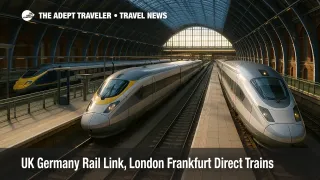
Plans for a London to Frankfurt direct train moved from political wish list to concrete project this week, as Eurostar and Deutsche Bahn signed a memorandum of understanding on 4 December 2025 to develop new UK Germany high speed routes. The proposal would create the first direct services between London, Cologne, and Frankfurt, replacing today's multi change journeys across France and Belgium. Travellers will still be working to a long timetable, but they can already start thinking about how these trains could reshape business trips, long weekends, and rail based itineraries in the early 2030s.
In practical terms, the Eurostar and Deutsche Bahn pact defines the political backing, fleet plan, and target window for a future London to Frankfurt direct train link, and sets up the task forces that now have to solve border controls, station capacity, and commercial risk.
What Has Actually Been Agreed
The new memorandum of understanding was signed in the first days of December by Eurostar and Deutsche Bahn, Germany's national rail operator. The companies state that they intend to work together on long distance services between London and major German cities, specifically naming Cologne and Frankfurt, and that they will now explore timetables and terminal layouts that can handle international border and security checks on both sides of the Channel.
A parallel UK government press release frames the agreement as "joint plans for a direct high speed rail connection between Germany and London," with routes to Cologne and Frankfurt pencilled in for the early 2030s and backed by the Department for Transport and the office of the Prime Minister. That political umbrella matters, because any cross Channel train has to pass through a maze of immigration rules, security standards, and safety approvals that individual operators have struggled to navigate since Brexit.
This is not yet a final operating contract or a timetable. There are no tickets on sale, no fare structure, and no confirmed path allocations through the Channel Tunnel or on German high speed lines. The pact is best understood as a formal commitment to move from idea to implementation, with both companies and both governments now publicly on the hook to make it work.
How The Celestia Fleet Fits In
A key difference between this push and previous, abandoned London Germany rail schemes is that Eurostar has already ordered the trains it plans to use.
In October 2025, the operator confirmed a €2 billion investment in up to 50 new double decker Eurostar Celestia trainsets, built by Alstom on the Avelia Horizon platform. Thirty units are firm orders, with options for twenty more, and the first sets are due to enter service in May 2031, initially on existing routes then on expansion corridors including Frankfurt and Geneva.
The Celestia fleet will be the first double decker trains ever to run through the Channel Tunnel and on the UK network, offering about 20 percent more seats per 200 metre unit and using up to 50 percent less energy than current stock. In practice, that gives Eurostar the spare capacity and operating efficiency to justify trying new long haul routes where margins are thinner and border procedures still add overhead.
For travellers, the combination of extra seats and lower energy use should translate into more choice of departure times, improved comfort, and at least some downward pressure on fares compared with what a smaller legacy fleet could support.
What It Means For Journey Times
Right now, most rail journeys from London to Germany require at least one change, usually in Brussels or Paris, and can involve a second transfer at Cologne. Typical London Frankfurt trips take around eight to nine hours, with the exact timing depending on how tight the Brussels connection is and how much buffer travellers build in for delays.
The new plan envisions city center to city center services that could run from London to Cologne in roughly four hours and to Frankfurt in just over five, according to both UK government guidance and independent travel reporting. Those times hinge on securing clear, high speed paths across multiple networks and on optimising border checks so that trains are not held at terminals for long inspection windows.
Berlin is not part of the first wave. Current daytime journeys from London to Berlin often take up to 11 hours with two or three transfers, including changes in Brussels and Cologne or via Amsterdam, although the absolute fastest combinations can be shorter. Officials on both sides have said that a direct London Berlin route remains an ambition, but they are openly treating Cologne and Frankfurt as the proof of concept that has to work before more complex extensions can be justified.
The Kensington Treaty And Political Backing
The technical work now starting sits on top of a broader political deal. In July 2025, the United Kingdom and Germany signed the Kensington Treaty, a wide ranging friendship and cooperation agreement that, among other priorities, explicitly calls for a direct rail service between the two countries within ten years and promises easier travel, including e gate access for British passport holders at German border points.
As part of this treaty, the governments set up a joint taskforce on rail, with instructions to dig into the border, safety, and commercial obstacles that previously derailed London Frankfurt plans and left operators cautious about further Channel Tunnel experiments. The new Eurostar Deutsche Bahn agreement is the first concrete product of that process, and the companies themselves have acknowledged that complex "framework conditions," including entry formalities and bilateral agreements, will only be solved through this kind of partnership.
For travellers, the treaty and taskforce matter because they point toward simpler, more predictable cross border flows. Wider use of e gates, harmonised security procedures, and shared digital ticketing standards across Europe would all reduce connection stress and help trains compete more directly with flights.
What Changes For Travellers Now
In the near term, the honest answer is that nothing changes for day to day bookings. Anyone travelling between the UK and Germany in 2026, 2027, or likely even 2028 will still piece together Eurostar services to Brussels or Paris, then connect to ICE or other high speed trains, exactly as they do now.
However, the pattern of future travel is starting to come into focus, and that does affect decisions travellers make today:
- If you are a regular commuter between London and Germany, there is now enough political and commercial momentum behind rail that long term loyalty to train based itineraries looks less risky than it did in the immediate post Brexit years.
- Businesses planning conference cycles or office locations for the early 2030s can realistically factor in direct London Cologne and London Frankfurt trains as part of their mobility strategy, especially for staff who prefer to avoid short haul flights.
- Travellers who care about sustainability can treat this as further confirmation that Europe's long term infrastructure will support lower carbon choices, though flights will remain faster for years on many city pairs.
How To Plan Rail Itineraries Until Direct Trains Launch
Until the first Celestia trains roll through the Tunnel with "Germany" on the departure boards, travellers should keep using established best practices for cross border journeys.
Book through tickets where possible, so that missed connections caused by late running trains remain the operator's responsibility instead of your own. When you cannot buy a single ticket, build realistic buffers in Brussels or Cologne, especially if you are changing platforms with luggage or traveling with family. A 20 minute legal connection can work, but a 40 to 60 minute window is usually a safer bet if you want room for minor delays and a coffee break.
Pay close attention to engineering works and seasonal disruptions. Winter storms, summer heatwaves, and major upgrades on French, Belgian, or German lines can all add unplanned diversions and longer trip times, and they will continue to do so even after direct services launch. For high stakes trips, such as cruise departures or fixed time business meetings, consider arriving the night before rather than trusting a same day connection.
What To Watch For Next
The next milestones to watch are not ticket releases, but detailed feasibility work. Eurostar and Deutsche Bahn now have to agree on:
- Which specific trains and formations will be used on London Cologne and London Frankfurt runs once Celestia units enter service.
- How London St Pancras, Brussels, and German terminals will handle exit and entry checks, security screening, and luggage flows for passengers boarding or alighting in multiple countries.
- How many paths per day can realistically be slotted through the Channel Tunnel and on congested European trunk routes without undermining reliability.
Until those pieces are agreed, any date beyond "early 2030s" stays indicative. History is full of high speed rail projects that slipped to the right once they hit the hard limits of infrastructure and funding. The difference this time is that the trains are ordered, the treaty language is written, and the political capital invested on both sides of the Channel makes quiet cancellation much harder.
For travellers, the smartest move now is to keep using existing rail options when they make sense, avoid locking long term plans around an assumed direct service in a specific year, and follow announcements from Eurostar, Deutsche Bahn, and the UK Department for Transport as work on the London Germany rail link moves from headline to timetable.
Sources
- Plans for direct UK-Germany rail link one step closer, UK Department for Transport press release, 4 December 2025
- DB and Eurostar lay the groundwork for a direct connection from Germany to London, Eurostar Media Centre, 4 December 2025
- Eurostar to roll out 50 double decker trains by 2031, Globetrender, 30 October 2025
- Eurostar has confirmed plans to launch direct trains from the UK to a new European country, Time Out, 5 December 2025
- Eurostar on track to link Germany and UK, Euronews Travel, 5 December 2025
- Direct London to Berlin trains move closer under new UK Germany treaty, Euronews Travel, 18 July 2025
- Kensington Treaty, Wikipedia entry