

Brazil Ground Staff Slowdown Hits Major Airports
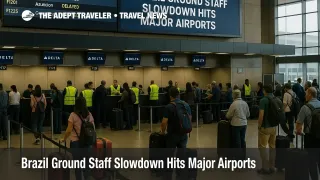
Brazil airport ground staff slowdown is now a factor for anyone connecting through São Paulo Guarulhos International Airport (GRU) and other major hubs, as unions representing ground handling and terminal workers shift into an operação essencial minimum service regime from December 5, 2025. The move affects travelers using São Paulo, Rio de Janeiro, Brasília, Porto Alegre, and Recife for both domestic and international connections, especially during dense early morning and evening bank structures. For the next several days at least, travelers should assume slower baggage delivery and boarding, add extra time between flights, and think carefully before booking short connections through Brazil's biggest gateways.
The Brazil airport ground staff slowdown means that flights continue to run but the ground operation is deliberately throttled, which raises the odds of queues, delayed bags, and missed tight connections for anyone passing through the affected airports.
What Operation Essential Means In Brazil
On December 2, unions affiliated with the National Federation of Civil Aviation Workers, FENTAC, voted to declare a nationwide state of greve and to begin an operação essencial regime from Friday, December 5, as part of their 2025 to 2026 wage campaign. FENTAC describes operation essential as a form of self defense and safety measure in which aeroviários, airport and ground workers, comply strictly with all technical and legal rules but withdraw from any task that is not strictly required to guarantee flight safety and the preservation of life.
In practice, this means that ramps, gates, and terminal teams are staffed only at the minimum levels needed to marshal aircraft, operate jet bridges, handle medical and emergency situations, and support flights that must operate, while non essential tasks such as rapid baggage loading, discretionary customer assistance, and some cleaning and servicing work are slowed or deferred. The unions argue that this keeps passengers safe while signaling dissatisfaction with the current offer from the National Airline Companies Union, SNEA, on pay and fatigue related conditions.
Where The Slowdown Hits Hardest
The first and sharpest effects are at the country's busiest hubs, particularly São Paulo Guarulhos, São Paulo Congonhas Deputado Freitas Nobre Airport (CGH), Rio de Janeiro Galeão International Airport (GIG), Rio de Janeiro Santos Dumont Airport (SDU), Brasília President Juscelino Kubitschek International Airport (BSB), Porto Alegre Salgado Filho International Airport (POA), and Recife Guararapes Gilberto Freyre International Airport (REC).
At Guarulhos, which handles a large share of Brazil's long haul international flights and domestic connections, the combination of dense early morning arrivals, heavy evening departures, and a reliance on banked connection structures makes the airport particularly sensitive to any slowdown in ramp and baggage operations. When tugs, loaders, and baggage belts work strictly to rule with fewer staff, bags take longer to reach the carousel, aircraft turns stretch past their scheduled window, and controllers may need to hold departures for missing passengers and bags.
Congonhas and Santos Dumont primarily handle high frequency shuttle traffic between São Paulo and Rio de Janeiro and other domestic routes. Here, the risk is less about long haul misconnects and more about daylong knock on delays, as any early morning slippage in the shuttle pattern can propagate across multiple flights, leading to late arrivals into business meetings and missed same day returns on Brazil's busiest business corridor.
Brasília acts as a central domestic hub and government corridor, so even small slowdowns in baggage or boarding can upset tightly timed connections between northern and southern cities. Porto Alegre and Recife are important regional gateways, where delays can leave travelers with fewer alternative flights and less flexibility if a bag fails to make a connection or if a late inbound reduces ground time before onward departures.
Early snapshots of the first days of operation essential already show an elevated level of delays and some cancellations across Brazil's network, with one industry tally pointing to at least 26 cancellations and 199 delays on December 5, although that count also reflects weather and routine congestion. Even when the cause column does not explicitly list the slowdown, the tighter ground staffing means the system has less resilience when storms pass through or when an aircraft goes temporarily out of service.
Pilots, Air Traffic Control, And Escalation Risk
Pilots and air traffic controllers are not formally part of the operation essential action, although the National Union of Aeronauts, SNA, has publicly expressed support for the aeroviários' wage demands while continuing its own contract talks. For now, this keeps the slowdown focused on the ground, which is why schedules still show most planned flights operating, even when bags and boarding lag behind.
The unions have been clear, however, that if negotiations with SNEA do not restart or fail to produce an improved offer, they are willing to escalate toward a full strike as the Christmas and New Year peak approaches. That would most likely involve new assemblies and legal steps to convert the current state of greve into a formal strike, which could trigger court imposed minimum service rules and a more visible pattern of cancellations and schedule cuts. Travelers booking trips into late December should treat that risk as a live possibility rather than a remote threat.
Connection And Baggage Risk For International Travelers
For international travelers landing at Guarulhos and connecting onward within Brazil, the main pain points are baggage timing and minimum connection buffers. Under normal conditions, a one hour thirty minute domestic to domestic connection or a two hour international to domestic connection at Guarulhos can be workable, especially on through tickets. With ground staff in operation essential mode and summer storms in the mix, those buffers are now tight.
Travelers with flexibility should aim for at least three hours between international arrival and domestic departure at Guarulhos, and at least two hours for domestic to domestic connections through any of the main hubs. Separate tickets are especially risky in this environment, because airlines are less likely to take responsibility for a misconnect caused by slow baggage or a departure that leaves late after boarding delays. Corporate travel programs and frequent travelers should push itineraries toward fewer, longer connections rather than stitching together multiple short hops.
Baggage strategy also matters. With ramp teams focused on safety critical work and reduced capacity for rapid transfers, bags are more likely to miss short connections or arrive late on the carousel after long haul flights. Where feasible, travelers should move to carry on only, keep essentials and at least one change of clothes with them, and assume that even priority tagged checked bags may take longer than usual to appear.
Local Ground Transport And Same Day Plans
Slow baggage and boarding have a knock on effect outside the airport as well. Afternoon arrivals that normally reach the city in time for evening tours, meetings, or dinner reservations may now emerge from the terminal significantly later, especially when immigration queues interact with slower baggage belts. In cities like São Paulo and Rio de Janeiro, that also pushes travelers deeper into the most congested traffic periods.
To manage that risk, travelers should pre book trusted private transfers or rideshare pickups from major airports rather than relying on last minute taxi queues that can lengthen when multiple delayed flights arrive close together. Same day tours, internal flights, or important meetings should be scheduled with generous buffers after arrival, and flexible cancellation or rescheduling policies should be confirmed in advance.
How This Fits With Brazil's Summer Travel Picture
The slowdown lands on top of an already stressed summer travel pattern, with recent storms, hail, and flood alerts around São Paulo testing airport operations and road access in parallel with the industrial action. Travelers who are already monitoring weather alerts and infrastructure issues should now treat labor related friction as a second axis of risk, especially when planning complex itineraries that combine multiple domestic sectors, long haul flights, and ground segments.
For a broader look at how early summer storms are affecting São Paulo and other Brazilian routes, readers can cross check our coverage of Brazil storms and São Paulo flood alerts, which maps how weather driven runway and road closures have interacted with limited airline flexibility. For structural context on how labor actions and minimum service rules usually play out, our guide to airport strikes and slowdowns in Brazil explains the legal framework that shapes both operation essential and full strike scenarios.
What Travelers Should Do Next
In the short term, anyone with flights into or through São Paulo, Rio de Janeiro, Brasília, Porto Alegre, or Recife in the next one to two weeks should audit their itineraries for tight connections, check baggage plans, and adjust where possible before queues and missed bags turn into forced overnight stays. Shifting to longer connections, consolidating segments, and, where it makes sense, using alternative hubs in the region can all reduce exposure to a system that is running with less ground slack than normal.
Looking ahead to the Christmas and New Year peak, the key variables are whether FENTAC and SNEA return to the bargaining table and whether the unions proceed with a full strike call. Travelers booking new trips that rely on Brazilian hubs for same day intercontinental connections should either build in overnight stops or consider alternative routings through other gateway cities if date flexibility is limited. As always, nonrefundable segments on separate tickets and tight self made connections are the highest risk choices when a country's main airports are operating under a formal slowdown.
Sources
- Campanha Salarial 2025/2026, aeroviários aprovam estado de greve e marcam operação essencial
- Em assembleia, aeroviários decretam estado de greve e operação essencial em todo país
- Brazilian Airport Ground Staff Declare Nationwide "Operation Essential" From 5 December
- Campanha Salarial 2025/2026, orientações da Operação Essencial
- Hundreds of Travelers Stranded across Brazil as GOL, Azul, and Others Suspend Flights
- São Paulo Guarulhos International Airport profile
- Recife Guararapes Gilberto Freyre International Airport profile