

Ecuador Armed Conflict Guayaquil Stays And Transfers
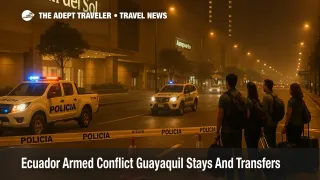
Ecuador armed conflict travel planning now has to start with Guayaquil, Ecuador, after car bombs on October 14 and 15, 2025 hit the Mall del Sol and Sheraton hotel area and nearby roads in Guayas and El Oro provinces. At the same time, the country remains under a nationwide internal armed conflict designation and a separate state of emergency tied to gang violence and terrorism, with curfews from 10 p.m. to 5 a.m. in parts of multiple provinces. Travelers using Guayaquil as a stopover for Galápagos cruises, beach breaks, or business trips now have to think carefully about where they sleep, how they move at night, and whether to shift more of their time to Quito or the islands.
In practical terms, the internal armed conflict status and the October car bomb near a major mall and international chain hotel mean Ecuador armed conflict travel is no longer an abstract advisory but a concrete operational issue for Guayaquil stays and transfers.
Background, armed conflict and states of emergency
Australia's Smartraveller, updated on November 14 and still current as of December 9, 2025, notes that Ecuador declared a nationwide state of internal armed conflict in January 2024 in response to a surge in gang violence and that this sits alongside a separate state of emergency aimed at crime. The emergency covers provinces including Guayas, Los Ríos, Manabí, Santa Elena, El Oro, Orellana, Sucumbíos, Azuay, and the Metropolitan District of Quito, with curfews from 10 p.m. to 5 a.m. in several cantons. During these periods, police and military can restrict movement, search homes, and shut down gatherings, and they have been given clear authority to tackle groups that the government labels as terrorists.
States of emergency are not new for Ecuador, but the internal armed conflict label codifies that the government treats major gangs and their allies as enemies in an internal war rather than just criminal suspects. That framing has allowed sustained deployments of troops in coastal cities and along main road corridors, which can improve control in some districts but also raises the stakes when those groups respond with bomb attacks or targeted killings.
What changed with the Guayaquil car bomb
On October 14, 2025, a car bomb exploded near the Mall del Sol shopping center and the Sheraton hotel in northern Guayaquil, killing at least one person and injuring several others, in an area that functions as a business, conference, and shopping hub close to the airport. Canada and the UK report that secondary explosions followed on October 15 on roads linking Guayas and El Oro, underscoring that this was a coordinated series of attacks, not an isolated incident.
The U.S. Consulate in Guayaquil issued a security alert telling travelers to avoid the Mall del Sol and Sheraton area and to stay clear of Guayaquil Airport roads until authorities declared the situation safe. Shortly afterward, the U.S. State Department updated its Ecuador travel advisory to add a terrorism indicator and to push large parts of Guayaquil and several coastal provinces into Do Not Travel or Reconsider Travel categories.
For travelers, the new element is not that Guayaquil is a high crime city, which has been true for years, but that vehicle borne improvised explosive devices are now part of the toolkit in busy commercial districts that also serve as hotel and meeting clusters for foreign visitors.
Risk map, Guayaquil versus Quito and the rest of Ecuador
Smartraveller advises travelers to exercise a high degree of caution in Ecuador overall, to reconsider travel to Guayaquil City and to normal tourist circuits in Sucumbíos and Esmeraldas, and explicitly carves out an exception for airside transit through Guayaquil Airport in Guayas province. The U.S. advisory goes further, labeling parts of Guayaquil south of Portete de Tarqui Avenue as Level 4 Do Not Travel due to terrorism and crime and classifying the rest of the city, as well as El Oro, Los Ríos, Esmeraldas, Sucumbíos, Manabí, Santa Elena, and Santo Domingo, as Level 3 Reconsider Travel.
The UK similarly warns that armed robbery, kidnapping, and bomb threats are widespread and that travelers should take particular care in Esmeraldas, Guayas, and Manabí, where gangs have stopped vehicles and threatened passengers, and notes that the murder rate in Guayaquil is very high even if most killings are gang related. Canada highlights a sharp rise in express kidnappings, bomb threats in Quito and Guayaquil, and small explosive devices used in attacks around ATMs and public buildings.
By contrast, almost all major advisories treat the Galápagos Islands as relatively low risk and say that travelers can use extra caution in Quito while sticking to safer neighborhoods, avoiding protests, and limiting movements after dark. In plain language, that means Guayaquil is now the outlier, with a risk profile more comparable to some of the hardest hit coastal and border areas than to the classic Andean and island tourism circuits.
Gateways, airports, and overnight stays
Most international travelers will route through either José Joaquín de Olmedo International Airport (GYE) in Guayaquil or Mariscal Sucre International Airport (UIO) in Quito, with onward links to Seymour Airport (GPS) and San Cristóbal Airport (SCY) in the Galápagos. Under current advisories, Quito is usually the safer choice for an overnight gateway stop, while Guayaquil is best treated as an airport transit point unless there is a strong reason to stay in the city.
If an itinerary requires Guayaquil, using airport linked hotels or properties inside controlled zones and arranging private, vetted transfers is more prudent than staying in central districts or relying on street taxis, especially late at night. Advisory language about car bombs, targeted killings, and express kidnappings makes it clear that criminals sometimes work with taxi or rideshare drivers and that passengers leaving malls, hotel lobbies, and transport hubs are prime targets.
Quito presents its own risks, particularly in older central districts and on some intercity routes, but the concentration of recent bomb attacks, car bombs, and gang turf conflicts remains heavier along the coast and in Guayaquil. For trips that combine highland cities and the Galápagos, using Quito as both entry and exit point and avoiding long overland connections through high risk coastal corridors will often be the most conservative choice.
Curfews, airport transfers, and timing flights
Because the state of emergency allows curfews from 10 p.m. to 5 a.m. in parts of Guayas, El Oro, Los Ríos, Manabí, Santa Elena, Orellana, Sucumbíos, Azuay, and metro Quito, timing matters. Smartraveller and earlier alerts stress that authorities can change curfew rules quickly and that police and military can stop vehicles and demand identification during these windows.
Most decrees allow travel to and from airports during curfew for passengers on scheduled flights, but drivers and travelers may still face checkpoints, delays, and local interpretations of what counts as "essential" movement. Practically, that means:
- Favor flight times that arrive and depart well outside curfew windows, especially if you are connecting between an international arrival and a domestic flight to the Galápagos or the highlands.
- Build generous buffers between flights that require a change of airport hotel or a cross town drive in Guayaquil, since a checkpoint or road closure can easily eat 45 to 60 minutes.
- Carry printed or offline copies of tickets and hotel confirmations, plus passport and local ID if you have it, so you can show checkpoint officers where you are headed.
Where curfews and checkpoints make same day overland links unreliable, it may be worth paying for an extra night near Mariscal Sucre in Quito or adjusting a cruise departure by a day rather than gambling on a last minute overnight in Guayaquil.
Coastal road trips and self drive plans
Beyond Guayaquil itself, most high risk areas cluster along northern and coastal provinces and borders with Colombia and Peru, which multiple advisories describe as hotspots for kidnapping, extortion, and armed robbery. Smartraveller explicitly tells travelers not to go within 20 kilometers of the Colombia border except at Tulcán and to reconsider travel to Guayaquil City and parts of Sucumbíos and Esmeraldas.
For trip design, that should trigger a rethink of classic coastal self drive circuits that run through Guayas, Santa Elena, Manabí, Los Ríos, and El Oro, especially if legs involve night driving or remote secondary highways. Canada and the UK both describe criminals stopping vehicles, staging accidents, or working with taxi drivers, and warn that express kidnappings often begin with what looks like a routine ride or roadside encounter.
Advisors should now default to recommending:
- No self drive car rentals that require passing through Guayaquil or high risk coastal provinces at night.
- Vetted, prebooked drivers arranged through reputable hotels, cruise lines, or tour operators if road transfers are essential.
- Daytime only travel, with routes and stops planned in advance and flexibility to postpone or reroute if local contacts warn about new incidents or roadblocks.
For travelers comparing regional choices, pairing this piece with our broader Latin America crime and safety explainer can help weigh Ecuador against alternatives like Costa Rica, where a different crime pattern is now targeting vacation rentals and ATMs rather than car bombs and curfew zones.
Galápagos and highland trips still workable, with new constraints
Despite the grim headlines, advisories from Australia, the U.S., the UK, and Canada all stop short of telling travelers to avoid Ecuador entirely. The Galápagos remain an area where "exercise normal safety precautions" is still the operative phrase, and highland tourism circuits can usually proceed with extra attention to nighttime movements, protests, and petty crime.
The real shift is that itineraries which once treated Guayaquil as an easy overnight or hub for combining coastal beaches, city time, and the islands now have to treat the city as a controlled risk environment. That might mean flying into Quito, spending time in the highlands, connecting directly to the Galápagos, then exiting via Quito again, or limiting Guayaquil to a daylight airport transit with no city side excursions.
For some travelers, especially those uncomfortable with visible military presence, bomb threats, or complex curfew rules, the honest answer may be to postpone coastal Ecuador or keep the trip focused on the Galápagos until the security picture improves.
Practical steps for travelers and advisors
Advisors building 2026 itineraries that touch Ecuador should start by mapping client routes against the Level 3 and Level 4 areas named in the U.S. advisory and the do not travel zones listed by Smartraveller and other partners. From there, the questions become concrete:
- Can we use Quito instead of Guayaquil as the main gateway, and if not, can we limit Guayaquil to daylight transits around José Joaquín de Olmedo International Airport, airport hotels, and prebooked transfers
- Do we really need a coastal self drive leg, or can we replace that with domestic flights and local touring run by operators with robust security protocols
- Are clients willing to carry extra documentation for land borders, enroll in STEP or equivalent programs, and accept last minute rerouting if curfews or bomb alerts affect their planned corridors
For travelers who still want Ecuador's mix of highlands, Amazon, and islands amid an internal armed conflict, the priority is not to eliminate risk, which is impossible, but to stack the odds in your favor by choosing lower risk gateways, minimizing exposure in Guayaquil and other Level 3 or Level 4 areas, staying inside curfew rules, and engaging local operators who treat security as a core part of the trip, not an afterthought.
Sources
- Ecuador Travel Advice & Safety, Smartraveller
- Ecuador Travel Advisory, U.S. Department of State
- Ecuador Travel Advice, UK FCDO
- Travel Advice and Advisories for Ecuador, Government of Canada
- Security Alert, Explosion Reported Near Mall del Sol, Guayaquil, U.S. Consulate
- Pickup Truck Explodes On Busy Street In Guayaquil, AP
- Explosions Hit Ecuador, Al Jazeera