

G3 Geomagnetic Storm North America Flights December 9, 2025
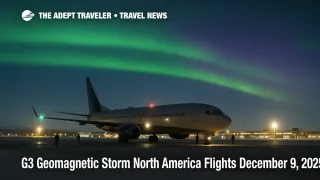
A G3 geomagnetic storm North America flights watch from NOAA for December 9, 2025 now links aurora chances with space weather risks across Alaska, northern Canada, Greenland, and the northern tier of the United States. The alert follows an M8.1 solar flare and full halo coronal mass ejection from active Region 4299, timed to reach Earth early to midday on December 9 with peak effects likely in the North American evening. For travelers this sets up an unusual mix of opportunity and risk, from last minute northern lights trips to a small but real chance of navigation and communications glitches, so plans should stay flexible and buffered.
In practical terms, the G3 geomagnetic storm North America flights watch means a temporary increase in space weather risk for polar and high latitude routes, Arctic and sub Arctic communities that depend on HF radio and satellite links, and aurora focused trips on the night of December 9, 2025.
What The Current G3 Watch Actually Says
NOAA s Space Weather Prediction Center, SWPC, has issued a Strong, G3, geomagnetic storm watch valid for December 9 after a full halo coronal mass ejection associated with an M8.1 flare from Region 4299 at 20:39 UTC on December 6. Forecasters expect the CME to arrive early to midday on December 9, with the possibility of G3 level geomagnetic conditions if the interplanetary magnetic field turns southward for long enough.
In its public messaging NOAA notes that the aurora may become visible over many northern states and some of the lower Midwest to Oregon, while regional coverage highlights that even California has a slim chance if the storm overperforms and skies cooperate. The same active sunspot region produced a G4 severe geomagnetic storm in November, which pushed auroras unusually far south, but a G3 event sits one step lower on the five point NOAA scale and historically happens more often with more modest impacts.
For this event the key nuance for travel is timing. The predicted arrival window lines up with North American evening and nighttime hours rather than staying confined to daylight, which means both aurora viewing and any operational impacts will overlap with overnight long haul departures, red eyes across Canada and the northern United States, and flights to and from Alaska, northern Canada, and Greenland.
Aurora Outlook For Travelers
If the storm reaches the upper end of the G3 range and the magnetic field orientation is favorable, auroras should be widespread across much of Alaska, most of Canada, and all of Greenland, with a realistic chance that the lights spill south into the northern tier of the continental United States. Under those conditions travelers in places such as Anchorage, Fairbanks, Yellowknife, Whitehorse, Winnipeg, Duluth, and northern parts of states like Montana, North Dakota, Minnesota, Wisconsin, and Michigan could see overhead or strong aurora rather than faint glows on the horizon.
However, this is still a watch, not a guarantee. CME forecasts carry timing errors of several hours and the strength of the storm at Earth depends heavily on how the solar wind magnetic field is oriented when it arrives. A favorable southward orientation can amplify the storm and push the aurora farther south, while a northward orientation can blunt impacts and keep the auroral oval close to its usual high latitude band even with the same CME.
Aurora chasers who are already in or can reach northern locations on short notice should focus on three practical factors they can control. First, they should prioritize dark, rural viewing sites away from city lights, ideally with a clear northern horizon. Second, they should plan for long, cold waits, since even strong storms can produce bursts of activity separated by quiet periods. Third, they should build in several hours of flexibility on either side of the forecast peak, since an early or late arrival can shift the best viewing window well before or after midnight.
Where Travel Impacts Are Most Likely
For most travelers on mid latitude routes in the United States, Canada, or Europe, a G3 storm is much more likely to be a sky watching opportunity than a direct disruption. The main aviation vulnerabilities sit farther north, on high latitude and polar routes where aircraft often rely on high frequency, HF, radio for voice communications and Global Navigation Satellite Systems, GNSS, such as GPS or Galileo, for navigation and precision approaches.
During geomagnetic storms, rapid changes in the ionosphere can degrade or briefly cut HF radio links at high latitudes and can introduce errors or outages in GNSS signals. Navigation agencies and space weather centers note that recent storms have produced measurable GNSS disruptions for aviation, maritime, and drone operations, along with impacts on power grids and other infrastructure in extreme cases.
In practice, airlines that operate polar or near polar routes between North America and Asia, or that serve communities in northern Alaska, Nunavut, the Northwest Territories, Yukon, or Greenland, sometimes respond to strong space weather forecasts by lowering cruising altitudes, rerouting away from the highest latitudes, or in more severe cases, suspending certain routes. All of those measures add flight time and fuel burn and can ripple into the wider network as aircraft and crews arrive late.
Remote Arctic and sub Arctic communities are also more exposed. Many smaller airports in Alaska, northern Canada, and Greenland depend on HF radio and satellite connectivity for basic communications, weather information, and sometimes navigation reference data. Short, localized outages matter more where there are few alternative links or where terrain and weather already limit options.
It is important to underline that a single G3 event rarely produces widespread, long lasting aviation disruption on its own. Modern fleets have multiple redundant navigation and communication systems, and airlines already incorporate space weather into dispatch planning on high latitude routes. The risk is less about dramatic single point failures and more about pockets of degraded performance that can force conservative choices, such as extra route mileage or longer holding, at exactly the time when overnight traffic is trying to move through a narrow band of airspace.
Background, How The G Scale Works For Travel
NOAA s space weather scales break geomagnetic storms into five categories, G1 through G5, that roughly mirror how hurricane categories help describe severity. G1 minor storms are common and usually bring only modest aurora and minor operational effects, while G5 extreme storms are rare and associated with serious risks to power grids, spacecraft, and navigation.
G3 strong storms sit in the middle of this spectrum. According to NOAA s guidance, they can cause intermittent voltage corrections in power systems, increased drag on satellites in low Earth orbit, and intermittent HF radio problems at high latitudes, along with occasional GNSS degradations. For aviation and remote travel, that translates into a day or night when dispatchers, pilots, and local operators pay closer attention to space weather charts, but routine operations typically continue with added caution rather than wholesale cancellations.
Practical Guidance For Different Traveler Types
For most passengers booked on standard domestic or transatlantic routes that stay well south of the Arctic Circle, the best response to this G3 watch is simply to stay informed, not to panic or scramble to rebook. Travelers should keep airline apps and notifications switched on, watch for any carrier specific advisories about polar or high latitude routes, and assume that any adjustments will be handled by the airline rather than requiring them to change plans on their own initiative.
Those whose trips rely on polar or near polar segments, for example links between Chicago or New York and cities in northern Asia that sometimes use high latitude tracks, should give themselves more connection buffer than usual, especially for self made itineraries on separate tickets. Adding an extra hour or two between flights, or even overnighting at a hub rather than trying to force a very tight connection, can keep a small operational delay from turning into a missed long haul segment.
Travelers heading to or from remote Arctic communities in Alaska, northern Canada, or Greenland should assume that weather, limited infrastructure, and now space weather can all stack together. Anyone positioning into Ted Stevens Anchorage International Airport (ANC), Fairbanks International Airport (FAI), Iqaluit Airport (YFB), or Kangerlussuaq Airport (SFJ) for onward bush flights on December 9 should plan more conservative same day connections, carry extra clothing, essential medicines, and backup power, and be ready for communication slowdowns if HF or satellite links briefly degrade.
Aurora chasers, especially those flying to Alaska, northern Canada, or Greenland specifically for this event, should treat the forecast as a high potential window, not a guarantee. Building a multi night stay, reserving cancellable accommodation and car rentals, and tracking both cloud cover and the NOAA aurora dashboard in the hours before the storm arrives will do more for viewing odds than rearranging flights at the last minute.
Finally, space weather and radiation exposure often generate concern among frequent flyers. For a single G3 event, existing research and aviation space weather guidance suggest that dose levels for passengers and crew on typical commercial flights remain low and well within established limits, even on high latitude routes, though dispatchers may choose lower altitudes or alternative tracks for additional margin. Travelers who routinely log multiple polar segments in a short period and who have specific medical concerns can raise the topic with their airline or physician, but there is no indication that this particular watch justifies broad cancellations on health grounds.
What To Watch Over The Next 24 To 48 Hours
As December 9 approaches, the most important variables will be the actual arrival time of the CME, its measured strength, the orientation of the magnetic field, and local cloud cover. NOAA s SWPC site, its alerts feed, and the experimental aurora dashboard will be the most authoritative sources for updated space weather conditions, while standard meteorological outlets will continue to handle cloud and visibility forecasts.
If the storm underperforms, the night may end up bringing only modest aurora near the usual high latitude zones and no noticeable changes for flights or remote operations. If it performs near the top of the G3 range, the payoff could be bright aurora visible across a wide swath of North America along with a few isolated reports of HF or GNSS issues at high latitudes. Either outcome will give airlines and travelers more data to work with as the current active solar period continues toward the next peak, when additional storms of this type are likely.
Sources
- Strong G3 Geomagnetic Storm WATCH Valid for 09 Dec 2025
- NOAA Space Weather Scales Explanation
- NOAA Space Weather Prediction Center, Alerts, Watches and Warnings
- NOAA Aurora Dashboard, Experimental
- NOAA, Space Weather and its Impacts on Aviation Operations
- SANSA, Strong Geomagnetic Storm Disrupts Navigation Systems
- SpaceWeatherLive, M8.1 Solar Flare With Earth Directed CME
- San Francisco Chronicle, Northern Lights Alert As Solar Storm Approaches California