

Lisbon Airport Border Queues Raise Security Concerns
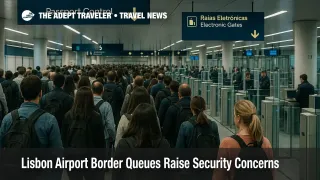
Portuguese police unions say border controls at Lisbon airport are being stretched to the point where both queues and security risks are rising, as officers are pushed to use simplified checks that skip core databases just to keep lines moving. For non EU travelers connecting through Lisbon, Portugal, this means longer waits at passport control, greater uncertainty about how rigorously documents will be screened, and a higher chance of missing tight connections during busy morning banks. Travelers planning winter or spring trips through Portugal should build in more buffer time and pay attention to how these internal disputes evolve.
In practical terms, the problem is a combination of Lisbon airport border queues, the rollout of the Entry Exit System, and simple capacity limits at Humberto Delgado Airport, one of Europe's more constrained hubs that has long operated above its design ceiling.
Police unions representing officers now responsible for border checks say the core issue is structural rather than a temporary staffing blip. The Public Security Police, PSP, which took over airport controls after the old SEF border agency was dismantled in October 2023, has warned that officers are repeatedly instructed to use a "Simplified System" when passenger volumes spike at Lisbon. Under this shortcut, officers confirm passport validity but do not run documents through law enforcement databases, a procedure originally intended only for departures and rare emergency arrivals, such as system outages.
Union leaders argue that this workaround has become routine. They cite an August case in which a man suspected of homicide in Porto nearly left the country while simplified checks were in place, and was stopped only because an inspector noticed his behavior and manually queried police systems. Their concern is straightforward, if borders depend on manual judgment rather than systematic database checks, wanted individuals have a greater chance of slipping through. That framing shifts the story from inconvenience to a broader Schengen security question.
The rollout of Europe's new Entry Exit System, EES, on October 12, 2025 has compounded the strain. The EU wide system, built to replace passport stamps with biometric records for most non EU travelers, requires people to scan their passport, provide fingerprints, and have a facial image captured on first entry, a process that can take several minutes per passenger when systems are new. At Lisbon, police reported that October 14 was a "critical" day, with non EU passengers waiting more than 90 minutes at both arrivals and departures as the new EES procedures collided with limited space and staffing.
Lisbon is also dealing with a simple volume mismatch. According to concessionaire VINCI, which controls ANA Airports, Humberto Delgado was designed for around 22 million passengers a year but handled more than 35 million in 2024, a gap that leaves little margin when something new, such as EES, is added. Police union officials argue that even adding more officers would not fully solve the problem without more physical "boxes," or inspection booths, and better use of space across Terminals 1 and 2.
The unions are unusually blunt about what they see as commercial pressure. Leaders from the ASPP union accuse ANA of pushing the government and PSP to prioritize shorter queues over strict controls, since faster passenger flow can help the private operator's bottom line and protect Portugal's tourism image. ANA publicly denies interfering with border procedures, saying that control is a state responsibility and that its only concern is passenger experience amid waits that have at times topped two or even four hours for non Schengen arrivals.
Scheduling choices and airport management are another friction point. Unions say peak stress typically hits between about 730 a.m. and 1130 a.m., when waves of long haul arrivals overlap with departures to destinations requiring passport checks, forcing border units to triage queues and lean more heavily on simplified procedures. Strains then ripple into later connection banks, which can hit travelers who thought they were booking off peak flights.
For travelers, this means that the risk is not limited to a single day or special event. Non EU passengers arriving or departing in those morning peaks are most exposed to long lines, and anyone connecting onward from Lisbon should consider the possibility that a 60 or even 90 minute connection might no longer be enough if border queues spike or a manual EES registration is required. This is especially true for separate tickets, where airlines have less incentive to help rebook missed onward flights.
There is also a human resources angle, but unions insist that raw headcount is only part of the story. Around 300 PSP officers and some 35 Judiciary Police inspectors rotate through Lisbon border duties, many of the latter on temporary assignments that were recently extended to April 2026 to cover the EES transition. Union representatives say their members feel overused and undervalued, arguing that they were told on short notice that airport postings would last months longer than planned.
The Portuguese government acknowledges that queues have become, in its words, a national embarrassment. Senior officials have pointed to both a shortage of PSP agents and technical instability in the e gates as key causes, even while ANA points the finger back at state agencies. The current plan is to increase manual booths and e gates at departures by roughly 30 percent, raise arrival booths by 30 percent, and boost e gates there by 70 percent by June 2026, part of a wider expansion program at Lisbon and other main gateways.
Those upgrades may help, but they will arrive slowly. The EES rollout itself is phased through April 10, 2026, and Lisbon's terminal expansion is constrained by its urban location and ongoing political wrangling about a long term replacement airport site. Until more space and stable automation are in place, system complexity and heavy traffic will keep nudging officials toward shortcuts when queues spike, exactly the pattern unions are trying to flag.
Travelers considering Lisbon as a hub over the next 12 to 18 months should respond with conservative planning rather than alarm. For now, the best move is to book longer connection windows, avoid separate tickets through Lisbon, favor midday or later evening flights where possible, and arrive at the airport early enough that an extra half hour at border control does not put the whole itinerary at risk. As unions stage plenary sessions on December 18 to assess conditions and the government rolls out promised infrastructure changes, Adept Traveler will track whether Lisbon's border queues move back into the normal annoyance band, or remain a structural chokepoint in the Schengen system.
Sources
- Lisbon airport queues spark security warnings as police unions cite pressure to speed up checks
- ANA denies pressure to ease border control at Lisbon Airport
- Travellers endure four hour queues at Lisbon airport as upgrades loom
- The new Entry Exit System went live on 12 October
- Entry Exit System background and rollout
- Entry/Exit System information, Lisbon Airport