

Tanzania Independence Day Protests Hit Safaris, Zanzibar
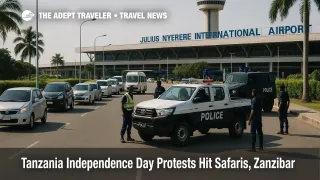
Tanzania Independence Day protests travel risk is now a central planning factor for anyone with safaris or Zanzibar trips around December 9, 2025, because the government has cancelled official celebrations, urged citizens to stay home, and warned that any demonstrations will be treated as illegal. Police and army units have already surged into Dar es Salaam and Arusha, and rights groups say that election related violence in October left hundreds dead. For travelers, this turns a familiar safari and beach itinerary into a trip that could be reshaped by curfews, checkpoints, and disrupted access to airports and ports.
The Tanzania Independence Day protests mean that travel through Dar es Salaam, Arusha, Moshi, Kilimanjaro, and Zanzibar now carries an elevated risk of delays, rerouting, or shelter in place periods, particularly between December 8 and December 10 when protests and security responses are most likely.
Background, how Tanzania reached this point
General elections on October 29, 2025, sparked some of the worst unrest in Tanzania in decades, with the United Nations and human rights groups saying that hundreds, and possibly more, were killed when security forces cracked down on protests after President Samia Suluhu Hassan was declared the winner with nearly 98 percent of the vote. Opposition figures and many analysts argue that the result was neither free nor fair, and report patterns of enforced disappearances, bodies removed from mortuaries, and treason charges filed against protesters, including teenagers.
As calls for nationwide demonstrations grew, the government first cancelled the usual Independence Day events, then moved to frame any December 9 protest as an illegal attempt to paralyze economic activity. Prime Minister Mwigulu Nchemba has publicly asked citizens to stay at home on December 9 unless their jobs require them to be on site, which is a clear signal that authorities expect serious trouble and intend to keep streets as empty as possible.
International partners have responded with a mix of pressure and warnings. The United States raised its country travel advisory to Level 3 Reconsider Travel on October 31, adding an unrest flag and highlighting the risk of demonstrations, checkpoints, and roadblocks, then followed up with specific security alerts tied to the December protest calls. Australia's Smartraveller and other partners now also tell visitors to reconsider trips, citing civil unrest, violent crime, and the possibility of renewed demonstrations and harsh responses around national holidays such as Independence Day.
What the December 9 protest window actually looks like
The December 9 protest risk is not a single march in one city. Rights groups and analysts describe calls for nationwide demonstrations that could begin as early as December 5 and flare again after Independence Day, often organized through social media and encrypted apps rather than formal permits. Police say that because no official notification has been filed they will treat any gathering as illegal, and officials have publicly accused organizers of trying to paralyze economic activity, which sets the stage for roadblocks, aggressive crowd control, and mass arrests if people turn out.
The security alerts that matter most to travelers do not focus on the politics, they focus on how the state might respond. U.S. messages warn that demonstrations could lead to nationwide curfews, an internet blackout, new checkpoints, and disruptions to international and domestic flights, while also advising people to keep several days of food, water, fuel, and cash on hand and to be ready to shelter in place. Canadian and Australian advisories echo the concern about firm responses, and explicitly flag that access to airports could be limited during unrest.
How this hits classic safari and Zanzibar flows
Most visitors enter through Julius Nyerere International Airport (DAR) in Dar es Salaam, Kilimanjaro International Airport (JRO) between Arusha and Moshi, or Abeid Amani Karume International Airport (ZNZ) in Zanzibar, then connect by short domestic flights and road transfers into the northern safari circuit or coastal islands. The protest calls and security posture do not close the national parks, but they raise the chance that travelers will struggle to move between these hubs if main roads or ferry corridors are blocked or if curfews limit overnight transfers.
Dar es Salaam is the most exposed gateway because protest organizers and security forces both focus on the commercial capital, which hosts embassies, ministries, and the main ferry terminal for Zanzibar. If demonstrations or crackdowns erupt in central districts, roads to Julius Nyerere, the harbor, and key hotel areas could be blocked or heavily controlled, and the U.S. Embassy has already warned that staff will face movement restrictions and that consular services may be limited around the protest window.
Kilimanjaro, Arusha, and Moshi are quieter than Dar es Salaam in normal times, but they are not immune. A visible buildup of security personnel and a legal stance that treats all gatherings as unauthorized mean that even small protests or rumors can trigger checkpoints on arterial roads linking airports to lodge clusters, or on the routes that safari vehicles use to exit the parks for late flights. Travelers who try to squeeze a game drive and a same day departure into the December 9 window are taking on more risk than usual of missing their flights.
Zanzibar has a slightly different pattern. The island itself can remain calm while the trouble is on the mainland, but Zanzibar City, the airport, and the ferry terminal all depend on predictable flows of people, fuel, and goods from Dar es Salaam. Security alerts that mention possible suspension of ferries and cancellations of international flights are a strong hint that operators fear these links could be cut for hours or longer if authorities decide to lock down traffic between the island and the mainland.
Internet, payments, and communications risk
Travelers also need to assume that internet and mobile service could be heavily restricted around December 9. After the election, Tanzania imposed a multiday internet shutdown that made it much harder to verify casualty reports and coordinate assistance, and both rights groups and foreign governments warn that similar measures could be used again if protests grow. Smartraveller, the U.S. State Department, and other advisors explicitly mention the possibility of internet and mobile outages, which would affect navigation apps, ride hailing, mobile money, and card processing in hotels and restaurants.
In practice, that means a visitor might suddenly lose access to maps, messaging, and digital boarding passes while also facing roadblocks and curfews. Anyone who decides to travel despite the warnings should carry printed copies of tickets and hotel confirmations, pre download offline maps, and keep enough physical cash in major currencies and Tanzanian shillings to cover several days of food, fuel, and contingency lodging without relying on cards or phones.
Should you postpone, reroute, or go ahead
For trips that have not yet begun, the combination of a Level 3 U.S. advisory, reconsider travel messages from other governments, and explicit warnings about December 9 protests is a clear signal that non essential travel can reasonably be postponed, especially for first time safaris or complex family itineraries with children. Operators with the flexibility to rebook clients into later 2026 windows may find that safer and easier than trying to thread a narrow window through a protest week.
For travelers already in Tanzania, the calculation is different. Parks, lodges, and many local operators continue to stress that core safari circuits and islands remain calm, and some on the ground providers argue that the risk is mainly in central city areas rather than in wildlife destinations. That nuance matters, but it does not remove the transport risk, because almost every visitor still has to pass through a major hub and move along roads or sea lanes that can be disrupted.
The most conservative approach for guests in country is to avoid any movement through downtown areas from December 8 to December 10, shift flight dates or times where possible, and overnight near airports before early departures rather than relying on same day transfers vulnerable to roadblocks or spontaneous curfews. Groups should agree in advance on a shelter in place plan at each hotel, including how to stay informed if internet goes down and which local contact or tour operator will relay updates by phone or radio.
Tour companies and advisors also need to revisit duty of care. After a string of African security shocks, including recent disruptions in Ethiopia and Benin that briefly shut down airports and border crossings, it is no longer defensible to treat political risk as a distant background factor in trip planning. Clients should see written guidance on protest risk, curfew scenarios, and emergency exit routes for Tanzania itineraries in the same way that they see malaria and road safety notes. Previous Adept Traveler coverage of the Marburg outbreak in southern Ethiopia and the brief coup attempt that closed Benin's borders gives a sense of how fast conditions can flip for travelers even when flights resume quickly.
For deeper context on how health and political shocks can affect African itineraries, see Adept Traveler's recent news pieces on the Marburg outbreak in Ethiopia's South Ethiopia Region and the coup attempt that briefly shut Cotonou Cadjehoun Airport and Benin's borders, which together underline how quickly road access and airspace can close and reopen. These are different crises than Tanzania's current unrest, but they illustrate the same structural exposure for travelers who rely on a small set of critical hubs.
Sources
- Tanzania urges citizens to stay home ahead of expected Independence Day protests
- Tanzania Travel Advisory, Level 3 Reconsider Travel
- Security Alert, U S Embassy Dar es Salaam, December 5, 2025
- Tanzania Travel Advice, Smartraveller
- Travel advice and advisories for Tanzania
- Tanzania, Preventing Another Massacre
- UN rights chief calls for a probe into killings in Tanzania and allegations of concealing evidence
- Tanzania braces for turmoil as US issues security alert ahead of planned December 9 protests
- Tanzania Travel Advisory, International Travel Information
- Tanzania Travel Advisory social and alert posts, Smartraveller and partners