

Buenos Aires Public Sector Strike December 9 Disrupts Center
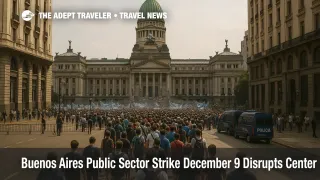
A Buenos Aires public sector strike on December 9 will center on Argentina's Congress district, where state workers plan a 24 hour national walkout and march against President Javier Milei's labor reform bill. The action, led by the combative public sector union ATE, is expected to close or severely limit service in many national and provincial offices, and to draw large crowds along Avenida de Mayo and around Plaza del Congreso. For travelers, the practical effect is fewer services and a downtown core that can be slow, noisy, and sometimes impassable during the main march hours.
In plain terms, the Buenos Aires public sector strike December 9 will concentrate disruption in the central government quarter, making it a poor day for embassy visits, errands at public offices, or tight transfers across the city center.
ATE, the Asociación Trabajadores del Estado, confirmed the date after its national leadership voted for a paro nacional, or national strike, and a march to Congress to reject the labor reform package now moving through the legislature. Union leaders, including national secretary general Rodolfo Aguiar, describe the bill as a pro market reform whose real aim is to discipline the workforce, and they are also demanding emergency wage increases, reopening of collective bargaining, and an end to planned 10 percent staffing cuts in state bodies. Media briefings from ATE provincial branches and local outlets make clear that the strike call covers agencies across Argentina, although the march and the sharpest travel impacts will cluster in the capital.
In the days leading up to the walkout, major outlets such as Infobae and regional sites in Buenos Aires Province have reported that the strike is set for Tuesday, December 9, and will include a march to Congress backed by allied social movements. That means central Buenos Aires should be treated as a live protest zone where traffic closures can appear with limited notice, and where police have to carve out space both for marchers and for counterflows of everyday commuters. Past marches in the same corridor show that once crowds fully occupy Avenida de Mayo, short street crossings can stretch into long detours, especially for cars and buses that cannot weave through side streets as quickly as pedestrians.
Although this is a sector specific strike, not a full general stoppage, it will land on top of wider changes to strike rules that already push unions toward marches and concentration tactics. A May 2025 presidential decree reclassified air transport, education, health, customs, telecommunications, and several other activities as essential, requiring up to 75 percent minimum service during strikes, while additional sectors such as food production and hospitality must operate at 50 percent. Critics argue that this directive effectively limits traditional shutdown strikes in many areas, which helps explain why unions like ATE are channeling pressure into mass mobilizations at symbolic sites such as Congress instead of trying to halt every train and flight.
For visitor level logistics, the most important distinction is between the core march zone and the rest of the city. Demonstrations are expected to converge on Congress, then flow along Avenida de Mayo toward or from Plaza de Mayo, a route lined with ministries, offices, and key cultural sites. Anyone staying in hotels or rentals within a few blocks of these plazas should expect chanting, drums, street vendors, closed lanes, and visible security forces for at least part of the day. Access by taxi or rideshare may be limited while marches are in motion, and local bus lines that normally use Avenida de Mayo can be detoured or suspended.
Outside the protest corridor, everyday services may still feel thinner than usual. ATE affiliates in provinces such as Buenos Aires, Río Negro, and Salta have already announced that they will join the strike, warning of impacts on schools, administrative offices, and other local services. Travelers trying to renew documents, pick up paperwork, or visit provincial museums on December 9 could find closures or reduced hours even far from Congress, especially in smaller cities where there is little redundancy in staff. Essential services like hospitals and emergency responders are expected to remain available, but with potential delays.
Airport operations are not the primary target of this strike, and there is no sign that aviation unions plan to join in the way they did for the broader April general strike that shut down much of Argentina's transport network. Even so, the combination of marches and rolling roadblocks raises the risk of missed flights for anyone crossing central Buenos Aires to reach Ministro Pistarini International Airport (EZE) or Jorge Newbery Airfield (AEP). Transfers from downtown hotels to either airport should be booked with extra buffer, and where possible, routings that use ring roads or skirt the core, such as via Avenida 9 de Julio and then outwards, are safer bets than direct crossings of the Congress corridor.
Background: How ATE Strikes Work In Practice
ATE has a long history of combative actions, from quick stand up protests at ministries to full day national strikes. Recent walkouts under the Milei government have tended to focus on a mix of wage demands, resistance to layoffs, and opposition to structural reforms, with participation that varies sharply by province and agency. In practical terms, this often produces a patchwork map where some offices shut completely, others operate with skeleton crews, and a few remain close to normal thanks to alternative staffing or low union penetration. For travelers, that means broad expectations of slowness, not necessarily a clear list of universally closed facilities.
The April 10 general strike, organized mainly by the CGT confederation, provides a useful upper bound for what a full day stoppage can look like, with trains, subways, flights, grain ports, and banks all affected and an estimated economic cost in the hundreds of millions of dollars. By comparison, the December 9 ATE strike is narrower, rooted in public sector workplaces, and geared around a single large scale march plus smaller local actions. Travelers should still treat any prebooked appointments with government offices as at risk, but they are less likely to see a complete shutdown of all transport modes.
How Travelers Should Adjust Plans
Visitors who can shift their Buenos Aires schedule have an easy option, simply avoid intensive downtown plans on December 9 and place heavy administrative days on other dates. For those locked into the date, the better strategy is thoughtful routing and time management. If you need to cross the center, do it early in the morning before marchers gather, or wait until later in the evening when crowds thin out and police start reopening streets. Midday is the most likely window for mass marches, speeches, and static rallies that close larger areas.
Travelers heading to or from Ezeiza or Aeroparque should allow wider margins than usual, two and a half to three hours from central hotels for international flights, and at least two hours for domestic trips, especially if your route normally crosses near Congress or Plaza de Mayo. Where possible, prebook transfers with drivers who know alternative corridors, and keep in touch by messaging in case they need to adjust pickup points at short notice. Metro and suburban rail services are likely to be busier around the center, as some commuters avoid surface streets.
If you are staying within walking distance of the protest route, treat the strike day as an opportunity for flexible, close in activities, for example local cafes, parks, or indoor attractions that do not require fixed entry times. Keep passports, electronics, and other valuables secured in your accommodation, carry only what you need for the day, and stick to main streets, especially when crowds thicken or visibility drops in the evening. As with any large gathering, the greatest risks for travelers are usually petty theft and being stuck in the wrong place when rival groups or police lines shift.
For broader context on how marches and strikes typically affect travel in Argentina, travelers can cross reference this alert with Adept Traveler's coverage of the April general strike, which mapped out how nationwide union actions ripple through flights, intercity buses, and rail, and with evergreen guidance on navigating protests and labor disputes across Latin America.
Sources
- ATE fijó la fecha del Paro Nacional para el 9 de diciembre y se movilizará al Congreso
- ATE convocó a un paro nacional para el martes y una marcha al Congreso contra la reforma laboral
- Paro de ATE este martes 9 de diciembre: se suma una movilización de organizaciones sociales al Congreso
- ATE ratificó el paro nacional de este martes en contra de la reforma laboral
- ATE convocó a paro nacional y marcha para el martes contra la reforma laboral
- Argentina imposes severe restrictions on the right to strike
- General strike against President Milei's austerity disrupts Argentina
- Argentine workers launch widespread 24-hour strike against Milei's austerity measures