

Cyclone Ditwah Sri Lanka Train Closures Hit Hill Country
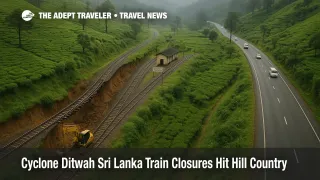
Cyclone Ditwah's cleanup phase in Sri Lanka is now defined less by dramatic flood footage and more by slow, technical repair work, and that shift is hitting the rail network hardest. Hill country tracks between Kandy and Ella, and parts of the northern line to Jaffna, have suffered such severe landslide and bridge damage that officials and tour operators now talk in months, not days, before normal service returns. For travelers with winter and early spring itineraries built around scenic trains, the new reality is that Sri Lanka trips can still go ahead, but hill country legs must be rebuilt around cars, vans, and coaches instead of beloved blue carriages.
In practical terms, Cyclone Ditwah Sri Lanka train closures mean that for at least the next one to three months, many inland rail journeys will be replaced by road travel, even as most key destinations, hotels, and national parks reopen and the country continues to market itself as "open for tourism."[1][2][5][6]
Where Sri Lanka's Rail Network Is Still Broken
Sri Lanka Railways' own leadership has been blunt about the scale of the damage. The general manager told a government briefing that Cyclone Ditwah and associated landslides left only the Coastal line from Colombo to Beliatta and the Kelani Valley line from Maradana to Avissawella fully intact in the immediate aftermath, while key inland routes were knocked out.[1] The worst structural damage is on the upcountry tracks to Kandy, Badulla, and Matale, where in at least fifteen locations the ground beneath the rails was washed away, leaving sections of track literally hanging with no earth supporting them.[1]
By early December, emergency crews had restored limited service on some lowland sections, such as Colombo to Ambepussa on the main line and part of the Puttalam line, but large stretches of the Colombo to Badulla route beyond Rambukkana, the northern line from Polgahawella toward Kankesanthurai, and the eastern spurs from Gal Oya toward Trincomalee and Batticaloa remained out of operation.[1] Officials estimated that about three weeks of work would be needed to bring the Trincomalee and Batticaloa lines back, while the northern line would require roughly one and a half months of intensive repairs, including help from the Indian company that previously upgraded the route.[1]
For travelers, that translates into two headline issues. First, the iconic hill country train between Kandy and Ella sits on some of the most badly hit track, with over half of certain sections needing reconstruction according to local operators in Ella, who now describe services as suspended for the foreseeable future.[7] Second, central portions of the northern line to Jaffna and beyond are likely to stay closed for at least a month while engineers fix washed out ballast, twisted rails, and damaged bridges.[1][2]
What Tour Operators Are Telling Travelers
Major small group operators have already rewritten their trip notes. Intrepid Travel's 9 December 2025 alert confirms that while destinations such as Kandy, Nuwara Eliya, and much of the Central Highlands are once again accessible and visited on tours, "some train lines remain out of service and are expected to stay offline for at least one month in the north (Jaffna) and up to three months in the Central Highlands (Kandy, Ella)," with road travel replacing train journeys on affected itineraries.[2]
Local drivers and transfer companies report the same pattern from the ground. Ella based operators emphasise that Sri Lanka is open and that beaches, cultural sites, and most wildlife parks are operating normally, but they also stress that hill country train services remain suspended and that alternative transport, such as private vans, long distance buses, and tour organised transfers, is now the default for moving between Colombo, Kandy, Nuwara Eliya, and Ella.[7]
The result is a split picture. Coastal and lowland rail lines, particularly around Colombo, Galle, and the deep south, are far more likely to function or come back quickly. Inland, especially on mountain routes that were famous for tea plantation views, travelers should plan on zero train availability through at least January and probably into February or March 2026 unless Sri Lanka Railways announces a faster than expected reopening.
Roads And Tourist Sites Have Largely Reopened
The good news is that the rail crisis does not mean a nationwide tourism shutdown. Sri Lanka's tourism board and UK facing trade outlets now say that road links to major cities and tourist areas are fully accessible again, including the main Kandy to Colombo highway and roads to Nuwara Eliya, albeit with occasional delays where repair teams are still at work.[5][6] Power has been restored to most urban areas, cruise calls into Colombo have resumed, and all national parks and wildlife centers have reopened except Wasgamuwa, which is expected to follow.[5]
Foreign travel advisories back up this mixed picture. New Zealand's SafeTravel describes significant flooding, landslides, and infrastructure damage nationwide, with some central areas inaccessible until rescue and engineering teams finish assessments, but confirms that international flights are operating.[3] Australia's Smartraveller notes that Sri Lanka "continues to experience widespread impacts from Cyclone Ditwah" and warns that transport, roads, railways, and essential services may be disrupted, especially in central mountain districts including Kandy, Nuwara Eliya, and Ella, where road closures and supply interruptions remain possible.[4]
Taken together, these sources support the idea that Sri Lanka remains open for tourism in a broad sense, but that travel through the heart of the island is now structurally more fragile and slower, with trains as the weakest link.
How To Rebuild Classic Hill Country Itineraries
Classic first time itineraries for Sri Lanka often follow a Colombo, Cultural Triangle, Kandy, tea country, and south coast pattern, with the Kandy to Ella train as a highlight. With that rail leg off the table for months, the most sensible approach is to keep the skeleton of the route but swap steel rails for asphalt.
Bandaranaike International Airport (CMB) remains the main gateway, and the expressway system from the airport to Colombo and the southern beaches is functioning normally.[5][7] From Colombo or Negombo, travelers can reach Kandy by highway in roughly three to four hours by private car or intercity bus, and local reports suggest that this corridor is clear even if temporary lane closures and slow sections crop up while post cyclone repairs continue.[5][7]
From Kandy, instead of boarding a train toward Nuwara Eliya or Ella, small group tours and independent travelers now have three realistic choices:
First, keep the original hill country loop and travel entirely by road, for example Kandy to Nuwara Eliya, then on to Ella, using a car and driver or tour minibus. This is the closest substitute for the old rail experience, but travelers must be ready for narrow mountain roads, occasional landslide work sites, and longer travel days, which is why daylight driving and flexible timing are essential.
Second, shorten time in the interior and shift more nights to the south coast. A revised loop could run Colombo or Negombo to Sigiriya and the Cultural Triangle, continue to Kandy, then use a direct road to the southern beaches around Galle and Mirissa, skipping Ella entirely for this season. That option reduces exposure to high risk slopes while preserving variety between culture, cities, and sea.
Third, for itineraries that previously ran all the way to Jaffna by train, travelers can look at domestic flights into Jaffna International Airport (JAF) when available, or combine long distance buses and private transfers on main roads, while leaving additional buffer time for any northern segments that pass through flood and landslide affected zones. Smartraveller still flags the northern and eastern provinces for landmine risk on side roads, so staying strictly on main highways remains important independent of cyclone damage.[4]
In all three cases, the key is to treat the car and the coach as the primary inland tool, not the train, for at least the next several months.
Reading Foreign Office Language Around Landslides And Flooding
One of the more confusing elements for visitors is that foreign office pages have to speak to security, politics, and weather all at once, which can make it hard to understand how worried to be about Cyclone Ditwah's aftereffects.
Smaller, event specific advisories, such as the New Zealand SafeTravel bulletin for Cyclonic Storm Ditwah, tend to focus on immediate hazards like impassable roads, contaminated water, and localised shortages, and they typically stress that conditions vary by district and can change quickly.[3] Country pages, like Smartraveller's Sri Lanka entry, zoom out and fold serious weather disruption into a broader list of risks that also includes protests, terrorism, and crime.[4]
For trip planning, the most useful way to read this language is to treat any mention of "central mountain districts" or named towns like Kandy, Nuwara Eliya, Ella, and Badulla as a flag that hill country travel will demand more homework than usual. If an advisory tells you to check conditions with local authorities or your travel provider before moving between specific regions, do exactly that, and assume that rail services will be at the back of the queue for restoration compared with major highways and power networks.
Because Sri Lanka remains under a state of emergency linked to the cyclone, travelers should also assume that curfews, checkpoints, or temporary closures of certain roads could be introduced at short notice if weather worsens or new landslides occur.[3][4] Carrying identification, keeping contact details for your embassy or consulate, and building slack into the schedule for inland legs are practical ways to absorb those shocks.
Using Existing Cyclone Ditwah Resources
If you are still deciding whether to travel or how much to trim an existing itinerary, it is worth reading a deeper structural overview of Cyclone Ditwah and Sri Lanka's tourism response alongside this specific rail update. Our earlier analysis of visa extension rules explains how temporary fee waivers and grace periods work for visitors whose stays were extended by flooding and flight disruption.[8] A separate regional piece on Asia floods and cyclones puts Sri Lanka's situation in context with late season storms in Indonesia, Thailand, Malaysia, Vietnam, and the Philippines, and it offers a broader decision framework for winter trips that cross several affected countries.[9]
Together with the rail focused picture here, those resources can help travelers decide whether to postpone, reroute, or proceed with extra buffers, while keeping expectations realistic about how "romantic" hill country travel will feel in the middle of a long rebuilding effort.
Sources
- [Sri Lanka railway tracks 'left hanging' by Cyclone Ditwah : GM, EconomyNext][1]
- [Travel Alerts, Sri Lanka update, Intrepid Travel][2]
- [Sri Lanka, Cyclonic Storm Ditwah, SafeTravel (New Zealand)][3]
- [Sri Lanka travel advice, Smartraveller (Australia)][4]
- [How to help Sri Lanka's tourism sector recover from Cyclone Ditwah, Condé Nast Traveller][5]
- [Sri Lanka restores access to all tourist areas following Cyclone Ditwah, Travel Gossip][6]
- [Is It Safe to Travel to Sri Lanka Right Now? Latest Update, Ella Rides][7]
- [Cyclone Ditwah Sri Lanka Visa Extensions And Travel, The Adept Traveler][8]
- [Asia Floods And Cyclones Disrupt December Travel, The Adept Traveler][9]