

Japan Megaquake Advisory Puts Northern Travel On Watch
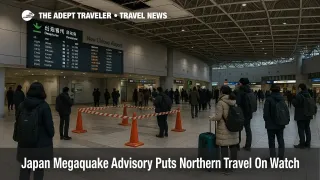
A strong 7.5 magnitude offshore earthquake near Aomori in northern Japan on December 8, 2025, combined with a rare megaquake advisory, has put Japan megaquake advisory travel plans for Hokkaido and Tohoku under closer scrutiny. The late night quake, which struck at about 11:15 p.m. local time, triggered tsunami warnings along the Pacific coasts of Hokkaido, Aomori, and Iwate, prompted evacuations for roughly 90,000 people, and led to precautionary shutdowns of trains and airport facilities in the region. Most services have since resumed, but the official advice for the coming week is to stay alert for strong aftershocks and to plan northern coastal itineraries with more flexibility than usual.
The Japan megaquake advisory travel story is that a single large offshore quake near Aomori has raised the statistical chance, still only around 1 percent, of a larger magnitude 8 class event along parts of the northern Pacific coast in the next seven days, so northern coastal trips should be treated as dynamic rather than cancelled outright.
The December 8 quake hit about 80 kilometers off the Pacific coast of Aomori Prefecture at a depth of around 50 to 54 kilometers, registering upper 6 on Japan's 1 to 7 seismic intensity scale in parts of Aomori and sending strong shaking across Hokkaido and Tohoku. The Japan Meteorological Agency, JMA, initially issued tsunami warnings predicting waves up to 3 meters, but observed heights stayed in the 20 to 70 centimeter range, mainly damaging oyster and fish farming installations. By early December 9 all tsunami warnings had been downgraded and lifted, and authorities reported several dozen mainly minor injuries, localized fires, and short power cuts, but no large scale structural collapse and no problems at nearby nuclear plants.
How Japan's megaquake advisory works
The more unusual development is the issuance of an "Off the Coast of Hokkaido and Sanriku Subsequent Earthquake Advisory," often shortened in media coverage to a megaquake advisory. This system, launched in 2022 after lessons from the 2011 Great East Japan Earthquake, lets JMA flag situations where statistics show an elevated chance that a big offshore quake could be followed by an even larger event in the same region within about a week.
In this case, JMA says the probability of a magnitude 8 or greater earthquake along parts of the Pacific coast from Hokkaido down to Chiba has risen from a background level of roughly 0.1 percent to around 1 percent over the next seven days. The advisory covers 182 municipalities across seven prefectures, including Hokkaido, Aomori, Iwate, Miyagi, Fukushima, Ibaraki, and Chiba, and officials emphasize that this is not a prediction that such a quake will occur, only a signal that residents and travelers in the coastal belt should review evacuation routes, prepare go bags, and stay tuned to local alerts.
The megaquake advisory does not, on its own, close airports, halt Shinkansen trains, or trigger foreign governments to raise their overall travel warning levels. At time of writing, major foreign offices including the United States continue to rate Japan as a destination where travelers should exercise normal or routine precautions, while issuing specific alerts to explain the earthquake and tsunami situation and remind visitors about standard earthquake safety steps.
Airport impacts, especially at New Chitose
For air travelers, the most concrete knock on effects have been in Hokkaido. New Chitose Airport (CTS), the main gateway for Sapporo and Hokkaido ski resorts, briefly closed runways for inspections after the quake, delaying or canceling some flights while engineers checked for damage. Part of a domestic terminal ceiling cracked and fell, leading the operator to cordon off an area, declare part of the building unusable, and keep some facilities closed while repairs are planned. Local reports suggest about 200 passengers spent the night in the terminal because of the disruption.
By December 9, New Chitose had largely resumed normal operations, with flights running but some ongoing delays and a request that passengers confirm their flight status with airlines before heading to the airport. Smaller regional airports in Aomori and Iwate also conducted inspections, with scattered cancellations and late departures, but there are no signs of long term closure at major northern gateways.
Tokyo's Haneda and Narita airports, Kansai International near Osaka, and Chubu Centrair near Nagoya are operating normally, apart from the usual ripple delays caused when aircraft or crew are out of position from northern disruptions. For most long haul passengers, this means that itineraries that only connect through Tokyo, Osaka, or Nagoya can continue largely as planned, while those who are connecting onward to Hokkaido or Tohoku should expect a higher than usual chance of schedule changes over the coming week.
Rail checks on the Tohoku Shinkansen and local lines
East Japan Railway, JR East, suspended Tohoku Shinkansen services between Fukushima and Shin Aomori immediately after the quake so that crews could inspect track, overhead lines, tunnels, and viaducts. Several conventional lines in Tohoku, including parts of the Ōu Main Line, the Tōhoku Main Line, the Gonō Line, and others, were also suspended.
By later December 9, JR East reported that bullet train operations had resumed after safety checks, although timetables remained thinner than normal and select services were still cancelled or delayed while inspections continued on some local sections. In practical terms, this means travelers can still use the Tohoku Shinkansen to reach cities such as Morioka, Hachinohe, and Shin Aomori, but should allow more buffer time for connections and keep an eye on JR East's English language disruption page before committing to tight same day transfers.
Rail in central and western Japan, including the Tokaido Shinkansen corridor between Tokyo, Nagoya, Kyoto, and Osaka, is operating normally, so itineraries focused on the traditional Golden Route are effectively unaffected except where travelers planned to tag on a northern excursion.
What this means for winter trips to Hokkaido and Tohoku
The timing of the quake is awkward, because early December is when winter tourism in Hokkaido and Tohoku starts to ramp up, especially around resort areas such as Niseko, Furano, Rusutsu, and ski towns in northern Honshu. Reports so far indicate that resorts in central and northern Hokkaido felt strong shaking and short power flickers but have not seen serious structural damage or long closures, and lifts and slopes are operating with only minor interruptions.
For visitors, the main distinctions over the coming week are geographic. Inland and western parts of Hokkaido, plus non coastal cities such as Sapporo and Asahikawa, are far from the tsunami risk zones and mainly need to plan for possible aftershocks and the chance of temporary checks on rail or road infrastructure. Coastal strips facing the Pacific, including parts of southern Hokkaido, Aomori's Hachinohe and Misawa areas, Iwate's Sanriku coast, and towns north of Sendai, carry a slightly higher risk profile because the megaquake advisory is specifically focused on offshore faults in these waters.
Travelers who are uneasy about even a 1 percent risk of a larger offshore quake can, without much friction, pivot northern itineraries inland or shift them south. That might mean swapping a road trip along the Sanriku coast for extra days in Sapporo and Niseko, routing via inland Morioka instead of hugging the coast, or reallocating time from Hokkaido to Nagano or Tohoku's interior ski resorts where tsunami exposure is negligible.
Practical planning steps for the next week
In the near term, anyone flying into or out of New Chitose, Aomori, Hakodate, or Sendai should reconfirm flights, avoid tight same day connections to separate tickets, and consider arriving in Japan a day earlier if they have fixed cruise departures or package tours tied to northern gateways. JR East passes and flexible rail tickets remain valuable tools, since they allow travelers to shift departures or route around any line that is temporarily suspended for inspections.
On the safety side, travelers booked into coastal areas inside the advisory zone should do what Japanese residents are being asked to do: learn local tsunami evacuation routes, identify higher ground or reinforced buildings, keep basic emergency supplies and medications in one place, and sleep with phones charged and alerts enabled. Hotels in Japan are generally well drilled on earthquake plans, so it is reasonable to ask front desk staff about their procedures on check in.
For trips to Tokyo, Osaka, Kyoto, Nagoya, Hiroshima, and most of Kyushu and Shikoku, the megaquake advisory is mainly a reminder of Japan's general seismic risk rather than a reason to cancel. Long distance travelers can keep their bookings, but should use this episode as a prompt to review insurance coverage, confirm that their policy covers trip interruption due to natural disasters, and consider adding a buffer day if their itinerary relies on one specific flight or train to make everything work.
Key points and Impact here follow Adept Traveler's standard JSON format, which is designed so that a reader can skim top sections and decide quickly whether to keep, shift, or reroute a trip. The visual guidance below follows the matching image style spec for realistic airport disruption scenes.
Sources
- Japan lifts tsunami warning after 7.5 magnitude earthquake off Aomori
- Japan assesses damage from 7.5 magnitude quake that injured 34
- Why Japan has issued an advisory for a possible megaquake in the country's north
- Alert: Japan Earthquake/Tsunami Warning Alert, December 8, 2025
- Megaquake Advisory Issued After M7.5 Quake Hits Aomori
- Japan earthquake: is it safe to travel amid 'megaquake' warning and tsunami alerts
- Japan hit by 7.5 magnitude quake: What to know if you have a trip planned
- Train Status Information, JR East
- New Chitose Airport facility notice on impact of Aomori offshore earthquake