

Nigeria $11.50 Security Levy On International Flights
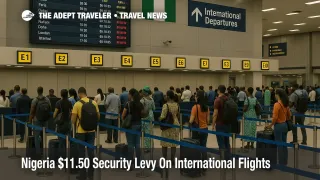
Travellers using Nigeria as a gateway will soon pay slightly more for the privilege. From December 1, 2025, the Nigeria Civil Aviation Authority, NCAA, is adding a new $11.50 (USD) security levy tied to the Advance Passenger Information System to every international ticket issued for travel into or out of the country, on top of an existing $20.00 (USD) security charge. Passengers flying through Murtala Muhammed International Airport (LOS) in Lagos, Nnamdi Azikiwe International Airport (ABV) in Abuja, and other international gateways will all see the extra line. For most individual trips the increase will be modest, but in a market where taxes and fees already bite, travellers and companies need to build the higher all in price into routing, budget, and hub decisions.
The Nigeria security levy international flights policy means that each international ticket touching Nigeria will carry about $31.50 (USD) in security related charges alone, which can influence whether travellers choose to route through Lagos or Abuja or pivot to competing West African hubs instead.
How The New APIS Security Levy Works
The levy is formally classified as an Advance Passenger Information System, APIS, security fee. NCAA guidance to airlines states that a charge of $11.50 (USD) per passenger will be collected automatically at the point of ticket sale for all tickets issued from December 1, 2025, covering any journey to or from Nigeria, and that the lifting carrier will remit the proceeds to the authority. The new charge joins an existing $20.00 (USD) security fee, which means the security slice of a typical ticket increases by more than 50 percent overnight.
Local and regional media summarise NCAA estimates that the APIS levy will run for about 20 years and generate on the order of $46 million (USD) per year for security infrastructure and passenger data systems, putting the total take near $1 billion (USD) over the planned life of the scheme. Officials frame this as a long term investment in screening, border management, and aviation IT rather than a short term cash grab.
APIS itself is not unique to Nigeria. It is a globally adopted data system that lets governments and airports receive key elements of passenger information in advance, screen it against watchlists, and run risk assessments before a traveller ever arrives at immigration or boarding. Many countries fund APIS and related systems through general taxation or broader ticket charges rather than a dedicated line, which is part of why this separate fee is drawing scrutiny.
Why This Matters For Fares From Lagos And Abuja
Nigeria was already an expensive aviation market before the new charge. A recent analysis of ticket taxes in Africa using IATA data found that Nigeria generated about $62 million (USD) from airline ticket specific taxes in 2024, placing it among the continent's top earners from this revenue stream. Separate reporting on regional airport economics notes that passengers departing Lagos and Abuja often face combined service charges that can approach or exceed $100.00 (USD) per ticket, among the highest cumulative burdens in the world for comparable routes.
Industry groups have been warning for years that multiple overlapping charges, including value added tax, ticket sales charges, passenger service charges, security and fuel surcharges, development levies, and navigation fees, already push Nigerian fares above those in many neighbouring markets. The new APIS levy arrives on top of that stack at a time when inflation and foreign exchange constraints have already doubled or tripled some long haul fares in naira terms.
For a Lagos to London economy ticket that prices at, for example, $1,000.00 (USD) all in, an extra $11.50 (USD) will not be the deciding factor by itself. However, when a family of four buys tickets or a company sends staff out on frequent trips, the incremental cost adds up quickly over a year. The psychological effect also matters, because it reinforces a narrative among both leisure and business travellers that flying from Nigeria always seems to attract yet another charge.
Where Travellers Will See The Charge
NCAA's memo instructs airlines to program their systems so that the APIS security fee is coded and collected automatically when a ticket is issued, regardless of whether the sale happens through a Nigerian travel agency, an international online travel agency, or a foreign point of sale. In most global distribution systems, the fee is expected to appear as an additional tax or surcharge line in the price breakdown, likely flagged with an APIS, security, or Nigeria specific code rather than folded into the base fare.
For travellers, the key thing is to look at the tax breakdown on booking pages or e tickets, not just the top line price. You may see the base fare remain flat while the sum of "taxes and fees" inches higher. Corporate travel managers should work with their travel management companies, TMCs, to ensure expense reporting tools can identify the new levy, which will help with budgeting and policy decisions on route choice.
Transit passengers who connect through Lagos or Abuja on a single ticket but begin and end their journeys outside Nigeria are still covered, because the levy applies to tickets for travel "to and from" the country, not just trips booked locally. That means anyone who uses Nigerian hubs as a bridge between other African markets and Europe, the Middle East, or North America will also pay the extra charge.
How Nigeria Compares With Regional Competitors
West Africa is in the middle of a wider debate about how much aviation and airport funding should be loaded directly onto tickets. ECOWAS discussions and regional reporting frequently highlight that both Nigeria and Ghana already impose combined ticket taxes and charges that can reach around $100.00 (USD) per international passenger, well above many competing hubs on other continents. Ghana, for example, is simultaneously considering big jumps in its own airport passenger service charges, which could narrow or widen gaps depending on the final rates.
For travellers who are price sensitive and have flexibility, this creates a calculation problem. If an Abuja to London ticket is, say, $80.00 (USD) more expensive in total taxes and fees than an equivalent itinerary via Accra or Lomé when all costs are converted to the same currency, some passengers will start building their trips around alternative gateways. Others, especially those who value nonstop routes or who would need extra hotel nights and visas to reposition, may decide that paying the higher Nigerian charges is still more practical.
From a policy perspective, aviation stakeholders argue that piling costs on a relatively small pool of international passengers risks depressing demand, which can in turn lead airlines to cut frequencies or withdraw from marginal routes. That would leave travellers with fewer choices and potentially even higher prices as competition thins. Nigeria's challenge is to balance legitimate security and data needs with the reality that high ticket taxes can push traffic and investment to more cost competitive neighbours.
Practical Planning Strategies For Travellers
For Nigerians and visitors whose trips must begin or end in Nigeria, the new levy is effectively a fixed cost. The best response is to treat it as a predictable part of the fare environment rather than a surprise. Build in the extra $11.50 (USD) per person when estimating trip budgets, and focus on managing factors you can control, such as booking far enough in advance to secure lower base fares or choosing travel dates outside peak holiday periods.
If you are based in a neighbouring country or have flexible routing options, it is worth running comparisons that include total journey cost, not just taxes. In some cases, flying to a nearby city like Accra, Lomé, or Cotonou on a low cost or regional carrier, then connecting onward, can be cheaper than buying a through ticket via Lagos or Abuja, even once you add hotel nights and local transfers. In other cases, especially on corporate contracts or where time is tight, paying Nigeria's higher charges to use a nonstop might still be the better value.
Corporate travel programs should update 2026 planning assumptions to reflect higher average ticket prices on Nigeria linked routes and should revisit guidance on when staff are allowed to choose alternative hubs. Travel buyers may also want to ask airlines what, if anything, they plan to do with base fares as the new levy kicks in, since some carriers might shave base prices slightly to keep round number fare points attractive in a high tax environment.
Finally, travellers should understand that the APIS levy is about information and screening, not a change in entry requirements. You still need to meet Nigeria's visa, health, and documentation rules for your nationality. The new charge pays for the systems that process data in advance, so it is unlikely to change your day to day airport experience in the short term beyond the heavier price tag.
Sources
- Fresh travel tax scheme worth $1bn sparks protest
- Nigerian air passengers to pay extra $11.5 per ticket for new security system
- Nigerian int'l airfares to attract extra $11.5 security charge from December 1
- New Levy to Push Up Cost of International Travel for Nigerians
- Understanding Nigeria's New $11.50 Travel Levy
- Nigeria generated $62 million from airline ticket taxes in 2024, IATA
- IATA, African passengers pay more taxes than base fares
- Nigeria keeps building airports, but where are the passengers