

Thailand Cambodia Border Fighting Triggers Travel Warning
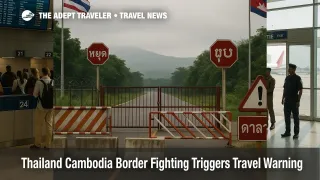
Fighting along the Thailand Cambodia border has escalated into airstrikes and sustained rocket and artillery exchanges, prompting the United States to carve out a new 50 kilometre wide Level 4 do not travel strip on its Thailand advisory as of December 8, 2025. The new Thailand Cambodia border travel warning is aimed squarely at frontier provinces where civilians have been killed and evacuated from their homes and where both armies now treat the border as an active war zone. For travellers, that means overland routes between Thailand and Cambodia are no longer a clever shortcut but a risk corridor to avoid, and most visitors should now route trips by air well away from the frontier, add extra buffer time, and revisit any plans that depend on buses, minivans, or self drive near the conflict area.
The new Thailand Cambodia border travel warning means the frontier has shifted from a tense political issue to a formal conflict zone in risk maps, where several governments now advise against entering a 50 kilometre deep band of Thai territory and warn that they may not be able to help if things go wrong.
What The New Alerts Say
The United States still rates Thailand overall at Level 2, exercise increased caution, but has elevated the Thailand Cambodia frontier to Level 4 do not travel and explicitly tells citizens not to go within 50 kilometres, about 31 miles, of the border. The advisory cites reports of fighting that includes rocket and artillery fire between Cambodian and Thai forces, notes that armed conflict has already led to civilian casualties, and confirms that Thai authorities have ordered evacuations in some areas. It also warns that the United States has limited ability to provide emergency services in the affected provinces and urges travellers to avoid all but essential travel into the zone until further notice.
Australia's Smartraveller goes further in geographic detail, telling travellers not to travel to areas within 50 kilometres of the Thailand Cambodia land border in the Thai provinces of Sa Kaeo, Buriram, Si Sa Ket, Surin, and Ubon Ratchathani and flagging the presence of landmines, military strikes, and ongoing armed clashes. It adds that all border crossing points along the Thailand Cambodia border are currently closed and warns that several temples popular with tourists, including the Preah Vihear area and Ta Muen Thom, now fall inside the do not travel zone.
Canada advises its citizens to avoid all travel to the area within 50 kilometres of the Thailand Cambodia border, pointing to heightened tensions, the imposition of martial law in several districts, and the risk that land crossings may close without warning. The United Kingdom's Foreign, Commonwealth and Development Office takes a similar line, advising against all but essential travel within 50 kilometres of the entire Thai Cambodian border, explicitly including the islands of Koh Chang, Koh Kood, and nearby islands that many travellers treat as a chilled detour from Bangkok.
Together, these advisories turn what had been a patchwork of local warnings and periodic closures into a clear, map like red band across the frontier that mainstream insurers and tour operators will treat as a hard line.
How Far The 50 Kilometre Zone Reaches
The conflict is anchored in longstanding disputes over border demarcation and temple sites, but December's escalation has widened the impact along much of the 817 kilometre border, with Thai forces launching airstrikes and Cambodia reporting civilian deaths and mass displacement on both sides. Thai media and regional outlets describe BM 21 rocket fire hitting Thai positions, retaliatory Thai air operations aimed at Cambodian long range artillery, and domestic rhetoric that frames the campaign as a defence of sovereignty rather than a limited border incident.
On the Thai side, the 50 kilometre band cuts deep into provinces that normally figure in rural road trips and temple loops, not war reporting. In Sa Kaeo, Surin, Si Sa Ket, Buriram, and Ubon Ratchathani, the zone sweeps up agricultural villages, small towns, and roads that feed popular crossings such as Aranyaprathet Poipet and smaller posts used by traders and long stay visitors. Further south and east, Smartraveller urges travellers to reconsider need to travel within 50 kilometres of the border in Chanthaburi and mainland Trat, while the UK extends its 50 kilometre caution zone to cover coastal areas and islands in eastern Thailand.
On the Cambodian side, fighting and displacement have been reported in parts of Banteay Meanchey, Oddar Meanchey, and Preah Vihear provinces, with pictures of villagers fleeing by tractor and residents sheltering in schools and pagodas. That means the risk is not limited to one or two remote clashes but instead spans multiple sections of the frontier that are embedded in common backpacker and overland itineraries.
What This Means For Common Routes
For years, one of the classic Southeast Asia loops has been Bangkok to Siem Reap by bus via Aranyaprathet on the Thai side and Poipet in Cambodia, followed by onward travel to Phnom Penh or Sihanoukville. That entire corridor now sits inside overlapping 50 kilometre warning zones and is directly affected by the closure of all border crossing points and the militarisation of key checkpoints. Travellers who already hold bus or minivan tickets should work on the assumption that coaches will be turned back or cancelled rather than gambling on last minute exceptions.
A second affected pattern is the mix of overland routes that link Bangkok or the eastern Thai islands with Cambodian coastal destinations. FCDO's advice that its warning covers within 50 kilometres of the entire border, "including Koh Chang, Koh Kood and the other islands in between them," means that British travellers who visit those islands are technically inside an area where travel is discouraged, something that can have knock on effects for insurance cover. Even if day to day life on the islands feels far removed from artillery fire in the interior, travellers who had planned to continue by bus into Cambodia should now plan to return to Bangkok and fly instead.
Temple focused day trips and self drive loops into the parks and historical sites along the frontier are also directly hit. Australian advice now lists the areas around Preah Vihear and several smaller temples on both sides of the line inside the do not travel zone, citing not only the current fighting but also unexploded landmines. That is a red flag for anyone considering renting a car or motorbike to "poke around" lesser known border temples, a behaviour that used to be framed as adventurous but now runs straight through a live artillery zone.
Long stay visitors and digital nomads are squeezed from another angle. Earlier this year, Thailand tightened enforcement on repeated land entries in a way that already made border runs less attractive for stretching visa exempt stays. With the frontier now a conflict zone, using land crossings as a visa management tool is not only harder but may simply not be possible for months.
Flights, Cities, And Where Travel Still Works
The good news is that, as of December 9, 2025, regulators in both countries say that commercial flights remain unaffected. Thailand's Civil Aviation Authority reports that border clashes have not affected inbound and outbound flights and that airspace remains open, while Cambodia's civil aviation authorities say flights between Phnom Penh, Bangkok, and Siem Reap are operating normally.
For most trips, that means Bangkok Suvarnabhumi Airport (BKK), Don Mueang International Airport (DMK), Phnom Penh International Airport (PNH), and Siem Reap Angkor International Airport (SAI) continue to function as reliable gateways. Travellers can still plan point to point itineraries between these cities, and tour operators that focus on Angkor temples and Phnom Penh's urban sights are continuing to run programs that stay far from the conflict zone.
The trade off is that journeys which once stitched the region together by road now require an extra leg and a bit more cash. A Bangkok to Angkor route that used to be a single long day on a bus will now be a Bangkok to Siem Reap flight plus a local transfer. Domestic loops inside each country, for example Chiang Mai to Bangkok to Phuket or Siem Reap to Phnom Penh to Kampot, remain broadly viable as long as travellers avoid detours that hug the border.
If You Are Already Booked To Travel
Travellers with imminent departures need to move from watching the headlines to changing logistics.
If you hold bus, van, or rail tickets that cross the Thailand Cambodia frontier, contact the operator, agent, or platform now rather than waiting to see what happens on the day. Many companies will offer credit or rebooking even when they are not legally obliged to, especially if government orders or security alerts make it impossible to operate the route described in the ticket.
If you have accommodation booked in border provinces on either side, check cancellation policies and consider shifting nights to Bangkok, Phnom Penh, Siem Reap, or inland Thai cities like Korat or Khon Kaen that sit outside the warning strip. If you are already in a frontier province and local authorities advise evacuation, follow orders immediately, keep your passport and essentials at hand, and move to official shelters or secure urban centres rather than trying to improvise a back road exit.
For multi leg trips where a land crossing sits between two flights, assume that segment will now break and re protect yourself by buying a direct flight across the border instead. That is particularly important if a missed bus would cascade into missed long haul flights, cruise departures, or prepaid tours.
Insurance, Liability, And Timing Your Trip
The United States advisory explicitly recommends buying travel insurance that includes evacuation and cancellation cover and reminds travellers that government help will be limited in the Level 4 zone. The UK bluntly warns that travelling against FCDO advice may invalidate your insurance, a standard clause for British policies that treat those warnings as a hard risk boundary. Canadian and Australian wordings are softer in public facing pages, but insurers in those markets also pay close attention to official "avoid all travel" and "do not travel" language.
That makes the new border warnings not just safety guidance but also a line between covered and uncovered risk in many policies. If you are tempted to keep a border hop in place because it seems cheaper or more convenient, read your policy carefully and assume that an insurer will expect you to have avoided clearly marked red zones. For trips that can be delayed, shifting overland segments into later 2026 or pivoting to purely domestic loops in Thailand or Cambodia will often be the lowest friction move.
How This Fits With Earlier Coverage
Adept Traveler's earlier reporting on this dispute traced how Thailand's closure of border checkpoints and Cambodia's retaliatory trade measures turned what began as an anti scam crackdown into a wider freeze on land crossings. Follow up coverage in July and November looked at how five days of combat, a Trump brokered ceasefire, and ongoing checkpoint closures were already reshaping backpacker routes.
The new element is not simply that fighting has resumed, but that several of the world's most influential travel advisories now draw an explicit 50 kilometre do not travel or avoid all travel ring around the entire border and confirm that evacuations and sustained bombardments are underway. That combination moves the story from a specialist warning for risk aware travellers into mainstream trip planning territory that anyone booking Thailand and Cambodia together needs to understand.
If you are mapping out Southeast Asia for 2026, treat this as a push to join Bangkok and Cambodia's cities by air, keep routes well clear of the frontier, and lean on structural explainer pieces such as Adept Traveler's "Global Guardian Flags Geopolitics as Top Travel Risk" when weighing how fast sharp geopolitical shocks can reshape classic itineraries.
Sources
- Thailand International Travel Information, U.S. Department of State
- Thailand Travel Advice and Safety, Smartraveller, Australian Government
- Travel Advice and Advisories for Thailand, Government of Canada
- Thailand travel advice, UK Foreign, Commonwealth and Development Office
- Thailand launches airstrikes along border with Cambodia as tensions reignite, Associated Press
- Thai army says air strikes launched along disputed border area with Cambodia, Reuters live coverage
- Thailand launches air raids along Cambodia border after deadly clashes, Al Jazeera
- Thailand launches airstrikes as border clashes with Cambodia reignite, Reuters live blog
- Thailand and Cambodia clash over border, AP and aggregated coverage
- Thailand Cambodia border fighting coverage, Nation Thailand and regional outlets
- CAAT reassures passengers and outlines their rights, Nation Thailand
- Civil aviation spokesperson, flights between Phnom Penh, Bangkok, Siem Reap operating normally, Khmer Times
- 2025 Cambodia Thailand conflict overview, Wikipedia
- Thai Military Closes all Border Checkpoints With Cambodia Amid Border Tensions, CamboJA News
- Thai Military Closes All Thai Cambodia Checkpoints Indefinitely, Chiang Rai Times
- Global Guardian Flags Geopolitics as Top Travel Risk, The Adept Traveler