

Uzbekistan High Caution Advisory For Silk Road Trips
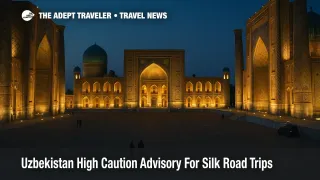
Australia's Smartraveller has refreshed its Uzbekistan high caution travel advisory, updated December 9, 2025, for trips linking Tashkent, Samarkand, and Bukhara with neighboring states. The page now sits alongside a cluster of destinations where Australians are told to exercise a high degree of caution, with fresh emphasis on terrorism risk in public places and volatile border regions. For travellers building Silk Road style itineraries, the change does not make Uzbekistan off limits, but it does mean routes, border crossings, and night travel all need to be planned with more discipline.
In practical terms, the Uzbekistan high caution travel advisory signals that while classic Silk Road cities remain open for tourism, Australia sees security risks that are serious enough to demand extra care in how visitors move between regions, particularly near Afghanistan, Tajikistan, and Kyrgyzstan.
What Smartraveller Is Now Saying About Uzbekistan
Smartraveller now headlines Uzbekistan as "Exercise a high degree of caution overall," with clearly tiered warnings for specific areas. The advisory highlights three core concerns. First, terrorist attacks have occurred in Uzbekistan and could happen again in places popular with foreigners, including markets, religious sites, festivals, and transport hubs such as airports and railway stations. Second, the security situation in border regions is described as volatile, with a formal do not travel line along the frontier with Afghanistan and "reconsider your need to travel" guidance for Andijan, the eastern Ferghana Valley, and other districts bordering Tajikistan and the Kyrgyz Republic, where violent protests and unmarked landmines remain a risk.
Third, Smartraveller underlines crime and policing issues that matter directly for trip design. Pickpocketing and robbery are flagged on trains and in unofficial taxis, crime risk is higher at night, and there are repeated reports of criminals and corrupt officials posing as police. For a Silk Road itinerary that strings together late night train segments, unvetted taxis, and remote guesthouses, that mix of threats should be a prompt to change how, and when, you move.
Travel And Tour World, which first pulled Uzbekistan into a wider list of high caution destinations that now includes Thailand, Indonesia, the Philippines, Brazil, Egypt, and Mexico, leans on the same themes, especially terrorism and border region instability. The nuance is that Smartraveller's own text stresses continuity, saying "we continue to advise exercise a high degree of caution," but the December 9 refresh and regional bundling make the warning more visible to Australian travellers than before.
How Other Governments See Uzbekistan
Australia's stance is now at the strict end of the spectrum compared with several other major outbound markets. The United States rates Uzbekistan at Level 1, "Exercise Normal Precautions," after a September 27, 2024 review, a reminder that Washington does not currently see the same broad uplift in risk, even though it still urges standard contingency planning and enrollment in its STEP alert system.
Canada also advises "take normal security precautions" in Uzbekistan, but carves out a five kilometer do not travel strip along the Afghanistan border and goes into granular detail on landmine risk, sporadic clashes in tri border mountain areas, and terrorism threats that look very similar to those Smartraveller lists. New Zealand tells its citizens to "exercise increased caution with higher advice levels in some areas," again citing terrorism, crime, and health care gaps. The United Kingdom focuses heavily on crime, transport risks, and conservative social norms, with separate sections on regional risks and seismic activity, rather than a single headline level change.
The takeaway is that Australia is not seeing completely different facts on the ground. It is choosing to codify that risk more assertively, folding Uzbekistan into a group of high caution destinations even as the US and Canada keep the overall level lower but still warn sharply about borders, terrorism, and crime. For travellers, that divergence should not be an excuse to cherry pick the softest sounding advisory. It is a prompt to read the fine print and plan for the shared worst case scenarios each government describes.
Mapping The Highest Risk Areas
For most visitors, the key structural risk is location. Smartraveller is explicit that the border region with Afghanistan is a do not travel zone and notes that the land frontier is closed until further notice. That is not a place to ride out curiosity or chase social media content, it is an area to cut out of your routing entirely.
Eastward, Andijan and the Ferghana Valley sit under reconsider your need to travel guidance from Australia because of regional political tension, the risk of violent protests, and unmarked landmines in some rural zones that straddle multiple borders. Canada describes recent armed clashes in the triple border mountains and warns that despite demining work, marked and unmarked minefields may still exist, particularly along the Tajik and Kyrgyz frontiers. That means scenic detours and improvised back roads are a bad idea near the edges of map tiles.
Smartraveller also cites 2022 protests in Karakalpakstan that turned violent, and both Canadian and British advisories point to a pattern in which rare but intense demonstrations can lead to rapid crackdowns. If your Silk Road route includes Nukus or Aral Sea side trips, they are still feasible, but you should avoid rallies, keep a close eye on local news, and have a rapid exit plan that does not rely on a single road or a lightly used land border.
Rethinking Silk Road Routing And Border Crossings
For classic city to city tourism between Islam Karimov Tashkent International Airport (TAS), Samarkand International Airport (SKD), Bukhara International Airport (BHK), and Urgench International Airport (UGC), the new advisory mostly changes how you knit segments together, not whether you go. Fast daytime trains, prebooked drivers arranged through reputable hotels, and licensed taxis from known apps or airport ranks are the tools that keep risk manageable. Night trains, informal shared taxis, and unplanned late arrivals into smaller towns are where petty crime and harassment climb.
Land borders are the other pinch point. Smartraveller and Canada both stress that many crossings with neighboring states are either closed, restricted to local residents, or subject to sudden closures and access limits. If your itinerary strings together Kazakhstan, Kyrgyzstan, Tajikistan, and Uzbekistan, you should assume that at least one projected road or rail crossing could fall over and buy tickets that allow you to reroute through major airports like Tashkent, Almaty, or Bishkek instead of being trapped at a shuttered frontier post.
For high value or mission critical trips, such as hosted group tours or film projects, it is increasingly rational to shift some "romantic" overland hops onto short flights, accept an extra night in Tashkent or Samarkand, and treat Uzbekistan as a hub between safer or more predictable segments elsewhere in Central Asia. That is less evocative than step by step caravan routes, but considerably more resilient to protests, checkpoints, or sudden security operations along minor roads.
Crime, Registration, And Everyday Friction
Beneath the headline terrorism and border language, all of the major advisories emphasise everyday frictions that can derail a holiday long before geopolitics does. Crime risk concentrates in larger cities and on public transport. Canada and Smartraveller both warn about pickpocketing, robbery on trains, taxi scams, and criminals posing as officials, with Bukhara, Samarkand, Ferghana, and Tashkent all named as hotspots for petty theft.
Uzbek rules also add bureaucratic friction that travellers sometimes underestimate. Smartraveller notes that if you stay three or more days you must register with local authorities in each city, something hotels usually handle but which independent guests need to double check. Canada and New Zealand point to strict controls on some medications, including codeine products and psychotropics, which must be declared on arrival and carried with a translated doctor's letter. Medical facilities outside main centers are limited, so emergency evacuation cover in your insurance policy is not optional.
Finally, social and legal norms remain conservative. Same sex relations between men are illegal, it is an offence to photograph some government and transport facilities, and the state retains a tight grip on political expression and demonstrations. Visiting does not mean endorsing those systems, but it does mean you should keep a low profile on politics, store protest selfies for another destination, and brief your group on dress, drinking, and public affection before arrival.
Who Should Rethink Their Plans
The travellers who are most affected by the Uzbekistan high caution travel advisory are those who assumed that all Silk Road countries carried similar risk and built complex land heavy routes through multiple border regions with little slack. That includes backpackers stitching together three or four Central Asian republics on single entry visas, escorted tours whose marketing still leans on frontier romance, and corporate or NGO teams that rely on cross border road moves to reach project sites.
For those groups, December 2025 is the moment to redraw maps and rebuild itineraries. Keep the core city pairings that make Uzbekistan attractive, trim or sequence high risk borders differently, give yourself extra nights in Tashkent to absorb shocks, and buy insurance on the assumption that political tension and terrorism are real background risks, not remote hypotheticals. Everyone else should treat the new advisory as a structured checklist, one that turns vague concern into specific, testable questions to ask agents, guides, and insurers before you step onto the plane.
Alongside this focused piece, readers planning wider Asia trips can cross check our recent coverage of regional advisories and visa changes, and use our Uzbekistan destination guide as a baseline for entry rules, rail options, and key cities before they layer on security planning.
Sources
- Uzbekistan Travel Advice & Safety, Smartraveller
- Uzbekistan Travel Advisory, U.S. Department of State
- Travel Advice and Advisories for Uzbekistan, Government of Canada
- Uzbekistan, SafeTravel New Zealand
- Safety and Security, Uzbekistan Travel Advice, UK FCDO
- Uzbekistan Joins Thailand, Philippines, Indonesia, Brazil, Egypt, Mexico, And More As Australia Issues New Travel Advisory Amid Rising Security Concerns, Travel And Tour World