

New Amsterdam Milan Night Train Opens Alpine Option
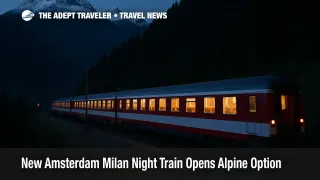
From 18 June 2026, the new Amsterdam to Milan night train from cooperative operator European Sleeper will stitch together the Netherlands, Belgium, Germany, Switzerland, and northern Italy in a single overnight run across the Alps. The service targets travelers in Amsterdam, Brussels, Cologne, Bern, Brig, Domodossola, Stresa, and Milan who want to trade short haul flights for a direct sleeper link into Lombardy and the lakes. Anyone planning 2026 city breaks, Alpine hikes, or rail passes in this corridor should start pencilling the route into itineraries and leaving room for reservations and onward connections.
The launch of the Amsterdam and Brussels to Milan sleeper in June 2026 creates a new north south overnight rail option across the Simplon line, giving pass holders and point to point travelers a low carbon alternative to two hour flights on one of Europe's busiest leisure corridors.
Route, dates, and key stops
European Sleeper has confirmed that the first Amsterdam and Brussels to Milan train will leave on Thursday 18 June 2026, with regular operations three nights per week. Departures from Amsterdam and Brussels are planned for Monday, Thursday, and Saturday, while northbound returns from Milan will run on Wednesday, Friday, and Sunday, with ticket sales expected to open in January or February 2026.
Operational details show that two train portions will start in Amsterdam and Brussels then join at Cologne for the overnight run south. From there the combined train will continue through the Rhine valley and into Switzerland, calling at Bern and Brig before crossing the Simplon route into Italy with planned stops at Domodossola and Stresa on Lago Maggiore, then terminating in Milan.
Exact departure and arrival times have not yet been published, but patterns on European Sleeper's existing Brussels and Amsterdam to Berlin and Prague service suggest an early evening departure and a morning arrival at the final destination, which allows travelers to treat the train as their hotel night. The operator notes that full timetables and any additional intermediate stops will be announced closer to the opening of bookings.
For many itineraries the most important hubs will be Amsterdam Centraal, Brussels Midi, Cologne, Bern, Brig, and Milano Centrale. Each of these has dense daytime connections, so passengers can attach the night train to Eurostar trips from London, international ICE and Thalys style services, Swiss domestic routes, and Italian high speed services that fan out toward Florence, Rome, and southern resorts.
Cabins, comfort, and what to expect on board
European Sleeper's existing trains offer three broad accommodation layers, and the Milan route is expected to follow the same pattern. Travelers can choose simple seats, shared couchette compartments with four or six berths, or sleeper compartments configured for one to three people, with washbasins in the cabin and toilets in the corridor.
On current routes, shared compartments in Classic class start from around €40 per person, with private compartments from roughly €180 for up to five passengers, although prices depend on route and date. Separate reports on the Brussels Berlin route quote entry level prices of about €49 for a seat, around €79 for shared couchettes, and from roughly €109 to €159 for sleeper berths.
The Milan service will publish its own fare tables, but travelers can safely assume that prices will sit in the same band as existing European Sleeper services rather than undercutting the cheapest budget flights. The main value proposition is that the fare covers both transport and a night's accommodation, with breakfast and simple snacks usually available on board, plus bike spaces that can be reserved for around €19 on current trains.
Interrail and Eurail Global Passes are valid on European Sleeper services, including the planned Milan route, so pass holders simply need to buy a reservation for their chosen cabin type. Reservation fees are currently published in fixed bands, with Budget class surcharges from roughly €11 to €21, Classic reservations from about €42 to €74, and Comfort reservations from about €89 to €179, depending on distance. That structure lets pass users upgrade comfort without forfeiting the value of the pass itself.
How it compares with flying
On speed alone, planes remain faster. Nonstop flights between Amsterdam Airport Schiphol (AMS) and Milan's airports typically take around one hour thirty to one hour fifty minutes in the air, while Brussels Airport (BRU) to Milan is about one hour thirty, and Cologne Bonn Airport (CGN) to Milan Malpensa Airport (MXP) averages roughly one hour thirty as well.
However, once travelers factor in airport transfers, security queues, boarding time, and post arrival transport from Milan Malpensa or Milan Linate Airport (LIN) into the city, the door to door advantage often shrinks to a few hours. The night train, by contrast, uses hours that would otherwise be spent sleeping, lets passengers start and end in city center stations, and removes the need to budget separately for a hotel night in Milan or Amsterdam.
On emissions, rail is unambiguously cleaner. The European Environment Agency and other analyses repeatedly find that trains emit only a fraction of the greenhouse gases per passenger kilometre compared with short haul flights, with some city pair comparisons suggesting rail can be five to ten times less carbon intensive. For travelers who want to cut their footprint without giving up long European trips, a new north south night train that replaces one or two flights is a material gain.
Price is more nuanced. A recent Greenpeace linked study and other fare comparisons show that, on many cross border routes, tickets for flights remain cheaper than train fares, partly because aviation enjoys lighter fuel taxes and lower VAT while rail operators face track access charges. For the Amsterdam, Brussels, and Cologne to Milan market, European Sleeper is likely to sit above the cheapest low cost carriers but below or in line with mid range fares once a hotel night is included in the calculation. Travelers who value private space, city center arrivals, and lower emissions are the ones most likely to see the night train as good value.
Building longer rail based itineraries
For pass holders and serial rail travelers, the Milan train is less a single product and more a new building block. European Sleeper already runs a Brussels and Amsterdam to Berlin and Prague service three nights per week, and has announced a Paris to Berlin night train due to start in March 2026. With the Milan link in place, it becomes much easier to string together multi leg trips such as London, Brussels, Cologne, Bern, Milan, Florence, and Rome in a mostly nocturnal chain, or to combine Prague, Berlin, Amsterdam, and the Italian lakes without repeated airport visits.
The new route also plugs into a wider renaissance in European night trains, from ÖBB Nightjet's dense Vienna, Zurich, and Rome network to new services such as the 2026 Basel to Copenhagen and Malmö sleeper. That gives travelers who are willing to accept occasional teething problems, such as rolling stock issues or schedule tweaks, a growing menu of overnight rail options.
Within Adept Traveler's own coverage there is a useful precedent in the dedicated Oktoberfest sleeper from Rome to Munich, which showed how targeted night trains can reshape seasonal flows. [Italy launches Oktoberfest train from Rome to Munich night train][1] serves as a reminder that once a direct overnight link exists, passengers quickly learn to treat it as a structural option rather than a novelty.
For Milan specifically, the new night train reinforces the city's role as a northern Italian rail hub. Travelers can wake up at Milano Centrale and step directly onto high speed services to Venice, Bologna, Florence, and Rome, or use regional trains and ferries to reach Lake Como, Lake Garda, and the Ligurian coast, building complex itineraries without relying on connecting flights. Readers planning deep dives into Lombardy can cross reference our [Milan, Italy guide][2] and other Italy planning pieces to match the new rail link with local logistics and seasonal patterns.
Who this matters for
In practical terms the immediate winners are travelers based in the Netherlands, Belgium, and western Germany who prefer rail but previously faced multiple daytime changes or had to route via Paris and Nightjet connections to reach northern Italy overnight. Families, school groups, and leisure travelers building longer Interrail or Eurail journeys will gain the most flexibility, especially if they are willing to travel in shared couchettes or Classic class to keep costs down.
Business travelers who work across Benelux, Switzerland, and Italy could also use the night train to turn long daytime journeys into work plus sleep cycles, especially if cabin designs and onboard Wi Fi match European Sleeper's existing offer. The presence of bike spaces and pet friendly private compartments adds further niche appeal for slow travel fans and digital nomads working around the Alps.
The main constraints are capacity and reliability. European Sleeper's earlier seasonal route to Innsbruck and Venice and the Brussels to Prague core line have both faced tight rolling stock availability, occasional downgrades, and bureaucratic hurdles crossing multiple infrastructure managers. Travelers should expect the Milan route to be popular from launch, book well ahead for peak dates, and keep an eye on operator channels for any timetable or rolling stock updates during the first year of operations.
What travelers should do now
For 2026 trip planning, the most useful step now is simply awareness. Anyone sketching Interrail and Eurail routes, long overland sabbaticals, or climate conscious business travel should mark 18 June 2026 as the point when a new Amsterdam and Brussels to Milan night train becomes available three nights a week. As soon as bookings open in early 2026, travelers aiming for summer dates should lock in their preferred cabin type and build the rest of their itinerary around those nights.
In parallel, it is worth tracking the evolution of other night trains that can connect into this route, such as the Paris to Berlin sleeper, Nightjet links from Switzerland, and any future expansion of European Sleeper's own network toward Barcelona. That way, travelers will be ready to assemble complex but coherent itineraries that use overnight trains as the backbone of their Europe 2026 plans.
Sources
- Night train to Milan, official route page, European Sleeper
- European Sleeper announces Milan route, International Railway Journal
- European Sleeper to launch Amsterdam and Brussels to Milan night train, Trip By Trip
- European Sleeper, company and service overview
- How much does a European Sleeper train ticket cost, Trainline
- Interrail or Eurail, European Sleeper reservations
- [Rail and plane emissions comparison, European Environment Agency and Our World in Data](https://www.eea.europa.eu/highlights/motorised-transport-train-plane-road, https://ourworldindata.org/travel-carbon-footprint)
- [Direct flights Amsterdam to Milan, Brussels to Milan, Cologne to Milan, FlightsFrom and Skyscanner](https://www.flightsfrom.com/AMS-LIN, https://www.flightsfrom.com/BRU-LIN, https://www.flightsfrom.com/CGN-MXP)
- In Europe, train travel remains significantly more expensive than flying, Le Monde
- New sleeper service will run from Paris to Berlin, The Guardian