

Europe December Strikes Hit Holiday Flights And Trains
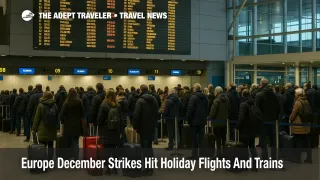
Travellers planning multi country holidays now have to treat Europe December strikes flights trains as a system wide planning problem, not just a local nuisance in one country. A run of coordinated actions in Portugal, Italy, Spain, and the United Kingdom, layered on top of earlier December strikes in France and ground handling issues in Switzerland, is hitting hubs such as Lisbon, Rome, Madrid, Barcelona, London, Zurich, and Geneva between 11 and 29 December 2025. Anyone relying on tight same day connections or non flexible tickets in this window should assume higher odds of delays, missed links, and last minute rerouting.
In practical terms, the December strike wave turns a handful of marked dates into a rolling risk calendar that affects both flights and onward trains, especially for travellers connecting through Lisbon Airport (LIS), Rome Fiumicino Airport (FCO), Madrid Barajas Adolfo Suárez Airport (MAD), and London Luton Airport (LTN). This guide steps through the highest risk days and hubs, outlines where airlines and rail operators are already cutting or reshaping schedules, and offers concrete tactics to build in buffers and choose more resilient routings across Europe.
How The December Strike Wave Fits Together
Several separate disputes happen to overlap in the second half of December, which is why the pattern feels more like a wave than isolated incidents. In Portugal, a rare nationwide general strike on 11 December is backed by the main union confederations and explicitly targets a new labour law package, with organisers and officials alike warning of widespread cancellations on flights, trains, and public services.
Italy then picks up the baton. A nationwide general strike called by major union CGIL for 12 December is set to hit public and private sectors, including transport, with advisory sites already listing disrupted trains, metro lines, ferries, and local services across the country. Five days later, a separate nationwide four hour air transport strike on 17 December, from 1300 to 1700, will involve air traffic control staff and multiple handling companies at Italian airports, directly affecting departures and arrivals during that afternoon window.
Alongside these national actions, Spanish baggage handlers at Azul Handling, which serves Ryanair and other carriers, are in rolling strikes at more than twenty airports every Wednesday, Friday, Saturday, and Sunday until the end of 2025, typically with stoppages in the early morning and other peak bands. At London Luton, about two hundred DHL employed ground staff who handle easyJet check in and baggage have confirmed six days of strikes, from 19 to 22 December and again from 26 to 29 December, which union and airport briefings suggest could affect over four hundred flights in the busiest week of the season.
France and Switzerland round out the picture in a softer way. France saw a national public sector strike on 2 December that only lightly scratched mainline rail but signalled continued labour tension, with localised follow on disruptions around metro and regional services in early December. Switzerland, where strikes are rare, has nonetheless had a turbulent early December at Zurich Airport (ZRH) and Geneva Airport (GVA) thanks to winter storms and earlier ground handling disputes, with data showing dozens of cancellations and over one hundred delays on recent snowy weekends, which leaves little slack when neighbouring countries are also under pressure.
Overlay normal winter weather and already tight capacity, and it is not surprising that analysts tracking the year estimate more than four thousand strike related flight disruptions across Europe in 2025, with December walkouts coinciding with peak holiday demand and pushing average fares higher on the remaining seats.
Key High Risk Dates And Hubs
For planning, it helps to think in terms of a calendar and the hubs most exposed on each day rather than a blur of headlines.
On 11 December, Portugal's general strike is the anchor. Airlines and local media warn that Lisbon, Porto (OPO), and Faro (FAO) will see a large share of flights cancelled or rescheduled, with national carrier TAP Air Portugal planning to operate only a legally mandated minimum of around twenty nine flights under special service rules and pre emptively cancelling many others in the days before. Intercity trains, metro lines into airports, and municipal buses are also set to run at skeleton levels, so even travellers with operating flights should assume slower airport access.
On 12 December, Italy becomes the centre of gravity. CGIL's nationwide general strike covers many sectors and is expected to hit Trenitalia and Italo rail services, urban transit in cities such as Rome and Milan, and some airport operations. Notices from operators such as Trenord, which runs the Malpensa Express to Milan Malpensa Airport (MXP), show classic Italian strike patterns, with guaranteed minimum services only in limited windows, for example 0600 to 0900 and 1800 to 2100, and replacement buses bridging some airport links while other trains are thinned or cancelled. Rome mobility authorities also warn of overlap with earlier Rome based strikes, meaning metro, bus, and tram networks feeding Rome Fiumicino and Ciampino may be less reliable around that date.
On 17 December, the Italian nationwide air transport strike compresses aviation risk into a four hour band. Advisories list carriers such as ITA Airways, Vueling, KLM, and easyJet among those affected, together with air traffic control agency ENAV and several handling companies at airports across the country. Minimum service rules protect some flights, but travellers with departures between 1300 and 1700 local time from hubs like Rome Fiumicino, Milan Malpensa, Milan Linate (LIN), Venice (VCE), Naples (NAP), and Bologna (BLQ) should expect cancellations or significant delays.
Throughout December, Spanish airports add a repeating pattern of early day risk. Azul Handling's rolling baggage handler strikes at more than twenty airports including Madrid, Barcelona El Prat (BCN), Seville (SVQ), Málaga (AGP), Alicante (ALC), Palma de Mallorca (PMI), Tenerife South (TFS), and Lanzarote (ACE) fall every Wednesday, Friday, Saturday, and Sunday until 31 December, with core strike windows from 0500 to 0900 and additional bands on some days. Because Azul serves Ryanair and several leisure carriers, the impact is concentrated on low cost and holiday routes, and even when flights operate, baggage delays and slow turnarounds are common.
At London Luton, DHL ground handling staff who work exclusively for easyJet will down tools from 0300 on 19 December to 0300 on 22 December, then again from 0300 on 26 December to 0300 on 29 December, with union estimates that roughly four hundred easyJet flights could be affected. The airline insists it plans to operate a full schedule using contingency labour, but passengers are being warned by multiple briefings to expect long queues, baggage delays, and a higher risk of missed onward connections, especially on busy days like Boxing Day.
France is quieter for now after the 2 December strike, but rail and metro strike calendars maintained by specialist sites still show intermittent SNCF and local actions during the month, typically with more impact on regional TER and Intercités services than on TGV high speed trains. Because many long haul travellers use Paris Charles de Gaulle and Paris Orly as gateways before transferring to trains, the main risk is a frayed last mile rather than outright flight cancellations.
Switzerland, while not facing formal December strike calls at the time of writing, illustrates how weather and staffing can combine with foreign strikes to clog the network. Early December snow already produced ten cancellations and more than one hundred delays over a single weekend at Zurich and Geneva, and analysts note that passengers misconnecting in Portugal, Italy, or Spain can easily spill into later departures through Zurich and Basel, stretching de icing and stand capacity further.
Flights And Trains Already Being Cut Or Reshaped
Travellers do not have to wait until strike morning to feel the impact. In Portugal, TAP has published a slimmed down 11 December programme of fewer than thirty flights under minimum service rules and is inviting affected passengers to rebook within a window of several days around the strike. Reuters and other outlets report unions and officials openly anticipating widespread cancellations, rather than the lighter disruption seen on some earlier sector specific strikes.
Italian railway and airport advisories similarly show how operators are trying to contain the damage by publishing "guaranteed trains" lists and trimming schedules in advance. For example, Malpensa Express has warned that normal service to Milan Malpensa will not run through most of 12 December, with replacement buses linking Milano Cadorna station and the airport during the day. Strike calendars compiled by risk consultancies highlight additional Italian actions between 9 and 24 December, including Rome ATAC transport strikes and a forty eight hour national ferry strike, which will matter for travellers combining flights with ferries to islands or coastal towns.
In Spain, the rolling Azul Handling strikes have already produced waves of delayed departures and sluggish baggage delivery at airports such as Madrid and Barcelona since August, and December's high load factors leave less margin for recovery when early morning shifts walk off. Luton strike notices, meanwhile, estimate hundreds of easyJet flights at risk and explicitly warn of potential cancellations if contingency staffing cannot fully cover ground operations on the six December strike days.
Even where strikes are not the primary driver, winter weather is acting as a multiplier. Snow and strong winds at Zurich, Geneva, Dublin, and other northern hubs have generated hundreds of delays and a smaller number of cancellations across recent weekends, so an aircraft or crew displaced by a strike related delay in one country can take longer to get back into regular rotation.
What This Means For Fares And Availability
From a traveller's perspective, the most visible effect, beyond the risk of disruption, is on choice and price. Capacity data and consumer facing reports note that airlines have already cut some winter services to traditional European ski hubs such as Geneva and airports in France and Austria, while carriers like Ryanair have removed seats and routes from several European markets because of taxes and higher charges. Add in strike day cancellations and the fact that many travellers are trying to move on the same weekends, and it becomes harder to find cheap last minute options when your original plan falls apart.
Analysts following December strike fallout emphasise that more than four thousand European flights have already been disrupted by labour actions in 2025, and that the coming weeks fall in a period when demand is both peak and inflexible for many families. Practically, that means popular departure times on non affected days, or in non affected countries, can sell out or spike in price quickly as people shift dates to sidestep risk.
Planning Strategies For Travelling Through The Strike Wave
For travellers who cannot avoid Europe in mid December, the best approach is to treat strikes as one more constraint to design around.
On the Portugal side, the simplest strategy is to avoid flying into or out of Lisbon, Porto, Faro, or Madeira on 11 December if you have any flexibility at all. If that is impossible, aim for flights that fall clearly outside the strike date or, if you must fly on the day, check whether your flight is on a published minimum service list and assume airport access by metro or bus will be slower.
In Italy, try not to schedule critical journeys on 12 December unless they are short hops with slack on either side. If you must connect flights with trains, use early morning guaranteed trains where published, or consider overnighting near your departure airport rather than relying on same day long distance rail. For flights on 17 December, look closely at your departure time; moving a departure from mid afternoon to mid morning or evening can remove most strike risk, while connecting through a non Italian hub such as Frankfurt, Amsterdam, or Zurich may be wiser if you are booking new long haul itineraries.
In Spain, avoid early morning departures on strike days from Azul Handling airports if you are connecting onward or have tight same day plans at your destination. Where possible, travel with hand baggage only so that baggage handling disruption is less likely to strand you without essentials.
For UK travellers, London Luton will be the main problem, not Heathrow or Gatwick. If you have the option to book from another London airport during the 19 to 22 and 26 to 29 December windows, that is often worth the extra transfer cost. If you must use Luton, build in extra time for check in and baggage drop, and avoid self connecting to non easyJet flights at other airports on the same day.
Across the whole network, a few general rules help. Avoid tight self made connections between separate tickets when strikes are in play. Prefer through tickets on one carrier or alliance, so that rebooking on later flights is automatic if you misconnect. Where possible, choose flexible or semi flexible fares that allow date changes if your strike day looks untenable as details firm up. Finally, check your travel insurance wording carefully; some policies cover strike related delays and cancellations, others do not.
How To Monitor And Adjust As New Notices Land
Strike calendars are dynamic. French unions, Italian sector unions, or Spanish handling companies can add or cancel actions at shorter notice than national general strikes. The safest move is to treat official airline and airport channels as primary sources for operational decisions, then use curated strike roundups and government travel advisories as context for whether more action is likely.
As your departure date approaches, set alerts on your airline's app and on flight tracking tools, and check airport news pages for your departure and arrival hubs at least a day before you travel. If your carrier announces a voluntary rebooking window ahead of a known strike day, take advantage early; once popular alternatives fill, options shrink quickly. For multi country itineraries in mid December, it may even be worth proactively moving some legs to earlier dates or routing via less affected hubs if your schedule and budget allow.
Sources
- Portugal Faces Major Travel Disruption: Strike on Eleven December Threatens Flights, Transportation and Tourism
- Portugal Set for Major Flight Disruptions Due to December 11 General Strike
- Major strike to affect transport and public services in Italy on December 12
- December 17 strike, airports involved, companies affected, guarantee time slots
- Ground Handling Strike to Disrupt Spanish Airports Every Weekend Until Year End
- Luton Airport Faces Major Christmas Disruption as DHL Ground Staff Announce December Strikes
- Portugal Joins UK, Italy, Spain, France, Switzerland and Others As December Airline Strikes Intensify Travel Chaos Across Europe
- Snow Hit Weekend Forces 10 Cancellations and 141 Delays at Zurich and Geneva
- Travel Costs Soar as Europe Braces for December Strike Chaos