

Saudi Storms Flood Jeddah And Threaten Makkah Trips
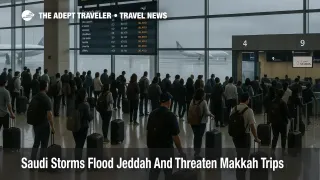
Travellers flying into Jeddah, Saudi Arabia for Umrah or winter city breaks are no longer dealing with abstract forecasts but with live disruption, after intense storms on December 9, 2025 dumped some of the season's highest rainfall totals on the city and its airport. King Abdulaziz International Airport (JED) reported heavy rain and thunderstorms, while streets in several districts flooded and traffic slowed or stalled. Pilgrims, business travellers, and residents using the Jeddah to Makkah corridor now need to treat every transfer as weather dependent, build in wide buffers, and be ready to reroute around flooded underpasses or wait out storm cells rather than pushing through.
Jeddah flooding Makkah travel means the same storm system that was a forecast risk in earlier advisories has moved into an operational phase, combining road flooding, school closures, and documented flight delays that can derail tightly timed pilgrim itineraries.
How The Storm Hit Jeddah And The Makkah Corridor
Saudi Arabia's National Center for Meteorology (NCM) placed eight regions under red, orange, and yellow warnings from December 8, 2025, including the wider Makkah region, with heavy rain, thunderstorms, hail, and flash flood risk highlighted across Jeddah and neighboring governorates. On December 9, NCM data showed that Jeddah Governorate recorded the highest rainfall in the Kingdom, with 135 millimetres at King Abdullah Sports City, 81 millimetres in the Al Basateen district, and about 51 millimetres at King Abdulaziz International Airport. Those numbers explain why even major arterials have struggled to drain and why localized flooding has developed quickly where drains and wadis were already saturated.
Civil Defense and education authorities responded by suspending in person classes in Jeddah, Rabigh, and Khulais for Tuesday, December 9, shifting students and staff to remote learning on the Madrasati platform as a red alert took effect. The move is a clear signal that officials expect conditions to deteriorate rapidly during storm pulses, especially around school start and end times when traffic is heaviest on local roads. For travellers, the same timing issue applies, since hotel checkout, airport transfer, and check in windows often coincide with these congested periods.
Flight Delays At Jeddah And Across Middle East Hubs
While King Abdulaziz International has remained open, weather impacts have spilled over into the air side. Airport messaging shared via local media urges travellers to contact their airlines and confirm updated flight schedules "due to weather conditions in Jeddah," which indicates that delays and some cancellations have already built into daily operations. Airlines typically respond to this sort of pattern with ground holding, wider spacing between arrivals and departures, and occasional diversions if crosswinds or visibility fall below limits, all of which erode already tight turnaround times.
The Jeddah disruption is part of a wider Middle East pattern. Industry tallies report around 1,124 delayed flights and at least 22 cancellations across regional hubs such as Jeddah, Dubai, Cairo, and Istanbul as storms and staffing knock on effects ripple through airline schedules. That means a flight that looks on time when you leave for the airport can easily slide by 30 to 90 minutes while you are in transit, and missed onward connections through Dubai International Airport (DXB), Cairo International Airport (CAI), or Istanbul Airport (IST) become more likely if your Jeddah departure is part of a chain of separate tickets.
Travellers who can route directly between their origin and Jeddah, or who can build generous connection windows of three hours or more through Gulf or Turkish hubs, are in a stronger position than those stitching together separate short hops on the cheapest fares. This storm cycle has not yet produced large scale blanket waivers, but as our earlier piece Saudi Storm Warnings Raise Flood Risk For Makkah Trips explains, airlines at Jeddah have a history of introducing limited fee free changes once images of flooded roads and terminals make clear how constrained the infrastructure has become.
Roads, Schools, And Umrah Logistics In The Makkah Region
At street level in Jeddah, the main operational problem is not wind or lightning but water with nowhere to go. Video and local coverage show flooded roundabouts, partially submerged vehicles, and waterlogged side streets in several neighborhoods, particularly in low lying areas and around underpasses where runoff collects. Civil Defense and municipal agencies routinely warn residents to avoid underpasses, wadis, and known flood routes during heavy rain, and the current alerts repeat that guidance in stronger language than usual because of the intensity of the downpours.
For Umrah travellers, that means the journey from King Abdulaziz International to Makkah and back is the core risk, even if flights operate roughly on schedule. Buses and private transfers that normally run on predictable timings can be significantly delayed or diverted if surface routes are flooded or if authorities temporarily close segments of the highway to clear debris and stalled vehicles. Travellers should expect longer door to door times, avoid planning same day return trips that rely on precise departure slots, and keep food, water, and power banks handy in case a one hour transfer turns into a two or three hour journey.
It is also important to think about where a vehicle might be parked during prayers or hotel stays. A street that looks dry when you step out can be under half a metre of water an hour later if a slow moving storm cell parks overhead. Parking on higher ground, avoiding spaces directly under flyovers or next to wadis, and following hotel staff guidance about safe loading zones materially reduce the risk of finding a flooded car when you return.
Landslides And Highway Risks Beyond Jeddah
The same weather pattern is also affecting northern and western Saudi Arabia, where steep terrain and loose soil combine badly with intense bursts of rain. In Tabuk, authorities closed a road after a rain triggered landslide, with the Saudi Geological Survey and emergency teams confirming that soil instability from heavy precipitation caused the slope to give way. Officials have stressed that there is no current risk of further slides at that particular site, but they continue to urge drivers to stay away from the affected area until full clearance is complete.
For visitors, the lesson is that even in a country better known for dry desert highways than for mountain passes, short sharp storms can produce rockfalls, washouts, or sinkholes that shut roads with little notice. Anyone planning road trips beyond the Jeddah to Makkah corridor, including routes toward Tabuk or along coastal and interior highways, should check local advisories daily, avoid driving at night in heavy rain, and maintain larger following distances than usual in case a vehicle ahead brakes suddenly around an unseen flooded dip.
How Long The Unstable Weather Could Last
NCM and regional media expect several days of unstable weather, with impact based alerts extending through at least Thursday, December 11, and forecasts calling for more thunderstorms, occasional hail, and gusty winds over parts of Makkah, Riyadh, Madinah, Tabuk, Hail, Qassim, the Eastern Province, and the Northern Borders. Airport specific forecasts for King Abdulaziz International point to periods of heavy thunderstorms followed by showers and low cloud, which can keep operations fragile even between major downpours.
This does not mean that travel to Jeddah or Makkah is impossible or that every flight or road segment will fail. It does mean that the baseline risk is meaningfully higher than on a typical dry season week, and that smart travellers will buy flexibility if they can. Fully refundable hotel nights near the airport, overlapping transport options, and the ability to move a return flight by a day or two through changeable tickets or miles give you options that fixed, nonrefundable itineraries do not.
Practical Steps For Pilgrims And Other Travellers
In the near term, the most useful step is to widen your margins. For flights, that means arriving at the airport earlier than usual, especially if local roads are congested or partially flooded. For connections, it means treating anything under three hours as risky if it involves a change of airline or terminal in Jeddah, Dubai, Cairo, or Istanbul while the storm pattern is active.
For road transfers between Jeddah, Makkah, and other nearby cities, allow extra time and have a clear backup plan. If you normally book a single shared shuttle, consider upgrading to a private transfer that can adjust routing in real time or coordinate with your hotel. If you are self driving, follow the same core rules that local Civil Defense guidance repeats each rainy season, never attempt to drive through floodwater of unknown depth, never treat a wadi or underpass as a shortcut when water is running, and be ready to turn back early if conditions worsen.
Finally, keep an eye on both official channels and your booking dashboards. NCM, Civil Defense, and education departments are posting regular updates on warnings, school status, and road conditions, while airlines are adjusting schedules and sometimes adding extra capacity once the worst of a storm cell passes. For broader planning around this storm cycle and future rainy seasons, our earlier Saudi Storm Warnings Raise Flood Risk For Makkah Trips piece remains a useful guide to patterns, while a dedicated Umrah and Hajj logistics guide can help you design itineraries that are resilient to weather, traffic, and policy swings over the long term.
Sources
- Saudi Storm Warnings Raise Flood Risk For Makkah Trips
- Jeddah Records Highest Amount Of Rainfall On Dec 9
- Civil Defense Warns Of Caution Amid NCM Forecast Of Heavy Rain In Jeddah And Other Governorates Of Makkah
- In Person Classes Suspended In Jeddah And Rabigh Schools On Tuesday Amid Issuance Of A Red Alert
- Jeddah Schools Switch To Remote Learning Due To Severe Weather Warnings
- Due To Weather Conditions In Jeddah, King Abdulaziz Airport Urges Travelers To Confirm Updated Flight Schedules
- King Abdulaziz International Airport Weather Forecast
- Saudi Weather Alert, Red Warnings Issued As Heavy Rain Sweeps Across Eight Regions
- Turkey, UAE, Egypt, Saudi Arabia, And More Face Major Setback In Middle East As 1,124 Flights Delayed And 22 Canceled
- Watch, Heavy Rain Triggers Landslide In Tabuk, Road Closed For Safety
- Stay Safe In Jeddah, Heavy Rain Causes Severe Flooding