

Austria Winter Travel Alert For Flights, Trains, and Roads
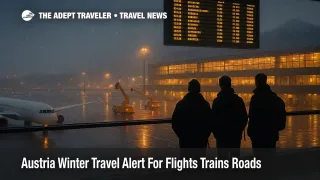
Austria winter travel alert flights is no longer a theoretical planning phrase but a live constraint for December trips, after civil protection authorities and meteorologists triggered the highest level of warning around December 5 2025 following 36 hours of torrential rain, strong winds, and heavy mountain snow. Rivers in Carinthia, Styria, and Lower Austria have approached or reached danger levels, the Danube Canal in Vienna has been put on pre flood standby, and city officials have urged residents and visitors to avoid unnecessary journeys until conditions ease. For travelers aiming at Vienna city breaks, Salzburg and Innsbruck Christmas markets, or early season skiing in Tyrol, this means treating weather and infrastructure as the first variable in any itinerary, building wide buffers into airport transfers, rail legs, and alpine drives, and choosing flexible tickets wherever possible.
In practical terms, the Austria winter travel alert flights framework reflects the fact that storms and flooding are already disrupting Vienna International Airport (VIE), core Austrian Railways routes, and key alpine highways, so itineraries for the first half of December need to be treated as provisional and managed actively rather than set and forget.
How The Alert Was Triggered
According to reporting that draws on Austria's civil protection authorities and GeoSphere Austria, formerly ZAMG, the highest level of weather alert was sounded in the early hours of December 5 after roughly a day and a half of persistent rain and gale force winds. That combination pushed several rivers in Carinthia, Styria, and Lower Austria to or near defined danger thresholds, prompting a mix of levee checks, temporary barriers, and appeals for people to stay off flooded local roads. In Vienna, pre flood procedures on the Danube system included placing the Danube Canal on standby status and reminding riverfront businesses and residents to secure basements and low lying storage.
The winter element arrived as that warm, wet air mass met colder air over the northern Alps, dropping the snow line to around 700 meters in some districts and loading passes with wet, heavy snow. Avalanche services in Tyrol and Salzburg have raised risk assessments to the considerable three band on the familiar five step scale, a level where human triggered slides become much more likely on steeper slopes even if ski areas themselves remain technically open.
Airports, Flights, And Vienna Connectivity
At Vienna International, early storm hours brought visibility around 1 200 meters and low cloud reported in night time airport weather observations, which forced air traffic controllers to increase separation between arrivals and departures. Airlines responded by slowing rotations on morning waves to hubs such as Frankfurt, London, and Zurich, while the airport operator shifted ground handling into so called weather programs that deliberately trade speed for safety when ramps are slick and winds are gusty.
Those protective measures translate into rolling delays of 30 to 60 minutes, longer queues at security and boarding gates, and a higher risk that tight onward connections, especially self made ones, will fail. The problems do not stop at Vienna. Separate winter storm coverage has documented how a snowstorm across Central Europe led airlines to cancel Munich to Vienna and Munich to Graz flights altogether, pushing both leisure travelers and corporate mobility teams toward rail and coach options instead of short haul hops on the most disrupted days.
Travelers coming from North America or Asia should therefore treat Vienna and Munich as a coupled risk zone for this pattern. If a snow band parks over southern Germany, it can shut or constrain the Munich air corridor even if Vienna skies look marginally better, and vice versa. On this alert cycle, the safest strategy for anyone with nonrefundable ski chalets or tight business schedules is to aim for earlier arrival days, avoid last flights into Vienna, Graz, or Innsbruck, and prefer through tickets on a single airline or alliance so that rebooking rights are clearer if weather forces cancellations.
For a wider European perspective on how snow and fog are already affecting key Nordic and alpine hubs, see Adept's recent analysis of Snow To Cause Nordic And Alpine Airport Delays, which sets out how disruption at airports like Geneva, Zurich, and Munich tends to cascade through winter schedules.
Rail, Roads, And Alpine Transfers
Austrian Railways, ÖBB, has already had to suspend parts of mainline routes where debris washed across tracks or small landslides followed the heaviest rain. One high profile example was the closure of the section between Bad Hofgastein and Bad Gastein, where replacement buses added up to an hour and a half to journeys between Salzburg and Carinthia. Elsewhere, rail managers have pre positioned snow plough locomotives on the Arlberg and Tauern corridors and warned that lightly used branch lines could be closed temporarily if drifts outpace clearing crews.
On the roads, motorway operator ASFINAG has urged drivers to postpone cross alpine trips where possible as closures, convoys, and rockfall controls have affected routes such as the Semmering expressway and the Katschberg road. Police checkpoints on stretches like the Fernpass route and the Leitha valley highway are trying to stop heavy vehicles from using narrow local detours that are not designed for continuous truck traffic, a reminder that even satnav suggested alternatives may not be viable when storms are in play.
Under the parallel winter advisory, foreign drivers are also being reminded that Austrian law requires winter tyres on most vehicles from November 1 to April 15 whenever wintry conditions prevail, that cars must carry a first aid kit, warning triangle, and high visibility vest, and that a motorway vignette remains compulsory for most expressways. Police have already issued hundreds of on the spot fines for non compliance this season, and officials are explicit that visitors cannot plead ignorance of the rules as a defense.
For ski transfers specifically, that combination of legal requirements and unstable weather should push travelers toward more conservative choices. Long late night drives to resorts after evening arrivals into Vienna or Munich are a poor match for flooded valleys and fresh snow on passes. Better options include breaking the journey with an overnight near the airport, using ÖBB or regional trains into valley towns with good onward bus links, or booking shared shuttle services that can respond collectively to road closures and convoy controls.
Urban Stays, Christmas Markets, And Security Layers
The winter alert is not only about alpine roads and high passes. Vienna, Graz, and other cities are heading into peak Christmas market season, with dense crowds, wet cobbles, and rising petty crime indicators that local police and private security consultancies have woven into their joint advisory language. The detailed winter travel bulletin highlighted a year on year rise in pickpocketing and a cluster of drink spiking incidents in nightlife districts, alongside winter weather and terrorism risk reminders.
From a traveler's perspective, the security component is straightforward. Keep valuables in zipped, interior pockets or money belts rather than open bags, watch drinks in crowded bars and market stalls, and make sure at least one member of your party always has a charged phone, local emergency numbers, and clear directions back to the hotel in case of sudden route closures or evacuations. In storm cycles like this, wet temporary structures, wind gusts, and slippery surfaces add another layer of risk that can turn a minor fall into a significant injury if people are juggling umbrellas, bags, and hot drinks.
How To Plan Around This Alert
Taken together, the storms, flood risk, and winter advisory language mean that anyone flying into or out of Austria in December should treat itineraries as living documents. The most resilient strategy is to build generous slack into every connection, aim for arrival at least one full day before nonrefundable chalet stays, tours, or ticketed events, and choose direct routes and through tickets over intricate self built connections wherever budgets allow.
Travelers who are willing to embrace rail and coach options often have more flexibility than those pinned to a single flight that may or may not operate on time. As Adept has already noted in coverage of European winter disruption, alpine partners and city authorities are gradually nudging visitors toward lower carbon, rail based travel that often proves more reliable in bad weather, and some ski areas even reward train arrivals with discounted lift passes or packages.
Finally, this alert is a reminder to treat local information channels as core travel tools rather than nice extras. GeoSphere Austria's warning maps, ÖBB and Vienna International apps, and city government feeds offer much finer grained updates than generic weather apps, and they are the sources that airlines, hotels, and tour operators will rely on when deciding whether to cancel, reroute, or wait. Checking those channels daily in the week leading up to travel, then several times a day during the journey, is now part of basic due diligence for winter trips to Austria.
Sources
- Austria issues nationwide travel warning as flooding and storms snarl flights, trains and roads
- Austria issues comprehensive winter-travel alert as storm intensifies
- All Warnings, GeoSphere Austria weather warning map
- Weather Forecast Austria, GeoSphere Austria
- Snow To Cause Nordic And Alpine Airport Delays
- CopenPay Spurs Rewards for Responsible Travel in Europe