

Chikungunya Alerts For Cuba, Bangladesh, Sri Lanka, China
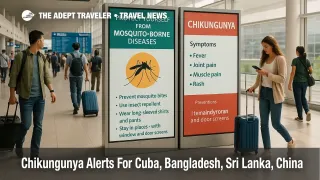
CDC chikungunya alerts for Cuba, Bangladesh, Sri Lanka, and China's Guangdong Province now move from background risk to an explicit Level 2 warning for winter travelers. The U.S. Centers for Disease Control and Prevention, CDC, has posted Travel Health Notices for outbreaks in all four destinations, advising visitors to practice enhanced precautions and, for many itineraries, to consider vaccination before departure. The change matters for beach breaks in Cuba, city trips to Dhaka or Colombo, and southern China hub itineraries alike, where older adults, pregnant travelers, and people with chronic illness now need to build health planning into their booking decisions.
The new CDC chikungunya alerts for Cuba, Bangladesh, Sri Lanka, and Guangdong Province in China mean travel is still allowed, but trips now require stronger mosquito protection, case by case vaccination decisions, and a closer look at travel insurance and timing.
What The New CDC Level 2 Notices Actually Mean
CDC uses Level 2, Practice Enhanced Precautions, when there is a significant outbreak that raises risk above the usual background level but does not warrant cancelling travel outright. For chikungunya, the agency has now flagged outbreaks in Cuba, Bangladesh, Sri Lanka, and Guangdong Province in China, with country pages and maps that spell out affected regions and mosquito bite avoidance steps.
Separately, CDC lists eight other countries, Brazil, Colombia, India, Mexico, Nigeria, Pakistan, the Philippines, and Thailand, as destinations where U.S. travelers face elevated chikungunya risk even without a formal outbreak notice, based on regular reports of travel associated cases. For someone planning a multi stop winter trip through Latin America or Asia, this means chikungunya is now a structural consideration across several warm weather circuits, not just an isolated story in four places.
Global Context, Cases, And Why This Is A 2025 Story
The CDC alerts sit against a wider resurgence. The World Health Organization reports 445,271 suspected and confirmed chikungunya cases and 155 deaths worldwide between January 1 and September 30, 2025, across 40 countries, a sharp uptick compared with recent years. Brazil accounts for the bulk of cases and deaths in the Americas, while Bangladesh, Sri Lanka, and parts of India have seen strong rebounds in South Asia, and Guangdong accounts for the largest chikungunya outbreak ever recorded in China.
Within the four destinations covered by the new notices, WHO and national data highlight different patterns. Cuba has reported dozens of laboratory confirmed cases in multiple provinces, including Havana and Santiago de Cuba, with public health teams focusing on mosquito control. Bangladesh has seen hundreds of confirmed cases in Dhaka, alongside much larger dengue activity, stretching hospitals and reinforcing how urban standing water feeds multiple mosquito borne threats. Sri Lanka's cases have risen through 2025, with a concentration in the Western Province and the Colombo area. In China, most recorded chikungunya cases are in Guangdong Province, particularly Foshan, within a densely populated delta region that also funnels travelers through Guangzhou Baiyun International Airport, CAN.
Symptoms, Transmission, And Who Is Most At Risk
Chikungunya is a mosquito borne viral illness spread mainly by Aedes aegypti and Aedes albopictus, the same daytime biting mosquitoes that transmit dengue and Zika. Symptoms typically start three to seven days after a bite and include sudden high fever, severe joint pain, muscle aches, headache, and rash. Most people recover within one to two weeks, but joint pain can linger for months or even years, and a small proportion of patients develop complications that require hospitalization, including heart, neurologic, or organ involvement.
Pregnant travelers face a particular concern, because infection late in pregnancy can sometimes lead to newborn infection, and older adults or people with conditions such as diabetes, heart disease, or immune compromise are more likely to have severe or prolonged illness. For these groups, CDC guidance often shifts from routine precautions toward reconsidering non essential travel into active outbreak zones.
Vaccine Options And Recent Changes
Chikungunya is now a vaccine preventable disease for many travelers, but the details matter. The first licensed vaccine, Ixchiq, a live attenuated product, was approved in 2023 for adults at increased risk of exposure, then ran into safety concerns in older recipients. In August 2025, FDA suspended Ixchiq's U.S. license following reports of serious cardiac and neurologic events, and CDC Yellow Book guidance reflects that the live vaccine is no longer in use in the United States.
A newer virus like particle vaccine, VIMKUNYA, received FDA approval in February 2025 for people 12 years and older, based on trials showing rapid development of neutralizing antibodies in most recipients and generally mild side effects. The CDC's Advisory Committee on Immunization Practices, ACIP, now recommends this chikungunya vaccine for travelers aged 12 and older going to a country or territory with an outbreak, such as Cuba, Bangladesh, Sri Lanka, or Guangdong Province in China. It may also be considered for travelers planning long stays, roughly six months or more, in elevated risk countries like Brazil, Mexico, or Thailand, even if there is no declared outbreak.
For an individual traveler, that translates into a pre trip consult rather than a blanket rule. Healthy adults planning short resort stays might focus on mosquito avoidance alone, while someone who expects frequent outdoor exposure in Dhaka or long term residence in São Paulo has a stronger case for vaccination. Pregnant travelers, and those with complex medical histories, should make the decision with a specialist in travel or tropical medicine, because safety data and local risk can shift as regulators and researchers gather more information.
Mosquito Avoidance On The Ground
Vaccination is only one layer. CDC still treats mosquito bite prevention as the foundation of chikungunya risk reduction, in outbreak and elevated risk countries alike. That means using an EPA registered repellent containing DEET, picaridin, IR3535, or oil of lemon eucalyptus, wearing long sleeves and long pants when practical, treating clothing with permethrin where allowed, and choosing accommodation with air conditioning or effective window and door screens.
In Cuba, that might mean favoring better screened resorts over budget guesthouses, keeping balcony doors closed at dawn and dusk, and using bed nets where air conditioning is unreliable. In Bangladesh and Sri Lanka, urban travelers should pay attention to hotel drainage, rooftop water tanks, and courtyards where Aedes mosquitoes can breed in even small containers, and they should take repellents seriously on daytime city walks, not just in the evening. In Guangdong, travelers moving through Guangzhou, Foshan, or nearby cities should not assume big city skylines remove mosquito risk, especially in parks, riverside promenades, or older neighborhoods with water storage.
Itinerary Specific Planning
For Cuba beach trips, most visitors will arrive at José Martí International Airport, HAV, then transfer to resorts or casa particular stays. Travelers who plan to stay in well maintained, air conditioned properties with good screens will have a different exposure profile than those spending long evenings outdoors in neighborhoods with intermittent water supply, so packing strong repellent, planning screened sleeping arrangements, and watching local health reports becomes part of the trip checklist.
Bangladesh and Sri Lanka pose a somewhat different challenge. Dhaka and Colombo are dense, fast growing cities where Aedes mosquitoes thrive in the mix of formal and informal water storage, construction sites, and rooftop containers. Travelers who combine city time with trips to coastal or hill country regions add more outdoor exposure, especially during or after rains, so they should layer daytime repellent, covered clothing, and careful lodging choices rather than relying on hotel air conditioning alone.
In Guangdong, many itineraries route through Guangzhou Baiyun International Airport, CAN, en route to other parts of China or Southeast Asia. For short airport connections, overall risk remains low, especially since there have been no locally acquired chikungunya cases in U.S. states or territories since 2019 and China's outbreak remains regionally focused. The calculus shifts for travelers spending days or weeks in affected cities such as Foshan or in suburban areas with poor mosquito control, where vaccination plus robust bite prevention is more likely to be worth the time and cost.
Finally, anyone stitching together a multi country trip that touches both outbreak countries and elevated risk destinations should remember that cumulative exposure matters. A month that mixes Havana, Bogotá, and coastal Mexico is not three independent low risk windows, it is a month spent moving through a band of Aedes friendly environments where chikungunya and dengue are circulating.
Insurance, Booking, And When To Rethink A Trip
There is no specific antiviral treatment for chikungunya. Care is supportive, focused on rest, fluids, and managing pain and fever, and severe cases can require hospital care. That makes travel insurance with robust medical coverage and evacuation benefits worth a close review for trips into outbreak zones, especially for older travelers or those with underlying health conditions.
From a booking perspective, travelers who can delay non essential trips into the four Level 2 destinations until outbreaks clearly subside may find that the simplest option. Others will decide that vaccination plus strong mosquito precautions bring risk down to an acceptable level for their circumstances. What matters is matching plans to current CDC and WHO information rather than to older assumptions about chikungunya as a rare or purely local problem.
Sources
- Chikungunya in Cuba, Level 2 Travel Health Notice, CDC
- Chikungunya in Bangladesh, Level 2 Travel Health Notice, CDC
- Chikungunya in Sri Lanka, Level 2 Travel Health Notice, CDC
- Chikungunya in China, Level 2 Travel Health Notice, CDC
- Areas at Risk for Chikungunya, CDC
- Chikungunya Virus Disease, Global Situation, WHO
- Chikungunya, Yellow Book Chapter, CDC
- Chikungunya Vaccines, ACIP and Clinical Guidance, CDC
- FDA Update on the Safety of Ixchiq, Chikungunya Vaccine, Live
- Bavarian Nordic, VIMKUNYA Chikungunya Vaccine Approval
- Chikungunya Virus Disease Worldwide Overview 2025, ECDC
- Chikungunya Virus Disease, Global Situation Report Summary 2025