

Coral Spawning On Great Barrier Reef Peaks December 2025
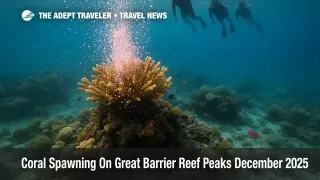
Great Barrier Reef coral spawning on December 10, 2025 turned Moore Reef, off Cairns in Queensland, into a pink underwater snowstorm that drew marine biologists, tour operators, and lucky night divers. Similar activity is now building on the Southern Great Barrier Reef near Lady Elliot Island, giving travelers a narrow window to see the reef release trillions of eggs and sperm into the dark water. For visitors, this is both a rare spectacle and a reminder to treat travel dates, night tours, and operator choice as tightly planned variables rather than last minute add ons.
The latest Great Barrier Reef coral spawning cycle, centered on November and December 2025 full moons, confirms that key tourism sites such as Moore Reef and Lady Elliot Island are entering peak reproductive season, which gives divers unique viewing opportunities but also requires flexible itineraries around a short, weather sensitive event.
What happened at Moore Reef and Lady Elliot Island
On the night of December 10, Sunlover Reef Cruises guides at Moore Reef reported dense clouds of coral eggs and sperm rising through the water column around their outer reef pontoon, located about 90 minutes by catamaran from Cairns. Master Reef Guide and marine biologist Michelle Barry described visibility briefly dropping to almost zero in the strongest part of the spawn as coral bundles turned the water pink, while worms, sea cucumbers, crustaceans, and other invertebrates moved in to feed on the nutrient rich slick.
The event followed a smaller November release on some northern and central reef sections, which acted as a curtain raiser for the larger December synchronised spawning. At Moore Reef, Sunlover's female led marine biology team has been running weekly biodiversity surveys and long term monitoring under Australia's Tourism Reef Protection Initiative, giving them baseline data to compare this year's spawn with previous cycles and to watch how the site copes with any summer heatwaves.
Further south, Lady Elliot Island's environmental team reports that the Southern Great Barrier Reef is in strong condition heading into the main reproductive season. While some northern and central reefs "fired up" in November, Lady Elliot timed its main act for December in what managers describe as a natural "split spawn" driven by moonlight and temperature differences between species and locations. Long running revegetation work and tightly controlled eco tourism on the island have helped rebuild bird habitat and reduce runoff, which, in turn, supports healthier coral communities feeding into this year's spawning success.
For visitors who join guided night snorkels or dusk dives when conditions allow, the emotional impact often matches the scientific importance. Guides describe guests surfacing from the glow of their torches into a sea that is literally thick with new life, a once a year moment that can shift conversations about the reef from simple decline to recovery and stewardship.
Background: How coral spawning works
Most hard corals on the Great Barrier Reef reproduce by mass spawning, a strategy that relies on precise timing. Corals use a mix of environmental cues, including gradually warming water, day length, and the lunar cycle, to synchronise the release of egg and sperm bundles once or twice a year, usually in late spring or early summer. Government and scientific briefings say the main window on the Great Barrier Reef falls between late October and December, often one to six nights after the full moon, with northern and inshore reefs tending to spawn earlier and outer and southern reefs skewing to November and December.
When bundles reach the surface, they break apart and fertilisation begins. The resulting embryos develop into tiny planula larvae that drift on currents for days or weeks before settling on suitable reef surfaces, where they can grow into new colonies if conditions allow. Many larvae and spawn slicks are eaten by fish, plankton, and other marine life, and others are pushed away from good habitat, so spawning in vast numbers is a strength in numbers tactic that improves survival odds even in a harsh environment.
Soft corals and some other groups layer additional strategies on top, including simultaneous hermaphroditism, asexual budding, and staggered spawning across multiple nights or months. The result for travelers is that there are two broad, overlapping spawning windows on the Great Barrier Reef, a warm up focused around the November full moon and a larger, more synchronised wave in late November or December, but exact dates change year by year.
Why this matters for reef health and climate risk
For reef managers and scientists, a strong 2025 mass spawn is a positive signal, because it shows that many corals on key tourism reefs are still producing viable gametes at large scales. The Great Barrier Reef Marine Park Authority and the Great Barrier Reef Foundation both stress that successful spawning underpins reef recovery, reseeding damaged areas after bleaching, storms, or crown of thorns outbreaks, and helping to maintain genetic diversity that can support adaptation to warmer seas.
At the same time, operators such as Sunlover and Lady Elliot Island Eco Resort continue to frame climate change as the biggest long term threat, because repeated marine heatwaves can reduce coral reproductive output, kill larvae, and trigger mass bleaching events that undermine the very colonies that need to spawn. Their monitoring programs are designed to flag early signs of heat stress, disease, or water quality problems so that local responses, such as shifting visitor use or focusing restoration sites, can be coordinated with broader management tools.
For travelers, this means that choosing eco certified operators, respecting site rules, and understanding why night access is tightly controlled are not just feel good options, they are part of keeping the system robust enough to keep producing these events in the first place.
Planning a trip to see coral spawning
Moore Reef, accessed by day boat from the Cairns Reef Fleet Terminal, is one of the most accessible outer reef sites in Tropical North Queensland, with Sunlover and other operators running daily catamaran trips that dock at a large pontoon in a sheltered lagoon. Standard tours focus on daytime snorkelling, glass bottom boat rides, and introductory diving, but during peak spawning years some operators may offer extended twilight or night options when conditions, permits, and safety allow.
Lady Elliot Island, at the southern tip of the Great Barrier Reef, is more remote and operates as a dedicated eco resort with capped guest numbers. It is only accessible by small aircraft charter flights bundled with day trip or overnight packages, with departures from Bundaberg, Hervey Bay, Brisbane, and the Gold Coast arranged through the resort and its aviation partner. For travelers, that means locking in flights and accommodation together well in advance, especially for late November and December dates that coincide with likely spawning nights and summer school holidays.
Because timing can shift by a few days based on local temperature and weather, the safest planning strategy is to give yourself several nights in reef hubs such as Cairns or on islands like Lady Elliot, rather than flying in for a single targeted date. Many operators publish indicative spawning calendars based on the full moon, but they also warn that high winds, swell, or late timing can force night tours to be rescheduled, shortened, or cancelled.
Practical tips and traveler expectations
Watching coral spawning is more technical than a standard day snorkel, and not every traveler will want or need to be in the water at night. If you are comfortable with snorkelling in the dark under guide supervision, expect detailed briefings on currents, visibility, torch use, and staying close to the group, along with strict no touch rules around coral and invertebrates. Some visitors may prefer to stay on board and watch footage from in water teams, especially if they are less experienced swimmers or are travelling with children.
Either way, packing reef safe sunscreen, secure swimwear, and protection against tropical sun and rain remains essential for daytime activities, while light layers, dry bags, and stable footwear help with late returns to ports and airstrips. Travelers should also keep an eye on broader Queensland weather patterns, since early summer storms or cyclones can disrupt marine conditions, flights into Cairns, Bundaberg, Hervey Bay, Brisbane, and the Gold Coast, and boat departures even when the reef itself is calm later in the night.
For many visitors, the most useful expectation shift is to see coral spawning not as a guaranteed check list item, but as a high value bonus layered onto a broader reef trip that also includes daytime snorkelling, island time, and education programs. The 2025 split spawn underlines that the reef is still capable of spectacular reproductive events, but that catching them requires flexibility, patience, and partnership with operators and guides who are directly involved in monitoring and conservation.
Sources
- [Tourism Tropical North Queensland, Diverse marine life joins Great Barrier Reef spectacle][1]
- [Breaking Travel News, Coral spawning on the Great Barrier Reef][2]
- [Sunlover Reef Cruises, Coral spawning Great Barrier Reef, Why It Matters][3]
- [Great Barrier Reef Foundation, What is coral spawning][4]
- [Great Barrier Reef Marine Park Authority, Coral spawning 101][5]
- [Lady Elliot Island Eco Resort, Nature's Marvel, Coral Spawning 2022][6]
- [Sunlover Moore Reef information and tour details][7]
- [Lady Elliot Island, Getting here and access information][8]